

Introduction
For renters in most pre-1978 housing, the lead based paint disclosure form for renters must be completed before a lease is signed. Landlords must verify whether the property is target housing, disclose any known lead-based paint or lead hazards, provide available inspection records and reports, supply the EPA pamphlet “Protect Your Family From Lead in Your Home,” and obtain signed acknowledgments from all adult tenants and agents. Completing these steps before lease execution satisfies the federal disclosure duties under Title X—the Residential Lead-Based Paint Hazard Reduction Act of 1992—and helps protect families from lead exposure.
Target housing refers to most private and public residential properties constructed prior to 1978, the landmark year the federal government banned residential lead-based paint. Lead is a toxic heavy metal, and older deteriorating paint generates fine dust that settles on floors, window sills, and soil. Approximately 24 million U.S. homes still contain active lead-based paint hazards, and about 4 million of those residences house children under six years old.
Young children face severe risks from lead exposure because their developing brains and nervous systems are exceptionally sensitive to toxic interference. While the median blood lead level in U.S. children has dropped from 15 μg/dL in 1976 to under 1 μg/dL today, elevated levels remain concentrated in aging residential properties. The CDC considers any blood lead level above 3.5 μg/dL actionable, requiring medical evaluation and environmental intervention.
To prevent childhood poisoning, joint EPA and HUD regulations place strict legal duties on landlords to inform incoming occupants about potential hazards before any binding agreement takes effect.
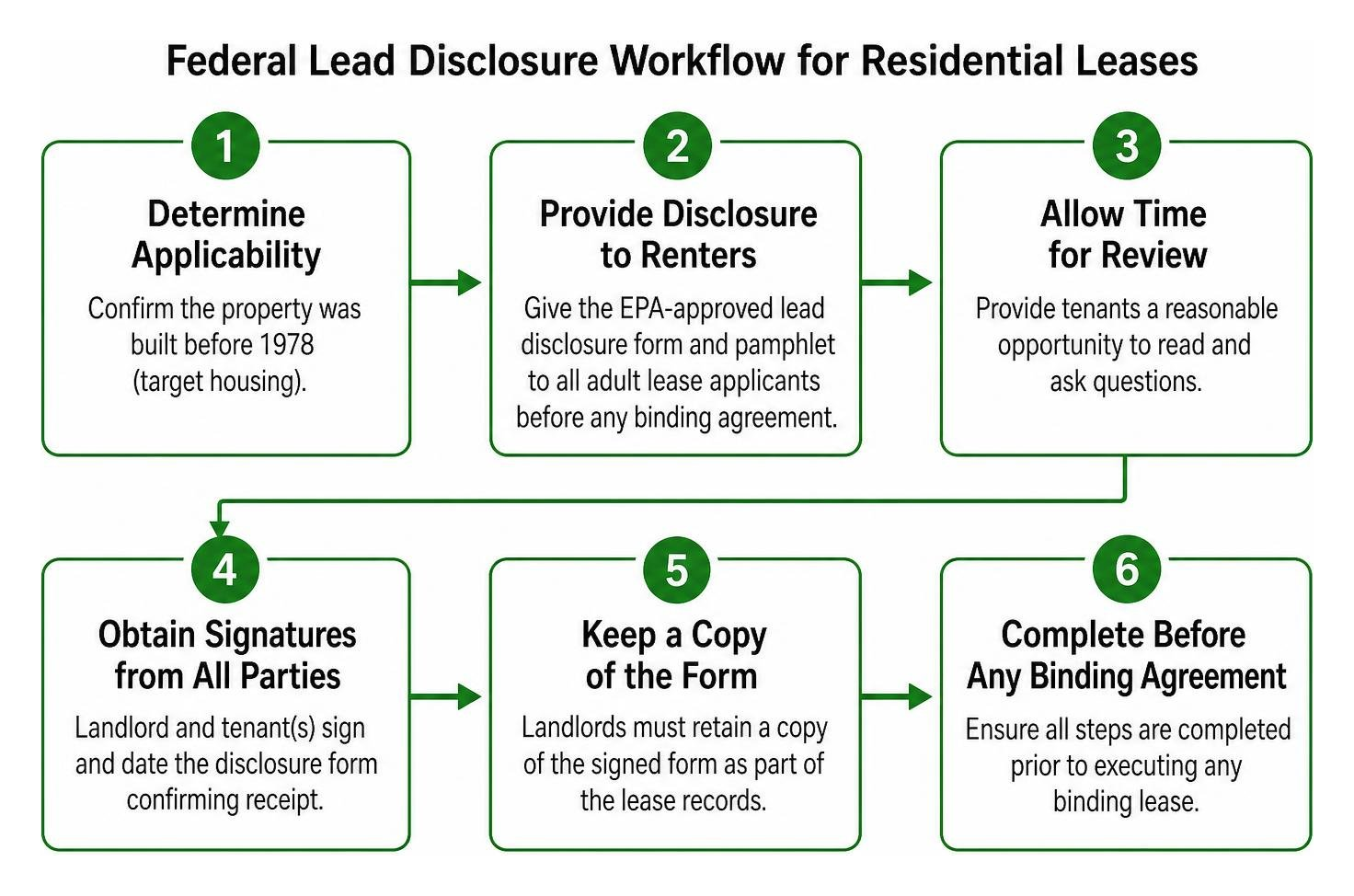
Step-by-Step Lead Based Paint Disclosure Form for Renters Checklist
Navigating federal compliance requires following an orderly process under federal statutes (42 U.S.C. § 4852d) and regulations (24 C.F.R. § 35.92). Landlords and property managers must complete these steps prior to executing any binding lease agreement.
- Verify Target Housing Status: Confirm property construction dates via tax records or historical deeds. Any property built prior to January 1, 1978, falls under federal disclosure mandates unless a specific statutory exemption applies.
- Compile Historical Records: Gather all historical lead inspection reports, risk assessments, maintenance logs, or abatement certifications associated with the dwelling and its shared common areas.
- Complete the Disclosure Form: Fill out the official disclosure document completely, ensuring every checkbox in the lessor section reflects accurate property knowledge.
- Supply the Federal Informational Pamphlet: Provide the tenant with a complete, current copy of the EPA safety booklet in an accessible format and preferred language.
- Secure All Required Signatures: Have all adult tenants, property owners, and leasing agents sign and date the certification blocks.
- Provide Signed Copies and Archive: Deliver a finalized, fully executed copy to the tenant and store the original in your permanent compliance archive.
Required Elements in the Lead Based Paint Disclosure Form for Renters
A valid disclosure document must contain distinct statutory sections. Skipping any mandatory element invalidates the disclosure and exposes property managers to severe administrative liabilities outlined in the Lead-Based Paint Disclosure Rule Fact Sheet.
The document begins with the verbatim federal Lead Warning Statement alerting tenants that housing built before 1978 may contain toxic lead. Next, the lessor disclosure section requires landlords to state whether they know of lead-based paint or hazards in the unit or common areas, and to list all available testing records provided to the renter.
The lessee section confirms the renter received all relevant notices, records, and the EPA pamphlet. Finally, licensed agents certify compliance, and all parties sign and date the document. To understand how each line protects both parties, read our detailed breakdown on understanding your lead-based disclosure form.
| Disclosure Component | Lessor (Landlord) Obligation | Lessee (Tenant) Acknowledgment | Agent Obligation |
|---|---|---|---|
| Lead Warning Statement | Provide exact statutory warning text within or attached to lease | Read and acknowledge federal health warning language | Ensure mandatory text is included in paperwork |
| Hazard Knowledge | Check box declaring known presence or “no knowledge” of lead hazards | Confirm receipt of landlord’s explicit hazard statement | Verify lessor has accurately completed declaration |
| Records & Reports | List and attach all available lead inspection/risk reports (or indicate none exist) | Initial receipt of all listed environmental reports and records | Ensure all referenced reports are physically delivered |
| Safety Pamphlet | Deliver official EPA lead informational booklet | Initial confirmation of receiving the EPA pamphlet | Confirm tenant received booklet prior to signing |
| Certification & Signatures | Sign and date certifying information is accurate to best of knowledge | Sign and date certifying accurate disclosure review | Sign certifying compliance with all Title X rules |
Distributing the EPA Lead Hazard Information Pamphlet
Federal law requires housing providers to distribute the official EPA booklet, “Protect Your Family From Lead in Your Home” (EPA-747-K-12-001). Handing over a generic flyer or self-made summary does not fulfill federal requirements.
Because tenant communities are diverse, property managers should supply the booklet in the tenant’s primary language. The EPA provides authorized versions in Spanish and several other languages to ensure clear comprehension.
When distributing documents digitally, landlords must obtain prior affirmative consent from the renter for electronic delivery. The tenant must retain the right to request a paper copy at any time without penalty. Distributing this material is an essential move-in protocol governed by comprehensive HUD, EPA, OSHA, CPSC, and NPS Lead Paint Rules. If tenants or owners suspect deteriorating paint, they can review guidance on checking a residential property for lead hazards to plan practical testing.
Pre-1978 Rental Property Exemptions and Special Housing Types
While Title X covers most pre-1978 residential properties, the statute excludes several housing categories from disclosure rules.

Statutory exemptions include:
- Post-1978 Construction: Any residential structure with construction permits issued on or after January 1, 1978.
- Zero-Bedroom Dwellings: Studio apartments, efficiency units, dormitory suites, and loft spaces where the living area is not partitioned into dedicated sleeping rooms.
- Short-Term Leases: Temporary rentals, vacation agreements, or subleases of 100 days or fewer, provided no lease extension occurs.
- Certified Lead-Free Properties: Housing inspected by a state-certified inspector and documented to be entirely free of lead-based paint.
- Dedicated Senior and Disability Communities: Designated housing for elderly residents or persons with disabilities, provided no child under six years of age resides or is expected to reside in the dwelling.
- Individual Room Rentals: Single-room rentals within an occupied primary residence.
To determine if an older building requires specialized management, consult our guide on evaluating safety in pre-1978 homes with lead paint.
Landlord Compliance, Legal Penalties, and Renovation Rules
Federal agencies actively audit real estate transactions and enforce compliance across residential rental portfolios.

Completing and Retaining the Lead Based Paint Disclosure Form for Renters
Federal law requires housing providers to retain signed disclosure forms for a minimum of three years from the date the tenancy begins. For ongoing leases, landlords should keep the documentation throughout the tenancy plus three years beyond move-out.
When existing leases renew under modified terms, executing a fresh disclosure ensures an uninterrupted compliance record. Property managers overseeing multi-unit portfolios should maintain centralized, searchable digital databases of all executed disclosures, reports, and tenant acknowledgments. Maintaining complete records provides landlords with a clear defense against claims of non-disclosure. Discover more strategies by mastering lead paint disclosure requirements and compliance.
Civil Penalties, Treble Damages, and Renovation Notice Requirements
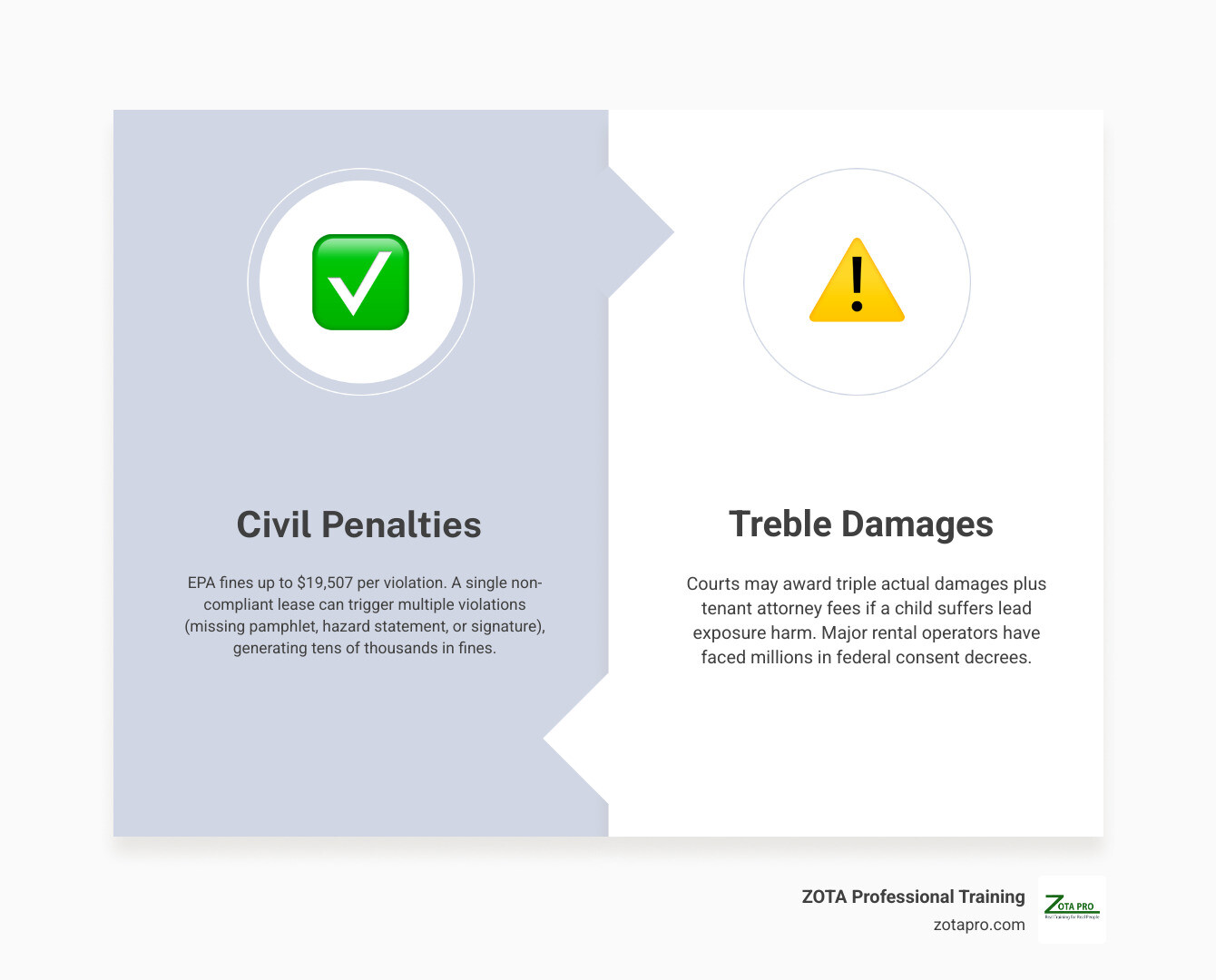
Failing to comply with Title X disclosure mandates can lead to severe financial and legal penalties. The EPA adjusts civil monetary penalties annually for inflation, with fines reaching up to $19,507 per individual violation. Because a single deficient lease can trigger multiple distinct violations—such as failing to supply the pamphlet, omitting the hazard statement, or missing an agent signature—a single non-compliant lease can generate tens of thousands of dollars in fines.
In civil litigation, landlords who knowingly violate lead disclosure rules face statutory treble damages (triple actual damages) plus tenant attorney fees if an occupant, particularly a child, suffers health harm from lead exposure. Consent decrees across major rental operators have resulted in millions of dollars in federal settlements.
Furthermore, lease disclosures do not cover repair work. Under the EPA Lead Renovation, Repair, and Painting (RRP) Rule and the HUD Lead Safe Housing Rule, contractors and landlords disturbing more than 6 square feet of interior painted surfaces or 20 square feet of exterior surfaces in pre-1978 units must:
- Distribute the EPA “Renovate Right” pamphlet to occupants before work starts.
- Provide written notice at least 60 days prior to commencing renovations in occupied common areas.
- Ensure all work is performed by EPA-certified renovators using lead-safe work practices.
Tenant Rights, Inspection Windows, and Overlapping Environmental Hazards
While home buyers receive a mandatory 10-day window to conduct independent lead risk assessments, renters have the right to review all historical reports and inspect the property for visible paint deterioration before signing a lease. Tenants who suspect undisclosed hazards can hire independent, certified professionals; our resource on hiring a certified lead inspector outlines how certified assessments work.
Property managers and real estate agents have a legal obligation to present hazard data honestly. Deliberately misrepresenting lead data carries severe professional and legal consequences, as explored in our review of risks when a realtor misrepresents lead hazards.
Beyond lead, landlords must also navigate overlapping environmental responsibilities, such as asbestos disclosure under OSHA standards and state-specific mold disclosure laws. Maintaining compliance across these environmental regulations protects tenant health and insulates property portfolios from liability.
At ZOTA Professional Training, we provide EPA-accredited lead, asbestos, mold, and OSHA certification courses—available through flexible in-person, hybrid, and online formats in both English and Spanish—to help property owners, contractors, and maintenance teams stay fully certified and compliant. Explore our lead paint disclosure resources and professional compliance training to safeguard your rental operations.