

OSHA Machine Guarding Rules: The Fast Compliance Check
The OSHA requirements for machine guarding start with one clear rule: protect workers from hazardous machine parts and motions. Under 29 CFR 1910.212, employers must identify each machine’s danger zones and install guards or safeguarding devices that keep hands, clothing, hair, and other body parts out of them during normal operation.
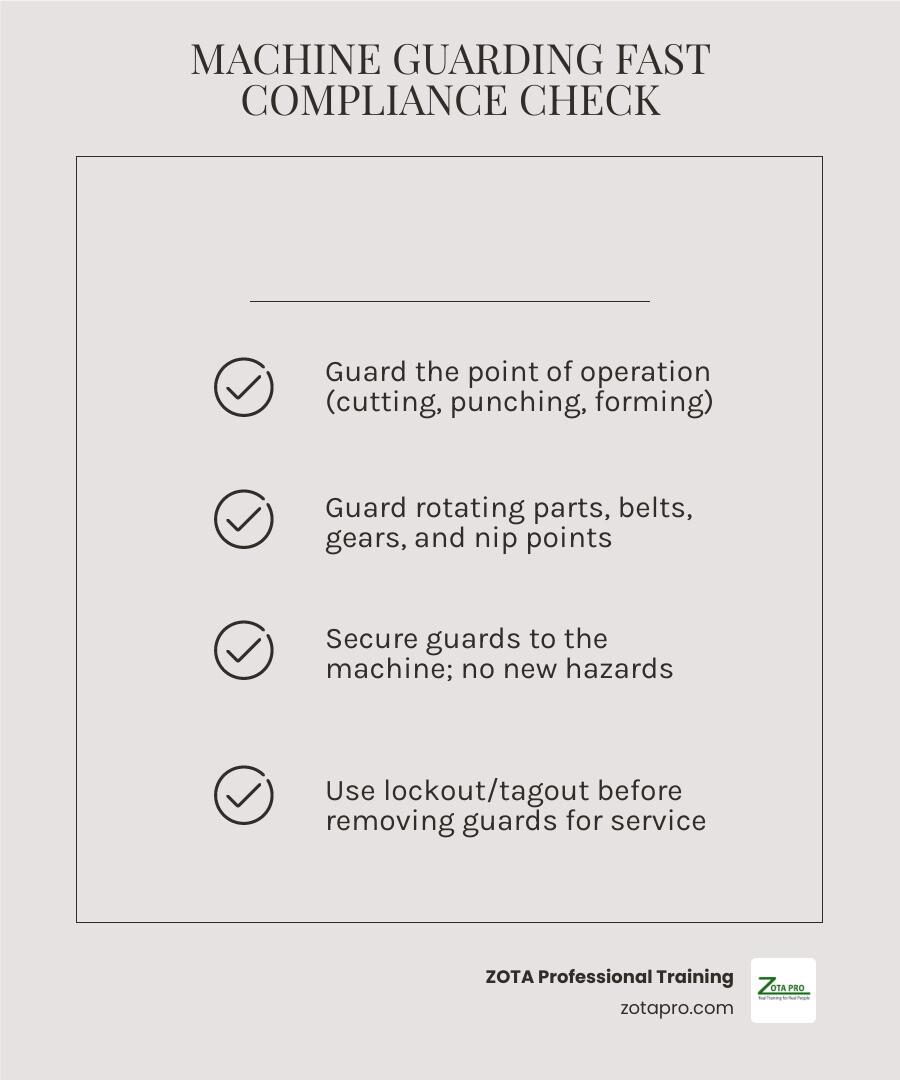
For a practical first check:
- Guard the point of operation, where the machine cuts, punches, forms, or processes material.
- Guard rotating shafts, belts, pulleys, chains, gears, blades, and in-running nip points.
- Secure guards to the machine whenever possible, and make sure they cannot create a new hazard.
- Anchor fixed equipment so it cannot walk or move during use.
- Use lockout/tagout before employees remove guards for servicing, adjustment, or repair.
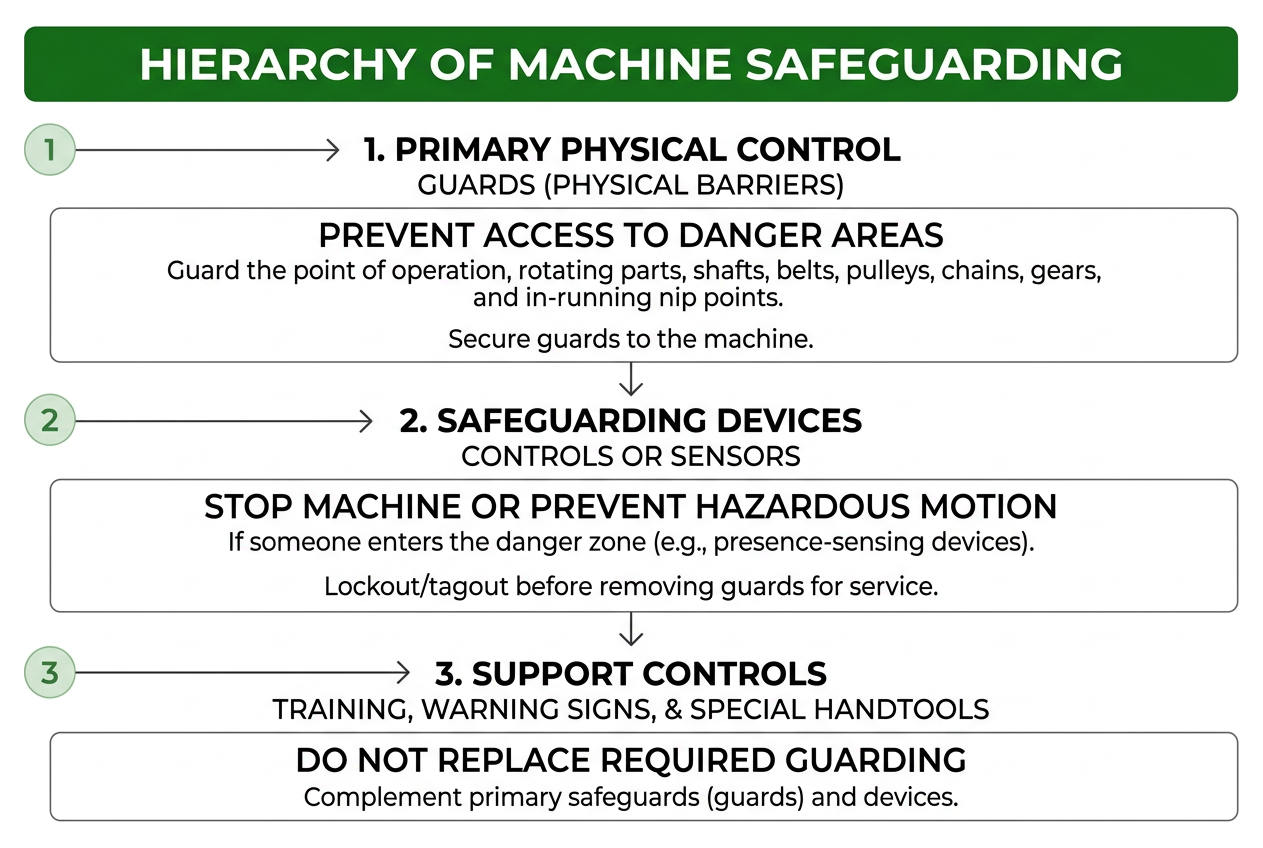
Machine guarding is not limited to large factory equipment. Contractors may encounter these hazards on power saws, jointers, portable tools, grinders, mixers, presses, and other equipment used during renovation work. A guard is a primary physical control; training, warning signs, and special handtools can support it, but they do not replace required guarding.
I am Bob Zak, Founder and CEO of ZOTA Professional Training, with more than 32 years of occupational health and safety experience, including service as an Occupational Health & Safety Manager at Ramsey County. I help contractors and crews understand OSHA requirements for machine guarding and apply them in real work settings through practical, flexible safety training.
Understanding OSHA Requirements for Machine Guarding Across Industries
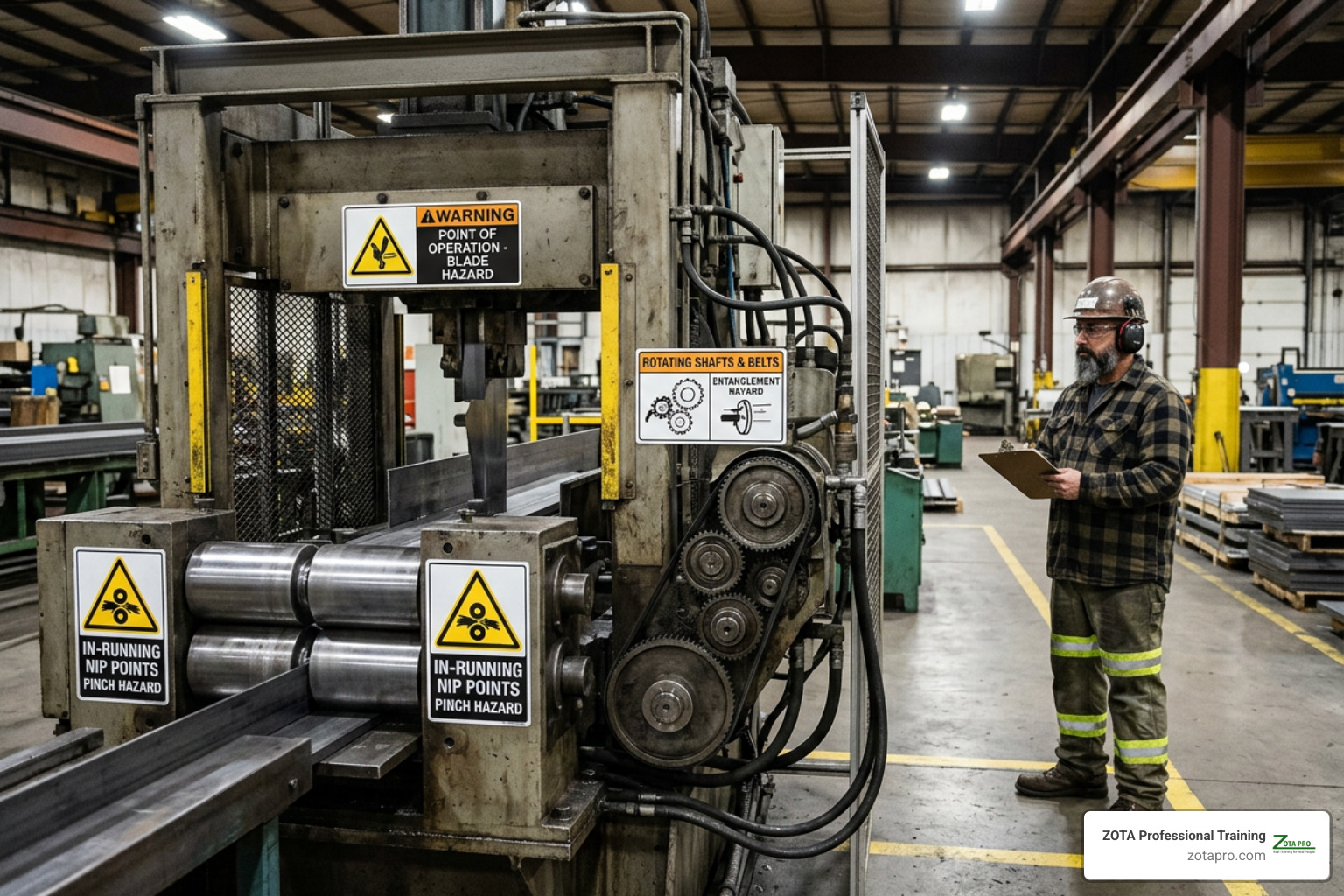
Industrial machinery drives production, but moving mechanical parts present constant risks. When a machine operates, its mechanical action produces distinct hazard zones. These include the point of operation (where cutting, shaping, boring, or forming takes place), power-transmission apparatuses (such as flywheels, pulleys, belts, connecting rods, couplings, cams, spindles, chains, cranks, and gears), and other moving parts like reciprocating, transverse, or rotating components.
The term “nip point” might sound like a minor pinch, but in-running nip points created by rotating parts can draw in loose clothing, gloves, or limbs in milliseconds. Approximately 44% of all workplace amputations occur in the manufacturing sector, and failing to physically safeguard moving components remains one of the primary drivers of these life-altering events.
To address these hazards systematically, OSHA enforces targeted standards tailored to specific workplace environments:
- General Industry: Under OSHA 1910.212 General requirements for all machines, employers must provide one or more methods of machine guarding to protect operators and other employees in the machine area. Key general requirements include securing guards firmly to the machine whenever feasible, ensuring guards do not introduce secondary pinch points or sharp edges, and anchoring machines designed for a fixed location so they cannot walk or tip during operation. Furthermore, whenever fan blades or other rotating blades operate less than 7 feet above the working level, the periphery guard openings must measure one-half inch (½”) or smaller.
- Construction: Governed by OSHA 1926.300 Construction tool and machine guarding, power-operated tools and jobsite machinery must feature functional protective guards. Moving parts of equipment must be shielded in accordance with ANSI B15.1 standards. Saws, abrasive wheels, and portable power tools require operational switch controls (such as momentary contact or constant-pressure switches) alongside protective barriers to prevent accidental contact during field operations.
- Maritime: Under OSHA 1917.151 Maritime machine safeguarding rules, marine terminals must safeguard rotating parts, drives, and connections within 7 feet of work surfaces. Saws must utilize enclosing hoods and automatic return mechanisms to prevent rebound, while power cut-off devices must remain directly accessible at the operator’s primary control station.
Types of Safeguards Under OSHA Requirements for Machine Guarding
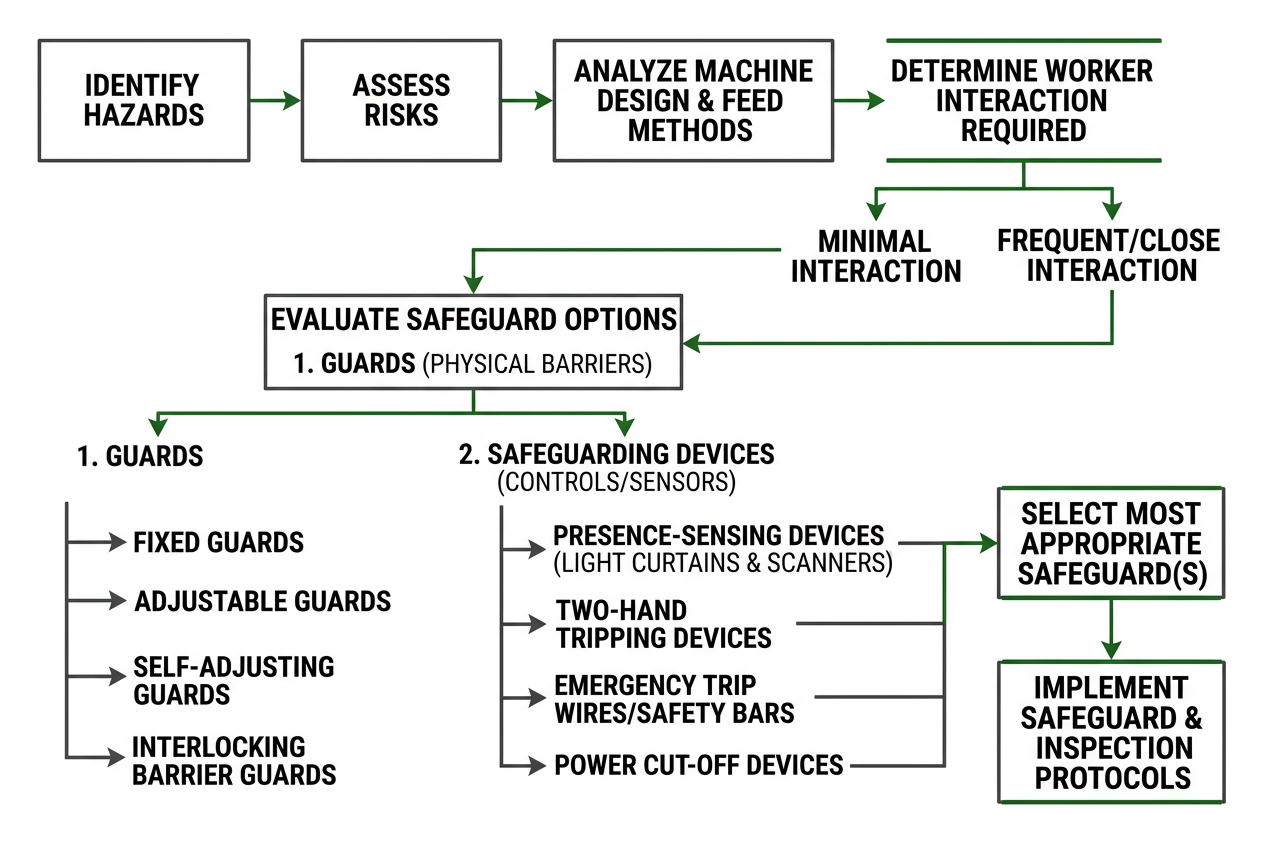
Safeguards fall into two main categories: guards (physical barriers that prevent access to danger areas) and safeguarding devices (controls or sensors that stop the machine or prevent hazardous motion if someone enters the danger zone). As outlined in the OSHA Machine Guarding eTool General Requirements, selecting the appropriate safeguard depends on machine design, material feed methods, and operator interaction.
| Safeguard Type | Primary Mechanism | Best Applications | Key OSHA Considerations |
|---|---|---|---|
| Fixed Guards | Permanent, rigid barrier attached with fasteners requiring dedicated tools to remove. | Enclosing power transmission, flywheels, gear assemblies, and non-operational machine zones. | Must be durable, tamper-resistant, and offer clear line-of-sight without creating visual distortion. |
| Adjustable Guards | Manually positioned barrier that accommodates different stock sizes and material profiles. | Band saws, circular saws, drill presses, and manual milling equipment. | Requires operator discipline and clear procedures to avoid oversized gaps during material adjustments. |
| Self-Adjusting Guards | Barrier pushed open by the workpiece; automatically returns to cover the hazard once cut is finished. | Table saws, jointers, radial arm saws, and standard woodworking equipment. | Must move freely without binding or jamming, providing continuous coverage as stock passes through. |
| Interlocking Barrier Guards | Gate or barrier wired to the power supply; automatically halts or cuts machine power when opened. | Revolving drums, tumbling barrels, robotic cells, and high-speed automated packaging machinery. | Must be fail-safe; interlocks must never be mechanically defeated, taped over, or bypassed during production. |
| Presence-Sensing Devices (Light Curtains & Scanners) | Optoelectronic light beams or area lasers that stop machine cycle when the sensing field is broken. | Mechanical power presses, hydraulic forming presses, and robotic assembly stations. | Requires precise safety distance calculations per ANSI standards so the ram stops before a hand reaches the die. |
| Two-Hand Tripping Devices | Dual control buttons that require concurrent pressure from both hands to initiate a machine stroke. | Part-revolution power presses, guillotine cutters, and single-cycle stamping tools. | Controls must be spaced far enough apart to prevent one-hand operation and protected against accidental bumping. |
Critical Equipment and Point-of-Operation OSHA Requirements for Machine Guarding
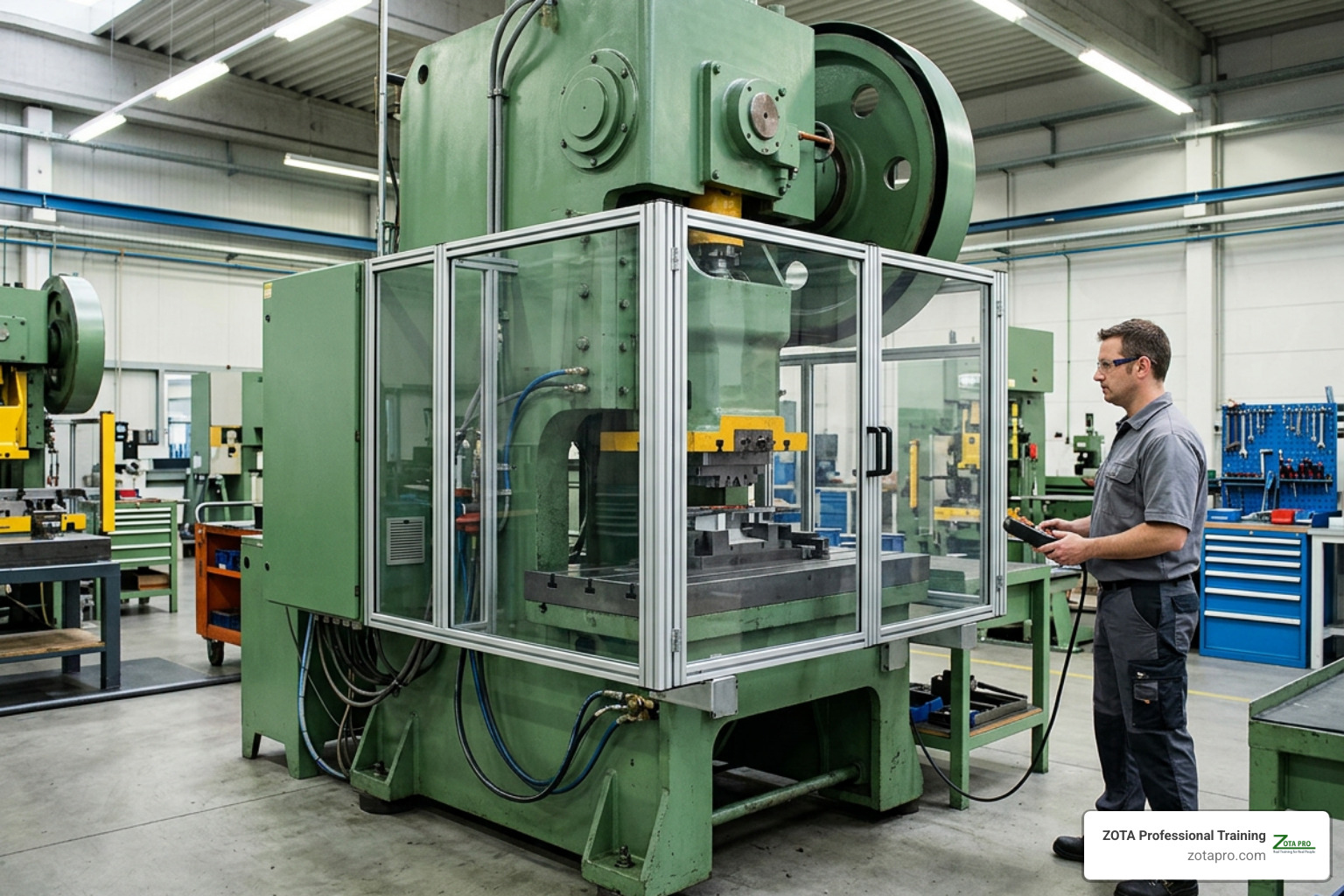
OSHA 1910.212(a)(3)(iv) explicitly lists several machine types that routinely produce severe crushing, cutting, and amputation hazards if point-of-operation safeguards are missing or modified. According to OSHA’s technical guide Safeguarding Equipment and Protecting Employees from Amputations, these high-risk machines require specific safeguarding setups:
- Mechanical Power Presses (29 CFR 1910.217): Dies and tooling must feature point-of-operation barriers, interlocking gates, or presence-sensing light curtains. Hand-feeding tools like tongs, vacuum lifters, or magnetic pickers may be used to position raw stock into the die, but OSHA explicitly states these special handtools only supplement and never replace required barrier guards or sensing devices.
- Guillotine Cutters and Shears: Blade danger zones must be enclosed with fixed or interlocked barrier guards across the full cutting table, preventing fingers or hands from slipping under the hold-down clamps or cutting edge.
- Revolving Drums, Barrels, and Containers: Under 1910.212(a)(4), rotating drums must be fully enclosed within a protective enclosure interlocked with the drive mechanism, ensuring the drum cannot rotate unless the guard enclosure is completely closed.
- Power Saws, Milling Machines, and Jointers: Saws must have upper and lower hoods covering rotating blades. Jointers require automatic guards covering the cutting head both before and behind the fence during stock passes.
- Forming Rolls and Calenders: In-running rolls must feature emergency trip wires, safety body bars, or pressure-sensitive cables located within easy reach of the operator to halt roller rotation immediately.
Establishing Field Compliance: Inspection Protocols, LOTO, and Enforcement
Maintaining machine guarding compliance is not a “set-and-forget” task. A guard that has been removed for clearing a jam and left leaning against a wall provides zero protection.
OSHA frequently cites machine guarding violations under general industry enforcement programs, with 1910.212(a)(1) (failure to provide adequate guarding methods) and 1910.212(a)(3) (inadequate point-of-operation protection) consistently ranking among the most frequent citations. Fines for serious and repeated violations can quickly escalate into tens of thousands of dollars per instance, not including workers’ compensation costs, lost productivity, and legal liability.
To build a reliable safety program, integrate these operational practices:
- Establish a Two-Tier Inspection Routine:
- Daily Pre-Shift Checks: Machine operators verify that all physical guards are bolted tight, interlocks operate correctly, light curtains pass self-tests, and emergency stops function without sticking.
- Monthly Maintenance Audits: Maintenance technicians examine mounting brackets, structural welds, electrical safety switches, and interlock wiring to detect wear, vibration looseness, or tampering.
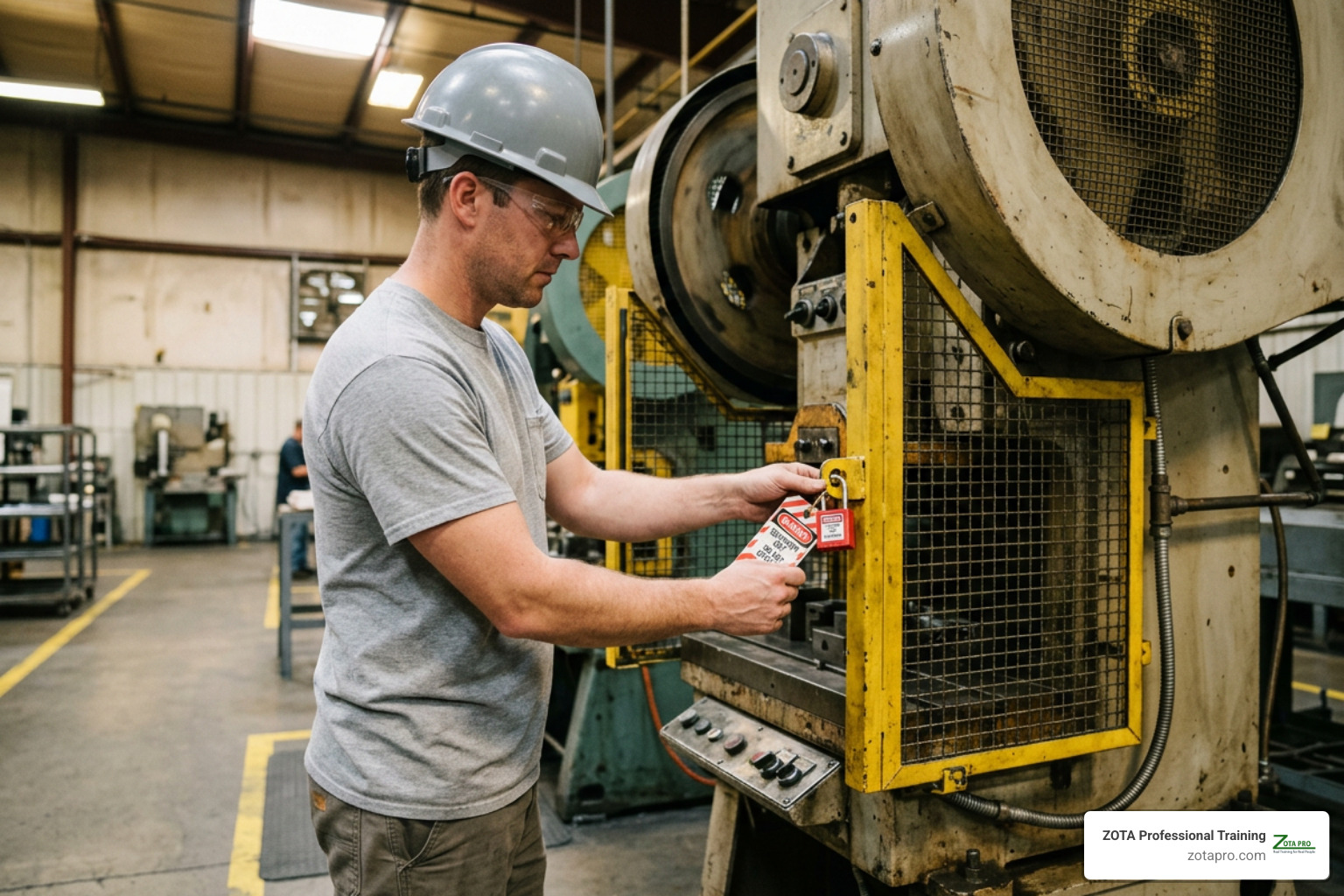
- Integrate Lockout/Tagout (LOTO – 29 CFR 1910.147): Physical machine guards protect workers during normal production cycles. However, whenever an employee must remove or bypass a guard to perform maintenance, unjam raw stock, adjust dies, or repair electrical drives, the equipment must be locked and tagged out. Safeguards and LOTO work as complementary controls—never assume a machine is safe to service simply because it is idling.
- Use Tamper-Resistant Engineering: Fasten guards using security hardware or dedicated tools to discourage operators from bypassing barriers to speed up production. Ensure that safety interlocks use coded magnetic or keyed actuators rather than standard mechanical microswitches that can be defeated with tape or zip-ties.
- Provide Structured Training for All Shifts: Every worker interacting with machinery must recognize mechanical hazard zones, understand why guards exist, and possess clear stop-work authority if a guard is missing, loose, or defective.
Ensuring your team stays safe and your facility avoids costly OSHA citations requires practical, comprehensive education. Explore our certified workplace OSHA safety training options to equip your supervisors, operators, and safety managers with the knowledge they need. At ZOTA Professional Training, we offer flexible, multilingual (English and Spanish) hybrid, online, and on-site training solutions to help your organization maintain full compliance and protect your workforce every day.