

Understanding OSHA Safety Standards and Core Employer Responsibilities
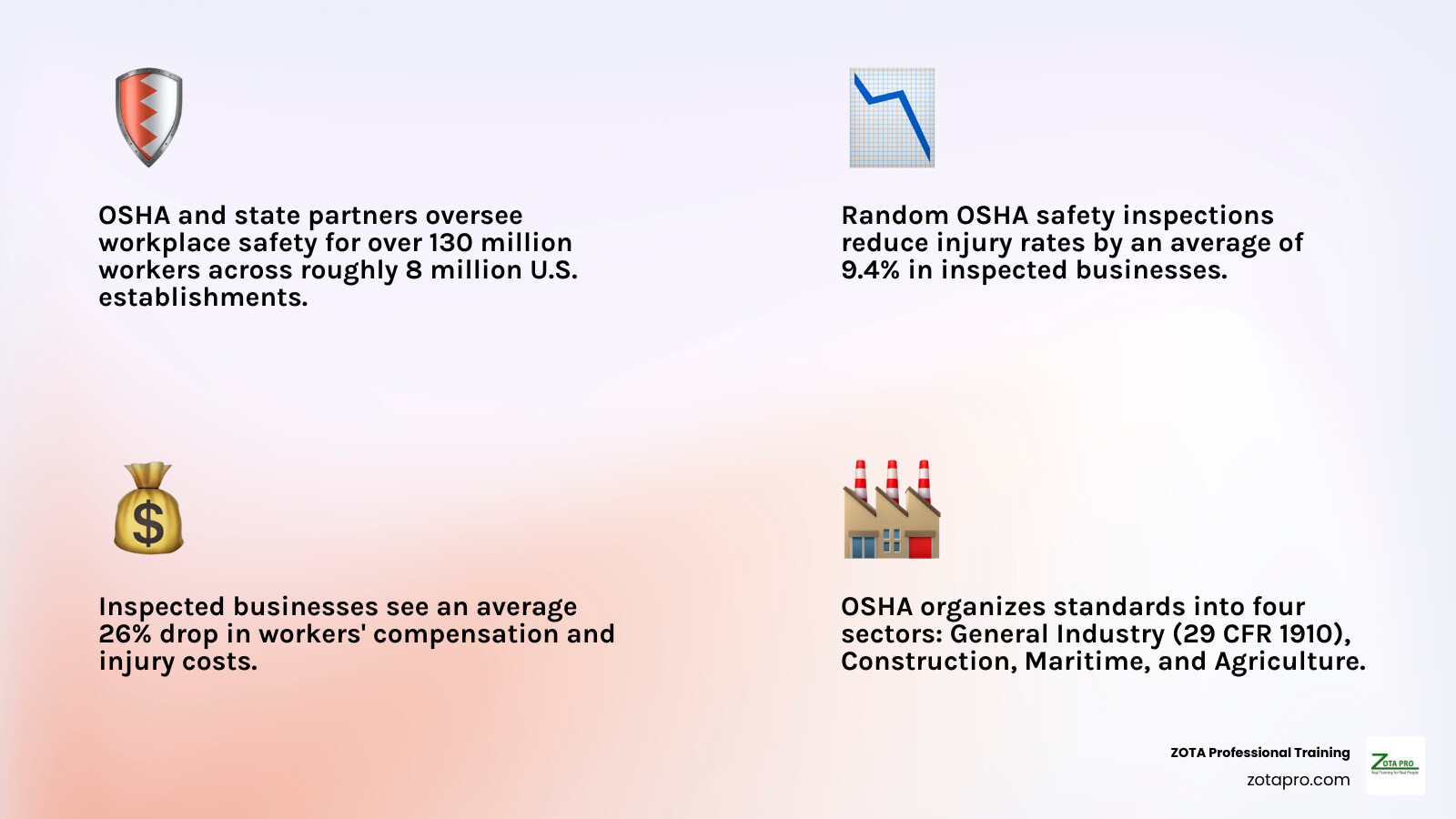
OSHA safety standards are the enforceable workplace health and safety rules that employers must follow to protect workers from recognized hazards. At their core, these standards require employers to identify and mitigate hazards, provide required personal protective equipment at no cost, deliver safety training in a language workers understand, and maintain accurate injury and illness records. When the Occupational Safety and Health Act of 1970 created OSHA, it established a foundational principle across American industry: every worker has the right to return home safely at the end of their shift. Today, as of September 2026, federal OSHA and its state partners oversee workplace safety for more than 130 million workers across roughly 8 million establishments.
The practical impact of these safety mandates is measurable. Studies have shown that random workplace safety inspections conducted by OSHA lead to an average 9.4% decline in injury rates and a 26% reduction in workers’ compensation and injury costs for inspected businesses. Safe operations protect your bottom line by minimizing downtime, avoiding litigation, and preserving workforce morale.
Main Industry Categories Covered by OSHA Safety Standards
To apply regulatory requirements effectively, we must first look at how OSHA organizes its safety standards. The agency divides its rules into four distinct industrial sectors:
- General Industry (29 CFR Part 1910): This covers the widest range of facilities, including manufacturing plants, warehouses, healthcare facilities, and retail environments.
- Construction (29 CFR Part 1926): Targeted directly at dynamic worksites involving building, alteration, demolition, and repair. Contractors should familiarize themselves with essential OSHA safety standards for construction to maintain active field compliance.
- Maritime (29 CFR Parts 1915, 1917, 1918): Covers shipyards, marine terminals, and longshoring operations.
- Agriculture (29 CFR Part 1928): Addresses farm operations, agricultural machinery, and field worker safety.
Twenty-two states and territories run complete State Plans that cover both private and public sector workers (such as Cal/OSHA and Oregon OSHA), while several others cover state and local government workers only. State Plans operate under federal approval and must establish rules that are at least as effective as federal OSHA standards.
Employer Duties, Worker Rights, and General Duty Clause Compliance
OSHA places the primary burden of hazard mitigation directly on employers. Under Section 5(a)(1) of the OSH Act—commonly known as the General Duty Clause—employers are legally required to furnish a workplace free from recognized hazards that cause or are likely to cause death or serious physical harm, even when no specific standard exists for a unique condition.
Core employer responsibilities include:
- Informing workers of chemical hazards via safety data sheets (SDSs) and compliant Hazard Communication programs.
- Providing required personal protective equipment (PPE) at no cost to employees.
- Maintaining detailed injury and illness records using OSHA Forms 300, 300A, and 301 (mandatory for non-exempt employers with more than 10 employees).
- Delivering safety training in a language and vocabulary workers comprehend.
At the same time, workers possess robust legal rights. Employees can request an inspection, review hazard records, participate in safety walkthroughs, and exercise protected whistleblower rights without fear of employer retaliation or termination. Understanding foundational OSHA requirements for small businesses helps emerging enterprises uphold these rights without disrupting operational workflows.
Key Regulatory Focus Areas: Violations, Hazard Prevention, and ISO 45001
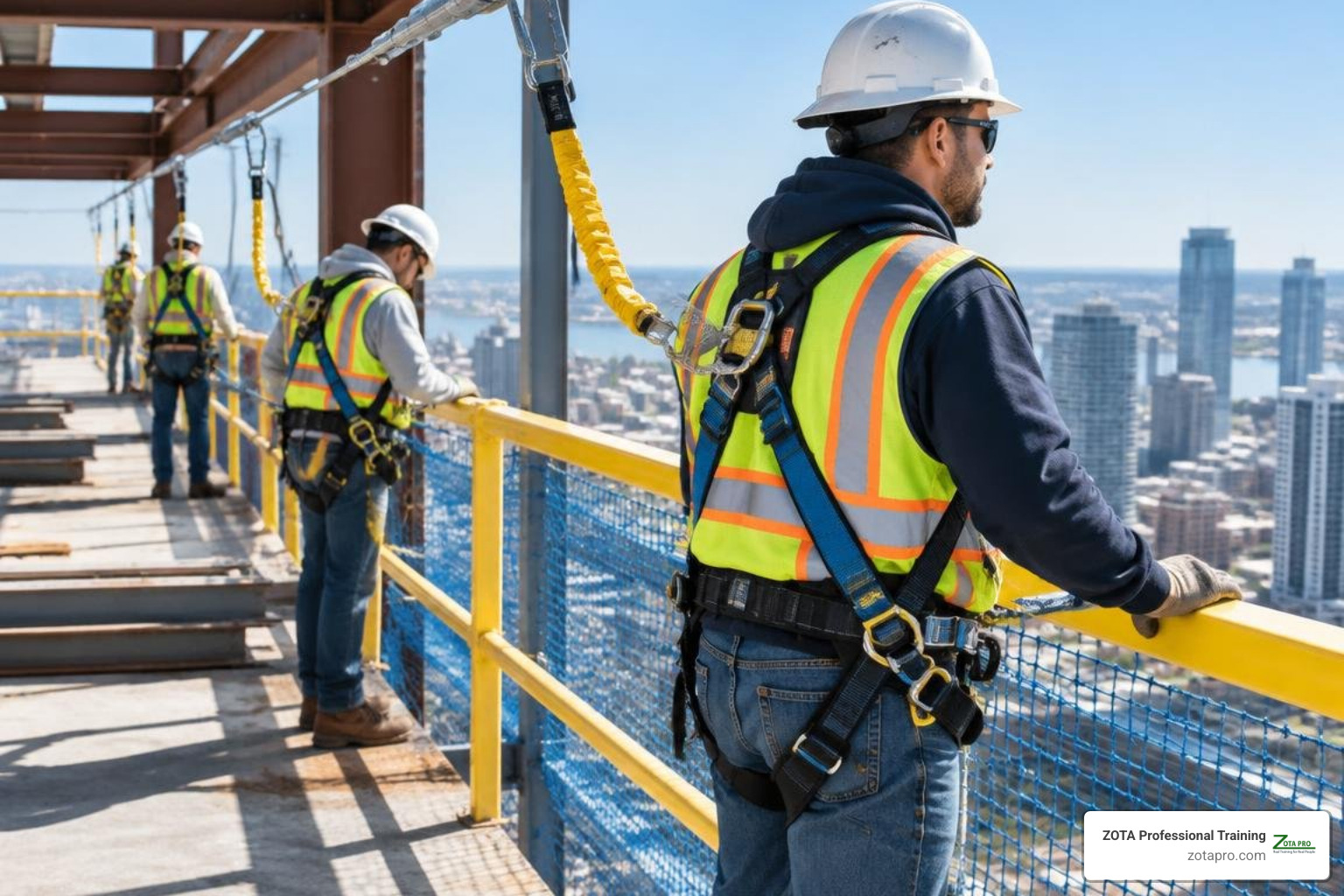
Preventing worksite incidents requires targeting the specific physical hazards that trigger the majority of agency citations and severe workplace injuries.
Common Violations Across Fall Protection, Ladder Safety, and PPE
Fall protection violations consistently rank as the single most cited standard in construction. Under federal rules, employers must provide fall protection whenever employees work at trigger heights of 6 feet or higher in construction (4 feet in general industry). Acceptable systems include guardrails, safety nets, or personal fall arrest systems (PFAS) anchored to engineered points capable of supporting 5,000 pounds per attached worker. Scaffolding must also be engineered to support at least four times its maximum intended load without failure.
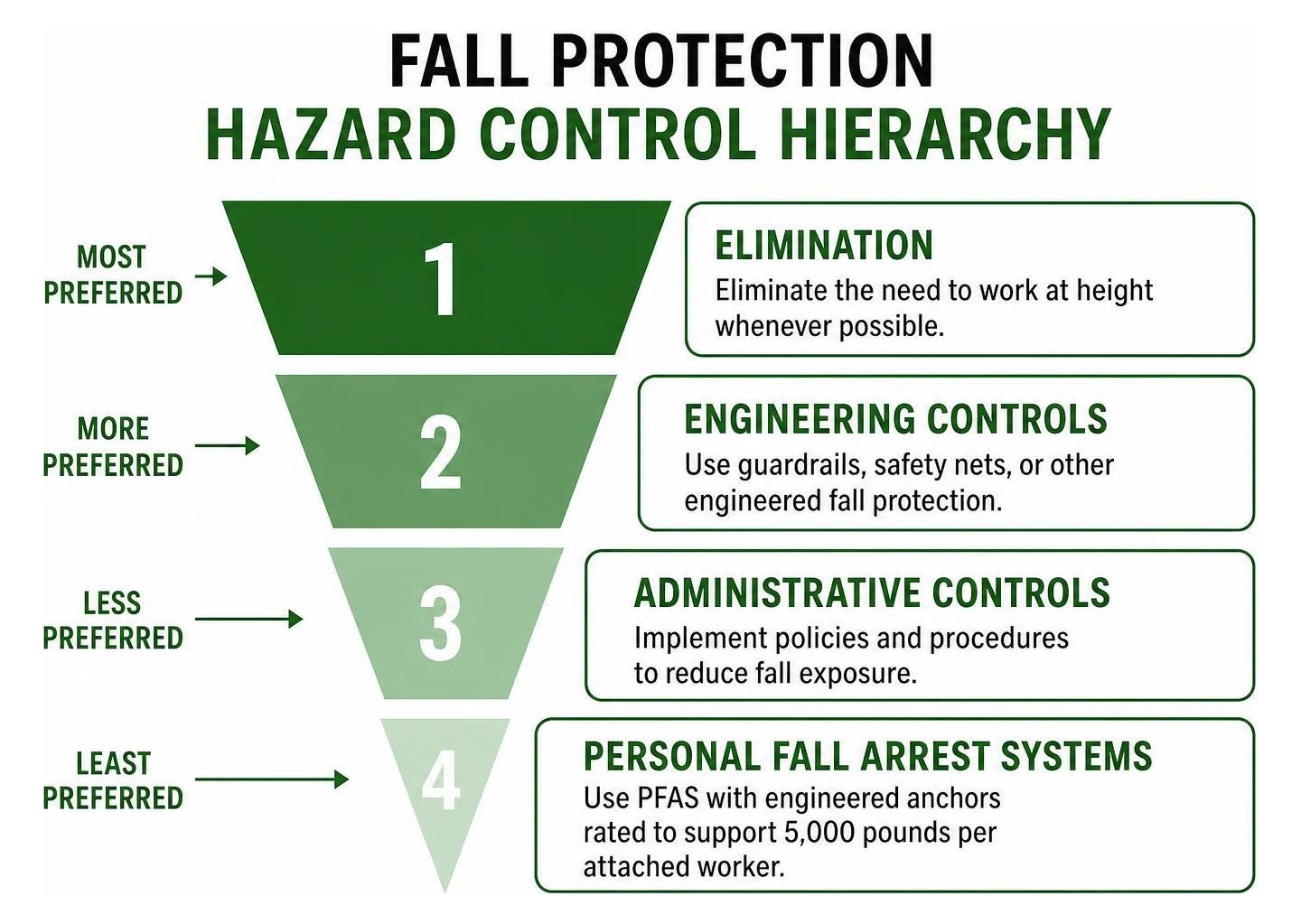
Ladder safety is another frequent source of regulatory citations. Following OSHA ladder safety regulations, portable ladders must be inspected before each shift, maintain rung spacing between 10 and 14 inches, and feature slip-resistant feet. Damaged ladders must be immediately tagged “Dangerous: Do Not Use” and removed from service.
For personal protective equipment, employers must adhere to mandatory personal protective equipment standards. This includes conducting formal hazard assessments to select appropriate head, eye, face, hand, and foot protection. When atmospheric hazards require respirators (such as during lead abatement or silica cutting), employers must implement a written respiratory protection program encompassing medical clearance questionnaires, annual qualitative or quantitative fit testing, and strict seal-check protocols.
Navigating Critical OSHA Safety Standards: 29 CFR 1910 and 1926
Navigating the federal code can feel overwhelming, but mastering the foundational subparts keeps operations straightforward. Employers should bookmark both the comprehensive 1910 general industry standards and the primary construction safety standard rules.
Within General Industry, review 1910 Subpart A – General to understand definitions and the general scope of agency authority, alongside the overarching 1910 regulatory provisions. By understanding how these parts align, companies can establish the critical compliance requirements that protect businesses against liability and workplace casualties.
Comparing OSHA Compliance Requirements and ISO 45001 Frameworks
Many growing organizations evaluate whether to stick strictly to OSHA compliance or pursue international standards such as ISO 45001 (Occupational Health and Safety Management Systems). While OSHA defines the non-negotiable legal minimums enforceable by law within the United States, ISO 45001 provides a voluntary, global management framework centered on the continuous “Plan-Do-Check-Act” (PDCA) improvement cycle.
| Dimension | OSHA Safety Standards (29 CFR) | ISO 45001 Framework |
|---|---|---|
| Legal Status | Mandatory federal/state law | Voluntary international standard |
| Primary Focus | Hazard mitigation and rule compliance | Systematic organizational safety management |
| Enforcement | Federal/state agency inspections and fines | Third-party accredited registrar audits |
| Program Scope | Prescriptive industry specifications | Process-driven continuous improvement |
| Worker Role | Training recipient and rights holder | Active participant in safety system design |
Integrating ISO 45001 concepts into your routine safety program strengthens your ability to consistently satisfy and exceed OSHA regulations.
OSHA Enforcement, Inspections, and Actionable Compliance Programs

With approximately 2,400 federal and state inspectors tasked with covering more than 8 million worksites, it is estimated that it would take OSHA roughly 129 years to inspect every single facility under its jurisdiction. Consequently, the agency deploys its inspection resources using strict priority tiers:
- Imminent Danger: Situations where death or serious physical harm is immediately threatened.
- Catastrophes and Fatalities: Workplaces where a fatality or inpatient hospitalization occurs (fatalities must be reported within 8 hours; hospitalizations, amputations, or eye losses within 24 hours).
- Worker Complaints and Referrals: Allegations of hazards or standard violations.
- Targeted Programmed Inspections: High-hazard industries and special emphasis inspection programs (e.g., trenching, silica, falls).
Inspection Procedures, Violation Penalties, and Establishing Safety Protocols
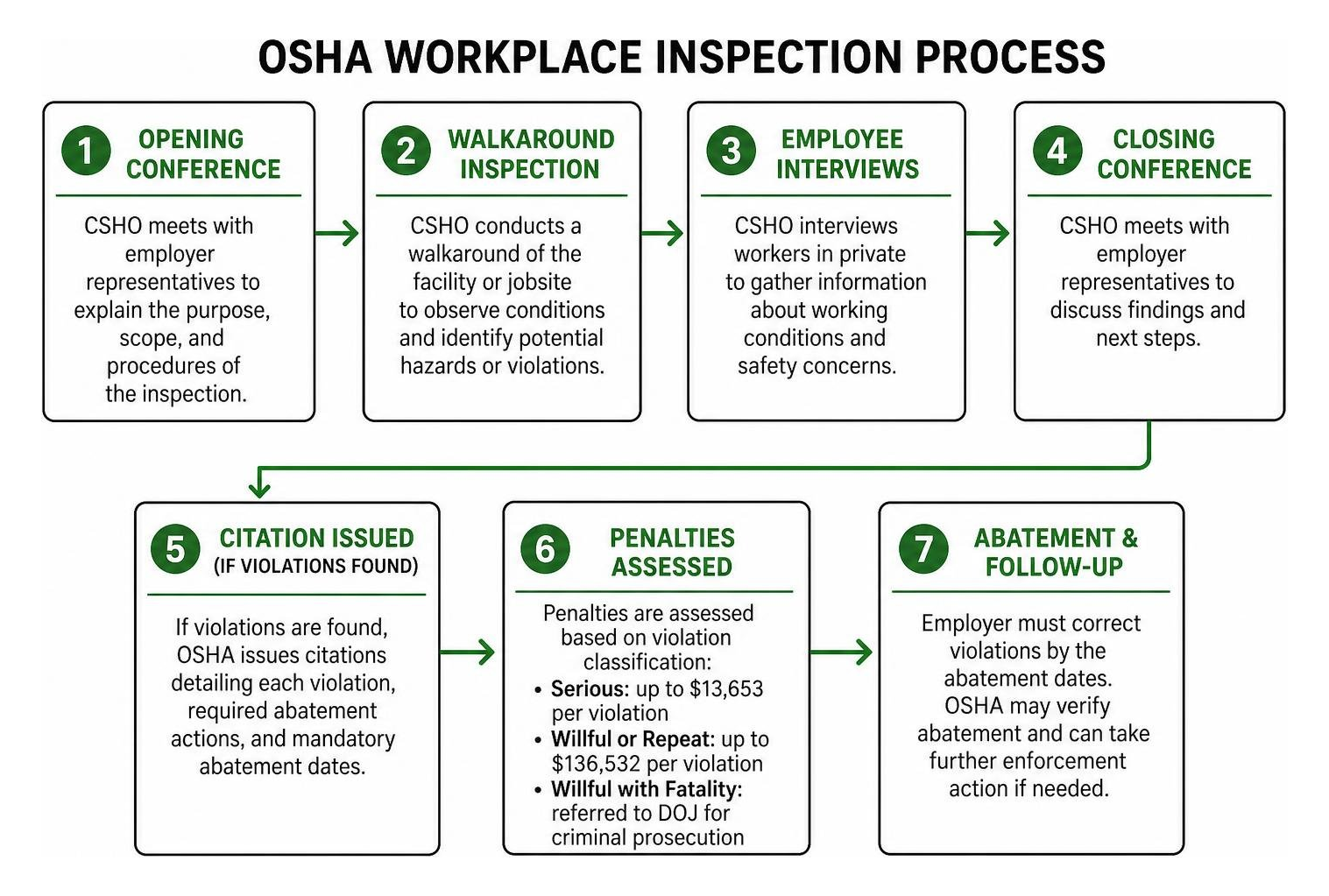
During an inspection, a Compliance Safety and Health Officer (CSHO) conducts an opening conference, leads a walkaround inspection across the facility or jobsite, interviews workers in private, and holds a closing conference. If inspectors find violations, citations are issued with mandatory abatement dates and statutory financial penalties.
A standard Serious violation carries a maximum fine of $13,653 per violation, while Willful or Repeat violations can reach $136,532 per violation. Willful violations that result in a worker fatality can also be referred to the Department of Justice for criminal prosecution.
To stay ahead of enforcement actions, businesses can leverage digital self-audit checklists and access state-run On-Site Consultation Programs, which offer free hazard evaluations to small businesses without triggering citations.
Equally important is investing in accredited workforce education. Enrolling field leaders and crews in mandatory safety training courses ensures workers recognize and eliminate hazards in real time. If you are deciding on training tiers for supervisory staff versus entry-level labor, evaluating OSHA 10 vs 30 credential options will help you determine the right depth of instruction.
At ZOTA Professional Training, we deliver EPA-accredited and OSHA safety certification courses designed for contractors and field professionals. We provide flexible, bilingual (English/Spanish) hybrid, online, and group training with nationwide on-site support to keep your operations compliant and your workers safe.
Ready to upgrade your compliance program? Explore our comprehensive workplace safety training solutions and schedule your team’s next safety certification today.