
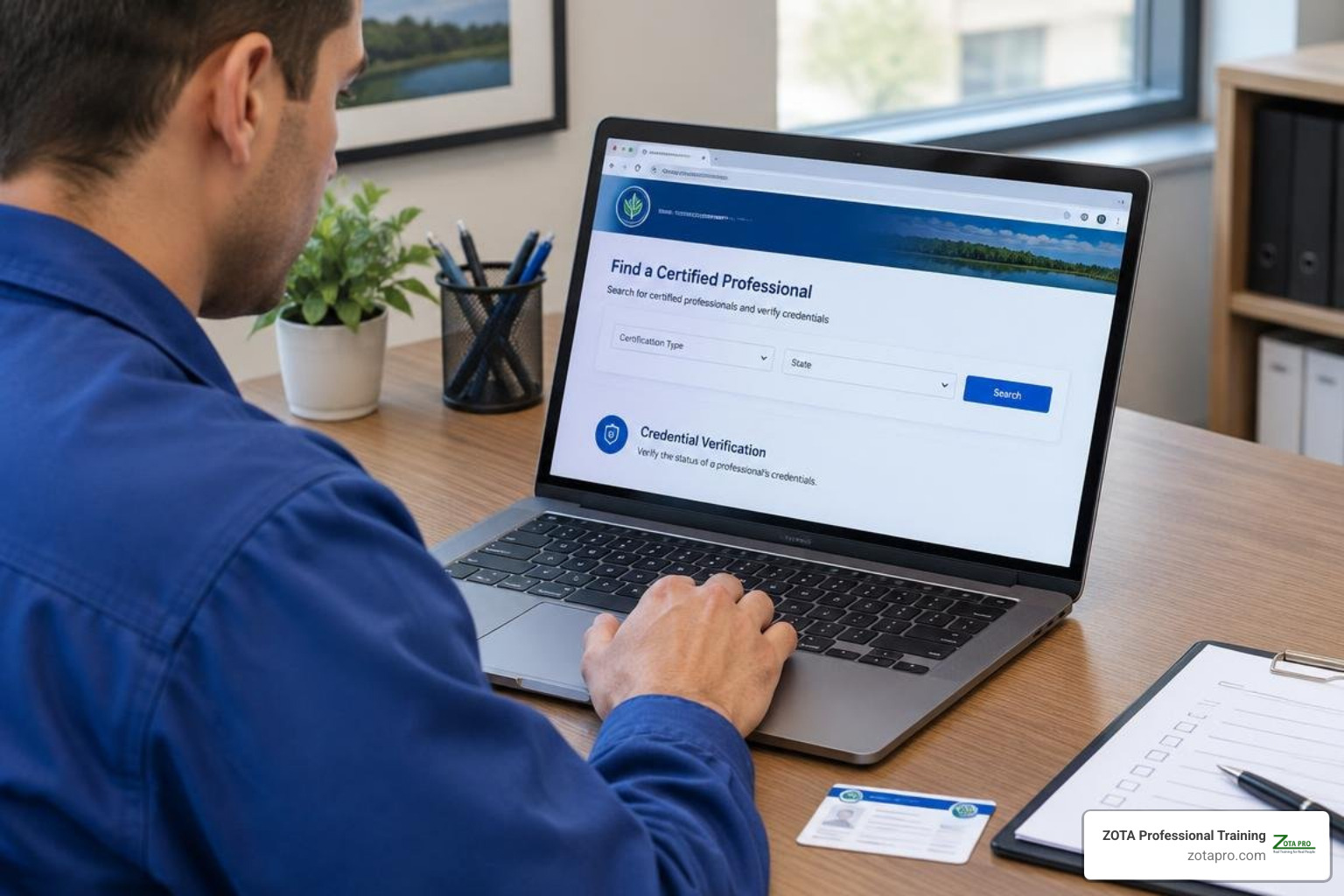
Verify EPA Credentials Before Work Starts
For a free EPA certification lookup, start with the database that matches the credential you need to check. For HVAC refrigerant work, search the Section 608 technician list using the person’s exact name or certification number. For a company or job-site record, use EPA’s free FRS and ECHO tools to review facility registration, permits, and compliance history.
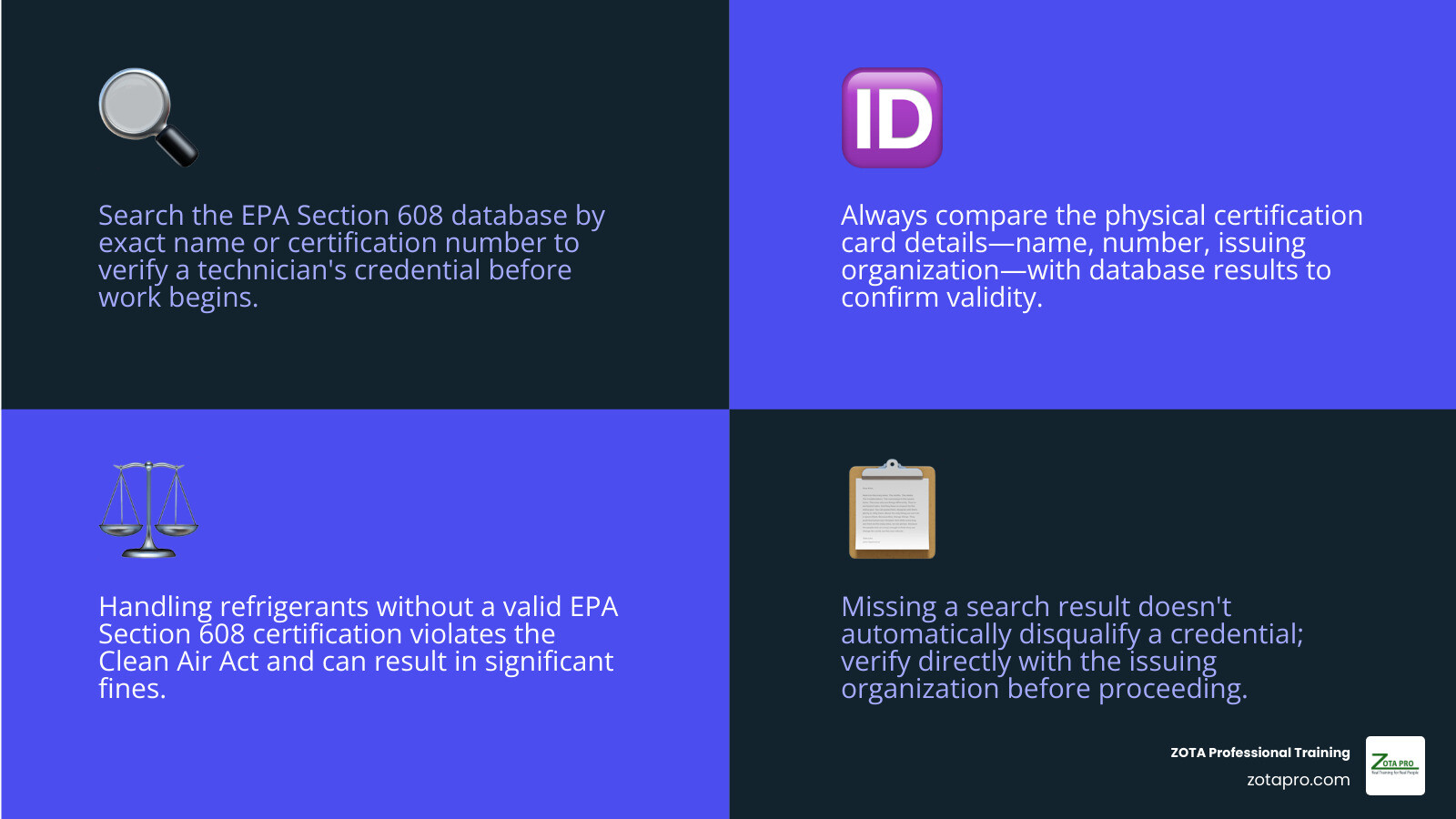
Before assigning regulated work, ask for the technician’s physical certification card and compare its details with the lookup result. A missing search result does not always mean the credential is invalid, but it does mean you should confirm the name, number, and issuing organization before proceeding.
EPA credentials are not all the same. Section 608 applies to refrigerant handling, while lead-based paint renovation work has separate EPA requirements. A database search can help you document due diligence, avoid unqualified subcontractors, and keep renovation projects moving without paying for a verification service.
I am Bob Zak, Founder and CEO of ZOTA Professional Training, with more than 32 years of occupational health and safety experience involving EPA, asbestos, mold, and OSHA training. In this guide, I will show you how a free EPA certification lookup fits into a practical compliance check for contractors and their teams.
How to Perform a Free EPA Certification Lookup for Technicians and Contractors
Verifying an individual’s credentials before they step foot on a job site protects your business, your clients, and the environment. Under the Clean Air Act, any technician who maintains, services, repairs, or disposes of equipment containing regulated refrigerants must hold an EPA Section 608 certification. Handling refrigerants without this credential violates federal law and exposes businesses to hefty fines.
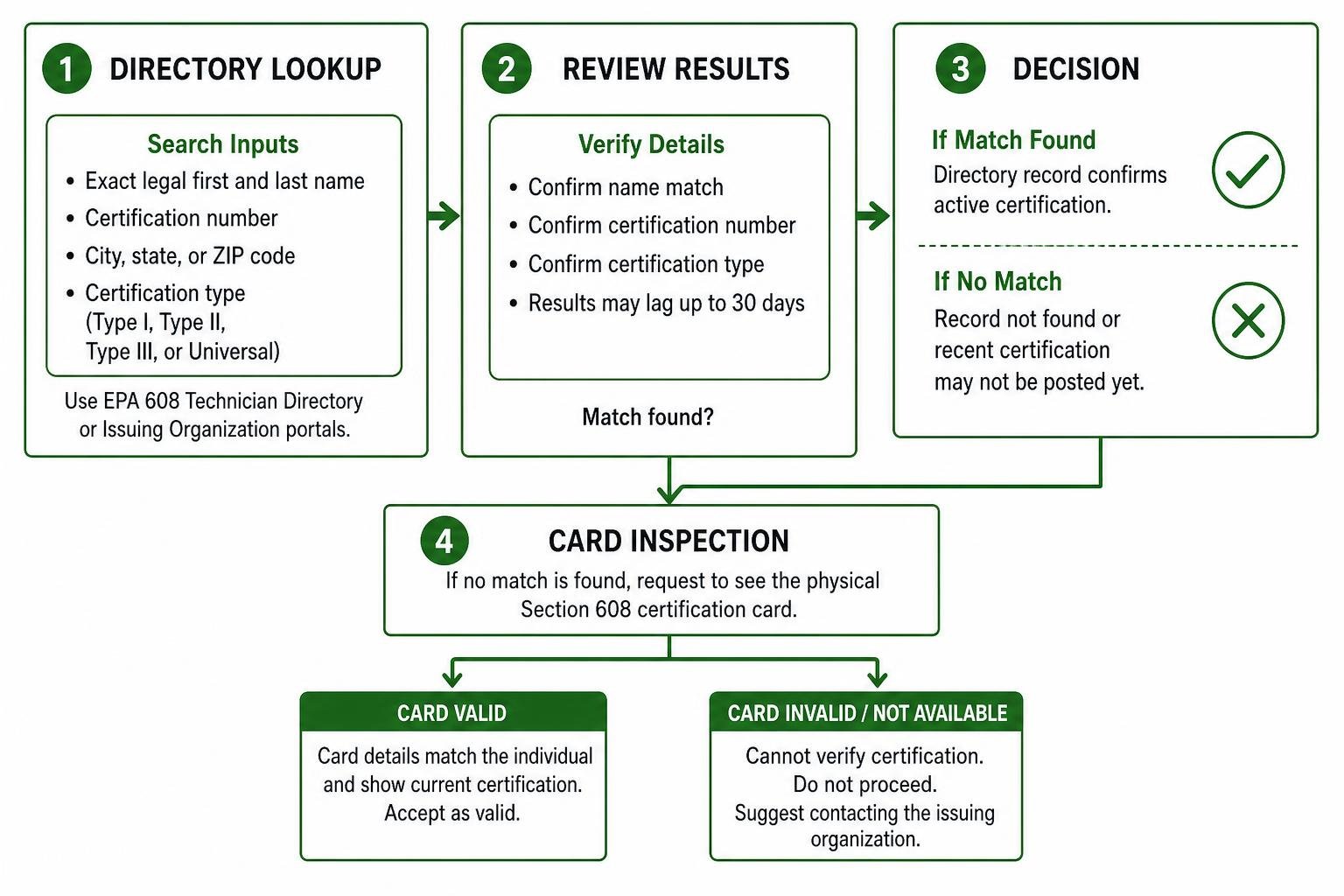
Performing an accurate search requires understanding the exact parameters used across federal and organizational databases. In most public directories, searching requires exact spelling matching the technician’s government-issued identification. You can narrow down your search using specific parameters:
- Technician’s first and last name (exact legal spelling)
- Unique certification number
- City, state, or ZIP code
- Certification type (Type I, Type II, Type III, or Universal)
| Tool / Database | Primary Search Inputs | Best Used For | Access Cost |
|---|---|---|---|
| EPA 608 Technician Directory | Exact Name, Certification Number | Direct Section 608 technician status | Free |
| Issuing Organization Portals | Last Name, Cert Number, ZIP Code | ESCO, Mainstream, Ferris State records | Free |
| EPA FRS Query | Facility Name, FRS ID, NAICS/SIC | Plant & facility environmental IDs | Free |
| EPA ECHO Database | Facility Name, Address, Program ID | Cross-media compliance & enforcement | Free |
Using Official Directories for a Free EPA Certification Lookup
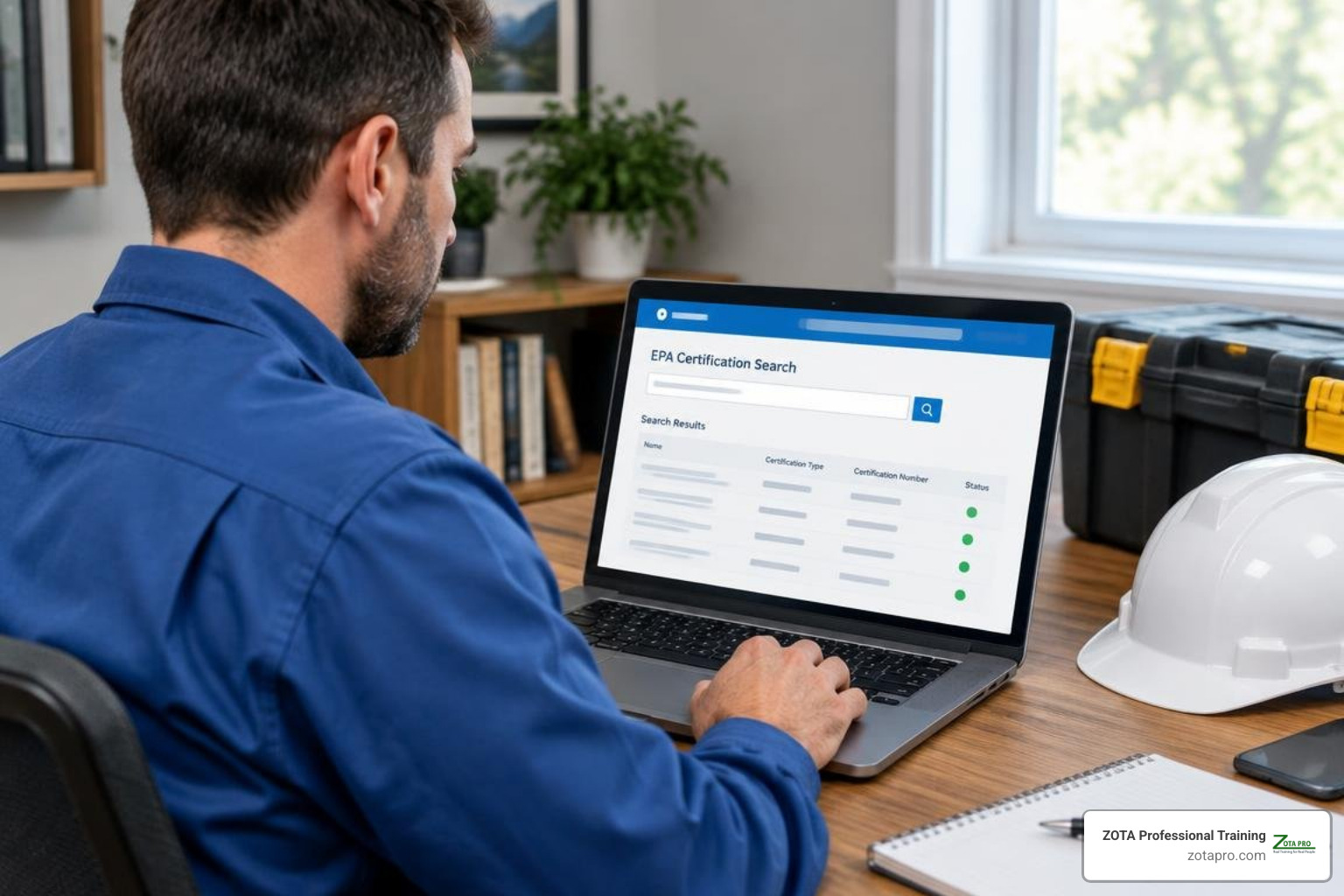
When checking refrigerant handling credentials, a primary public resource is the Section 608 Technician Certification List. This searchable database allows contractors, employers, and clients to verify an individual’s certification status without paying subscription fees.
To use this directory effectively:
- Enter Identifiers: Input the technician’s full legal name or unique certification number. Due to strict privacy protections, personal details like birth dates or phone numbers are generally excluded from public view.
- Filter by Type: Sort or filter results by the specific credential level. The system categorizes technicians based on the equipment they are legally authorized to service:
- Type I: Small appliances containing 5 pounds or less of refrigerant.
- Type II: High-pressure appliances (such as residential split systems and commercial rooftop units).
- Type III: Low-pressure appliances (such as chillers).
- Universal: Certified to service all equipment covered under Types I, II, and III.
- Account for Database Lag: That recently certified technicians may not appear instantly. Most submissions and new testing records are posted within 30 days of processing.
If a newly certified technician does not appear, ask to see their temporary documentation or check directly with their approved testing organization.
Free EPA Certification Lookup via Testing Organizations and Card Verification

The Environmental Protection Agency does not directly administer Section 608 exams. Instead, the agency authorizes independent, accredited testing organizations to conduct training, proctor exams, and issue credentials. Major approved providers include the ESCO Institute, Mainstream Engineering Corporation, and Ferris State University.
Many of these approved organizations maintain their own online portals where you can perform a verification by entering the technician’s last name and certification ID.
When reviewing a technician’s credentials in person, always inspect their physical card. A legitimate certification card must meet strict federal standards:
- Physical Format: Technicians must hold a physical, durable, credit-card-sized card issued by an EPA-accredited organization.
- No Digital Substitutes: Home-printed certificates, digital wallet screenshots, or downloadable PDF versions are not legally recognized on job sites. Think of an EPA Section 608 card like a driver’s license—you cannot simply print one at home and expect it to pass an audit!
- Proctoring Integrity: Certifications obtained through unapproved online venues, unverified recorded AI proctors, or “take-at-your-own-pace” unmonitored tests are invalid under federal regulations. A legitimate exam must be administered by an EPA-approved organization with verified human proctoring.
Signs of an invalid or fraudulent card include generic templates missing the certifying organization’s official seal, altered numbers, blurry non-standard logos, and cards claiming direct issuance from “The EPA Headquarters” rather than an authorized testing institution.
How to Replace Lost Section 608 Certification Cards
Because the EPA does not issue physical certification cards directly, the agency cannot replace a lost, damaged, or stolen card. If you or one of your workers misplaces a Section 608 card, follow this protocol to secure a replacement:
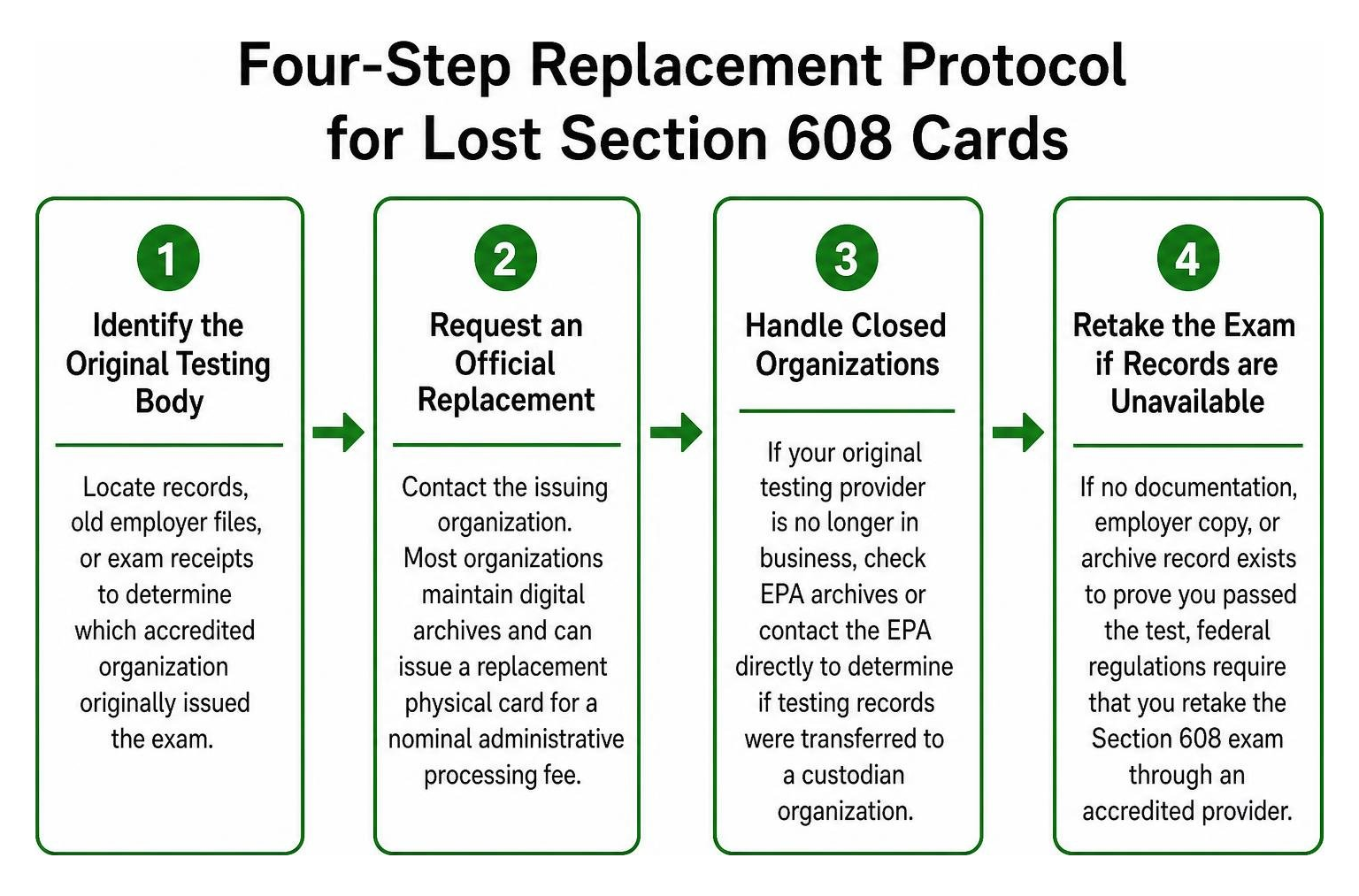
- Identify the Original Testing Body: Locate records, old employer files, or exam receipts to determine which accredited organization originally issued the exam.
- Request an Official Replacement: Contact the issuing organization (such as ESCO Institute, Mainstream Engineering, or Ferris State University). Most organizations maintain digital archives and can issue a replacement physical card for a nominal administrative processing fee.
- Handle Closed Organizations: If your original testing provider is no longer in business, check EPA archives or contact the EPA directly to determine if testing records were transferred to a custodian organization.
- Retake the Exam if Records are Unavailable: If no documentation, employer copy, or archive record exists to prove you passed the test, federal regulations require that you retake the Section 608 exam through an accredited provider.
Tracking Facility Compliance and Expanding Your EPA Credentials
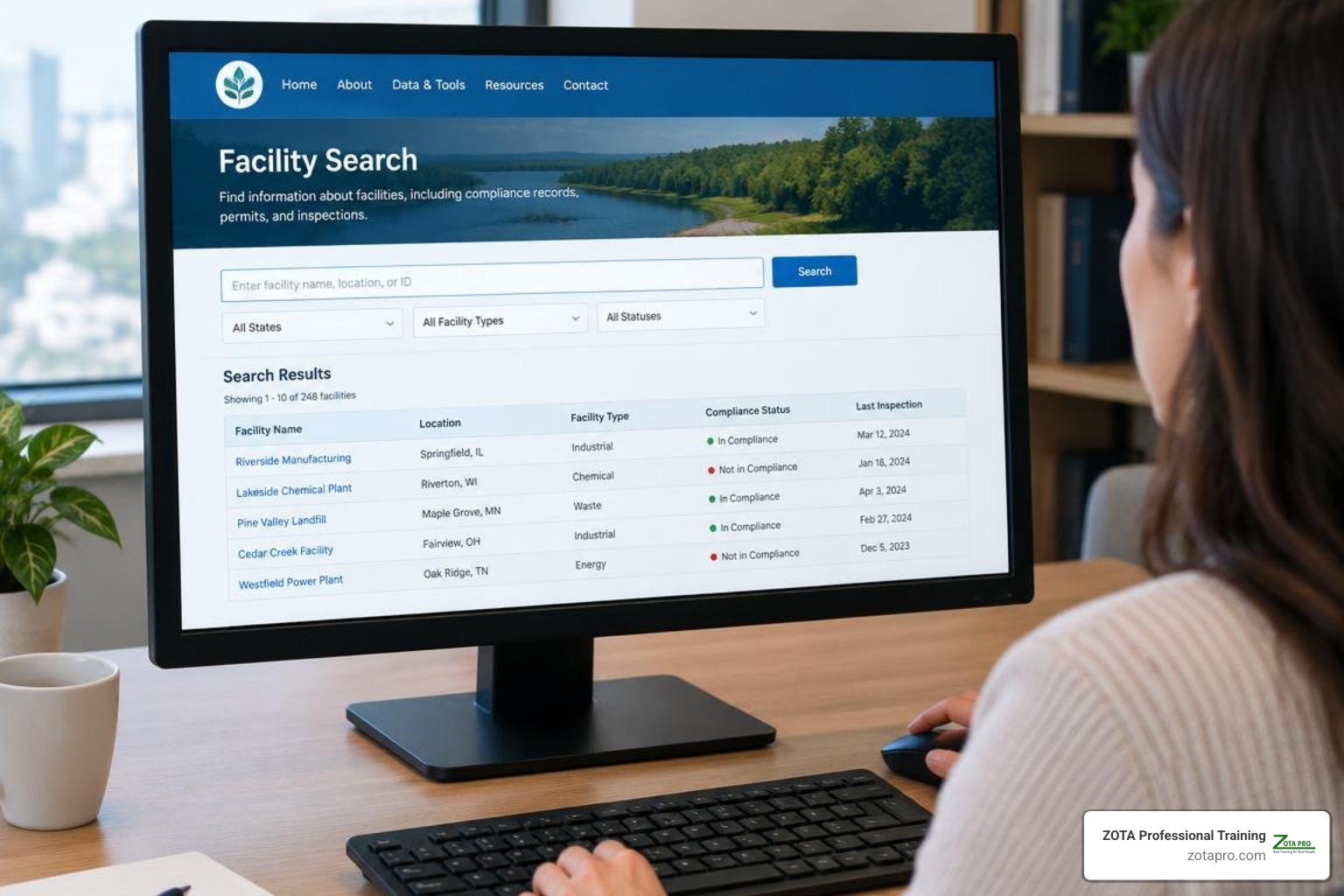
Beyond individual technician credentials, general contractors and project managers frequently need to evaluate commercial properties, industrial facilities, and trade subcontractors. The EPA maintains comprehensive, free public databases to monitor environmental permits, historical violations, and site compliance across the country.
Searching Facility Compliance Records via FRS and ECHO Databases
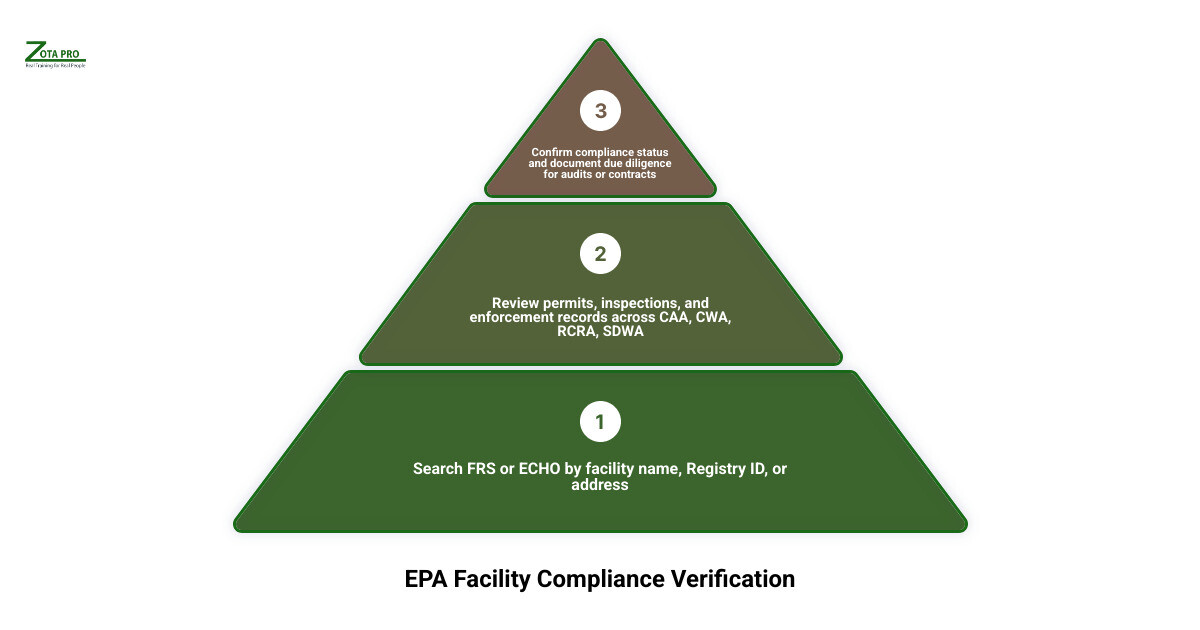
If you need to verify facility-level compliance, emissions data, or environmental permits, two primary federal databases provide open access:
1. EPA Facility Registry Service (FRS)
The EPA FRS Query system is a centrally managed database that assigns a single unique Registry ID to every facility subject to environmental regulation.
To search the FRS tool effectively:
- Query by Facility Name, Registry ID, or street address.
- Use geographic parameters like city, county, state, or predefined EPA regions.
- Filter by Standard Industrial Classification (SIC) or North American Industry Classification System (6-digit NAICS) codes to pinpoint specialized facilities.
- Review the FRS user guidance to avoid search timeouts—queries are limited to 2.5 minutes of CPU time, and user sessions expire after 15 minutes.
2. Enforcement and Compliance History Online (ECHO)
For deep compliance audits, the EPA ECHO compliance search provides direct access to enforcement records, inspection summaries, and permit statuses across more than 800,000 regulated facilities nationwide.
ECHO covers multi-media environmental programs:
- Clean Air Act (CAA): Air stationary sources and major emissions permits.
- Clean Water Act (CWA): National Pollutant Discharge Elimination System (NPDES) permits.
- Resource Conservation and Recovery Act (RCRA): Hazardous waste handlers and disposal sites.
- Safe Drinking Water Act (SDWA): Public water system compliance.
Additionally, contractors assessing greenhouse gas compliance and air permit determinations can review the EPA’s RACT/BACT/LAER Clearinghouse (RBLC) database, which compiles air permit records across pollutants like CO₂e, methane, and hydrofluorocarbons (HFCs).
Maintaining Lead-Based Paint and Environmental Certifications
While Section 608 covers HVAC refrigerants, construction contractors, painters, and property renovators working on pre-1978 housing or child-occupied facilities face entirely different regulatory mandates under the EPA RRP Program.
Under federal Lead Renovation, Repair, and Painting (RRP) regulations, firms must be certified by the EPA, and individual renovators must complete an accredited training course to handle lead-containing materials safely. Overlooking these requirements can lead to severe penalties, stop-work orders, and substantial civil liabilities.
When preparing your crew for residential or commercial remodeling, following the proper steps to obtain EPA lead certification ensures your team remains fully compliant before the first wall is opened. Selecting an experienced EPA accredited training provider makes all the difference in understanding containment protocols, cleaning verifications, and record-keeping mandates.
At ZOTA Professional Training, we specialize in helping contractors, property managers, and safety professionals navigate regulatory standards seamlessly. We deliver flexible, high-impact instruction through our professional EPA lead certification programs, offering in-person, hybrid, and bilingual (English and Spanish) training options tailored to your crew’s schedule. Keep your credentials up to date, protect your clients, and bid on regulated projects with total confidence.