

Why a Lead Abatement Contractor License Is the Foundation of Legal Lead Work
Getting a lead abatement contractor license is the legal requirement for any company that wants to perform lead hazard reduction work on pre-1978 homes, schools, or child-occupied facilities. Here is what you need to know upfront:
What does a lead abatement contractor license do?
- It authorizes a business entity to contract for lead hazard reduction work
- It is separate from individual worker or supervisor certifications
- It is required at the state level in most U.S. states (and enforced federally in states without their own programs)
- Without it, your firm cannot legally bid on or perform lead abatement projects
Who issues it? Each state has its own licensing authority — for example, the Ohio Department of Health, Virginia’s DPOR, Pennsylvania’s Department of Labor and Industry, and Massachusetts’ Department of Labor Standards. In states without a delegated program (like Idaho), the EPA enforces firm certification directly.
How much does it cost?
| State | Fee | Validity |
|---|---|---|
| Ohio | $500 | Varies |
| Virginia | $117.25 | Varies |
| Missouri | $250 | 2 years |
| Massachusetts (Deleader) | $575 | 1 year |
| Massachusetts (Lead-Safe Renovator) | $375 | 5 years |
The stakes are high. Operating without a valid license can trigger fines of up to $37,500 from the EPA alone — not counting state-level penalties.
I’m Bob Zak, Founder and CEO of ZOTA Professional Training, and with over 32 years in occupational health and safety, I’ve helped thousands of contractors navigate the exact licensing requirements covered in this guide — including what it takes to qualify for and maintain a lead abatement contractor license in states across the country. Whether you’re just getting started or renewing an existing license, the sections below walk you through everything step by step.
Understanding the Lead Abatement Contractor License and Its Requirements
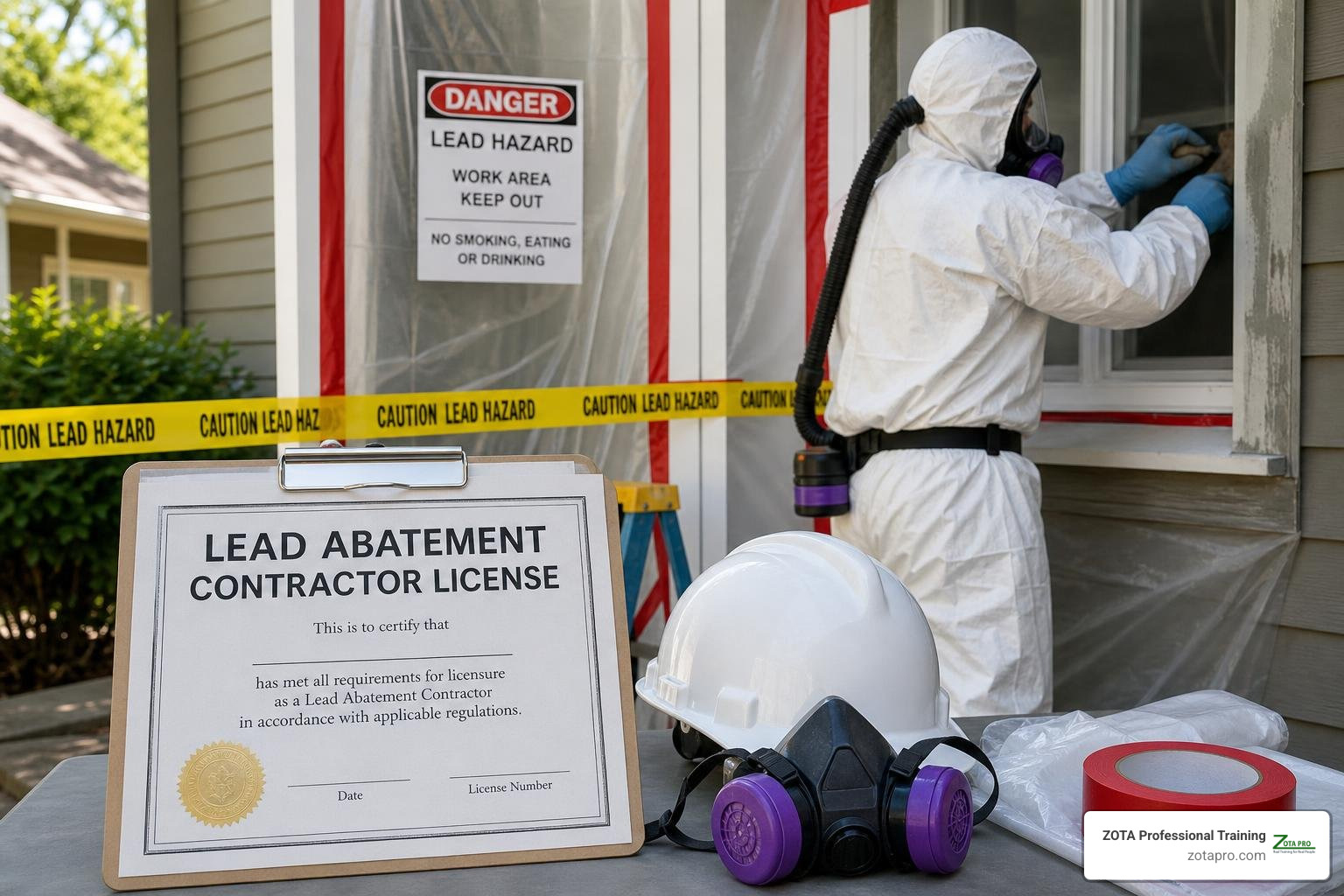
Before we jump into the paperwork, let’s define what we are actually talking about. A lead abatement contractor license is a specialized credential issued to a business entity (whether a sole proprietorship, LLC, or corporation) that permits them to offer and perform Lead Abatement services.
Lead abatement is defined as any measure or set of measures designed to permanently eliminate lead-based paint hazards. This is highly regulated work because of the extreme public health risks associated with lead dust. This work typically takes place in “target housing” (residential dwellings built before 1978) and “child-occupied facilities” (such as daycares and kindergarten classrooms visited regularly by children aged six and under).
If you are a business owner bidding on these projects, having your individual workers certified is not enough. Your company itself must hold a valid firm credential. Obtaining this is a critical step in securing Lead Certification for Contractors to protect your business, your workers, and the families living in the properties you service.
Lead Abatement Contractor License vs. Lead-Safe Renovator (RRP) Certification
One of the most common points of confusion in our industry is the difference between lead abatement and Lead-Safe Renovation (RRP). While they both deal with lead-based paint, they are governed by different rules, require different training, and have completely different objectives.
The EPA’s Renovation, Repair, and Painting (RRP) rule applies to aesthetic or functional renovations that disturb lead paint. Lead abatement, on the other hand, is the permanent elimination of lead hazards.
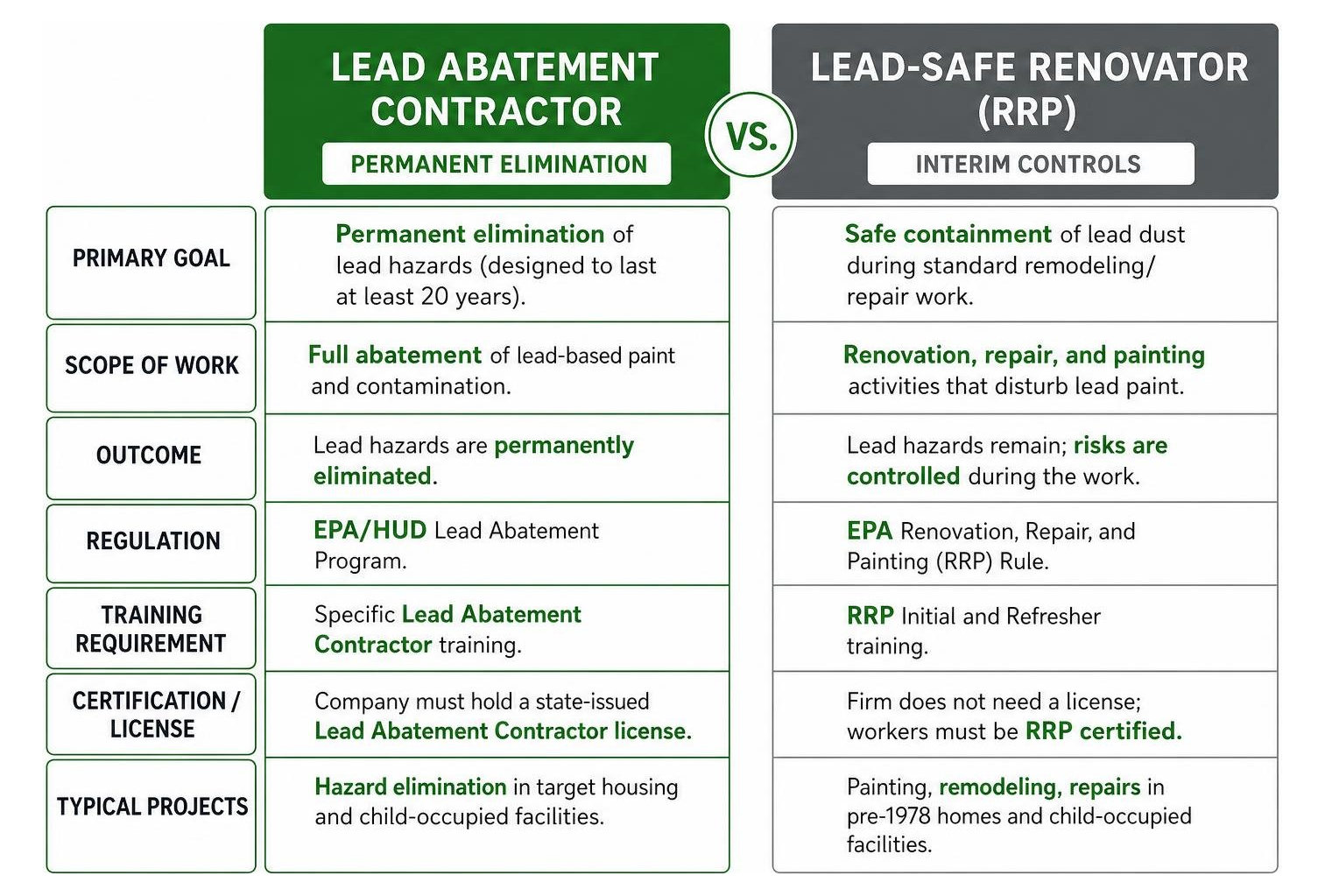
Here is a quick breakdown to help you keep them straight:
| Feature | Lead Abatement Contractor | Lead-Safe Renovator (RRP) |
|---|---|---|
| Primary Goal | Permanent elimination of lead hazards (designed to last at least 20 years). | Safe containment of lead dust during standard remodeling/repair work. |
| Typical Activities | Encapsulation, enclosure, replacement of lead components, or total paint removal. | Window replacement, sanding, cutting, or demolition for remodeling purposes. |
| Notification | Strict state/federal project notifications required (e.g., 7 or 10 days in advance). | No pre-project state health department notification required. |
| Clearance Testing | Mandatory third-party clearance inspections and dust wipe sampling. | Visual cleaning verification (or dust wipes if required by local rules). |
Confusing these two can lead to catastrophic project delays and massive regulatory fines. If your project’s intent is to solve a lead hazard permanently—especially under a state-funded program or a court order—you must operate under a lead abatement contractor license rather than a standard RRP firm certification. For a deeper dive into these differences, see our comparison guide on Lead Abatement vs. RRP Renovator.
Required Qualifications, Personnel, and On-Site Supervision
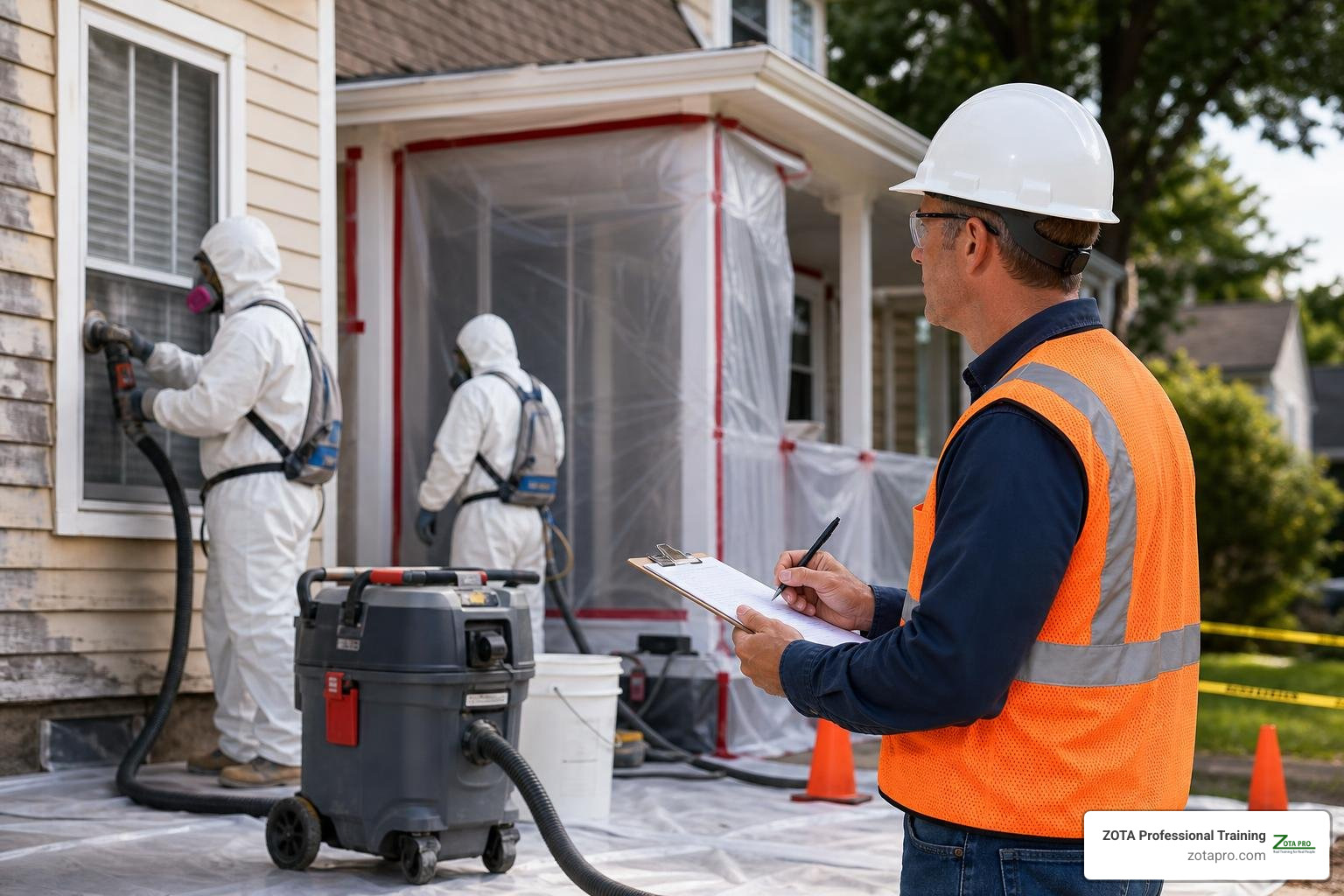
To qualify for a contractor license, your firm cannot simply pay a fee and fill out a form. You must prove that you have the technical capacity and qualified personnel to perform the work safely.
First, a licensed lead abatement contractor must employ at least one certified Lead Abatement Supervisor to oversee operations. In many states, this supervisor acts as the “Qualified Individual” (QI) for the business license. If you are a sole proprietor, you must wear both hats: you must hold the company’s contractor license and maintain your own individual Lead Abatement Supervisor credential.
The personnel requirements generally include:
- Certified Lead Abatement Supervisors: Responsible for preparing occupant protection plans, overseeing engineering controls, and ensuring OSHA compliance.
- Certified Lead Abatement Workers: Hand-on professionals trained in safe removal, cleanup, and disposal methods.
The prerequisites for these individual roles are demanding. For example, to become a certified supervisor, states often require at least one year of experience as a certified lead worker, or at least two years of experience in a related field like asbestos abatement, radon mitigation, or general building construction. Make sure you understand these career pathways by reading the Facts Anyone Seeking Lead Abatement Certification Should Know.
Furthermore, states have strict rules regarding on-site supervision. For instance, according to the Connecticut Department of Public Health’s Standards for Licensure and Certification of Lead Abatement Contractors, Lead Consultants, and Lead Abatement Personnel , contractors must utilize certified supervisors to oversee all active work sites. In states like Ohio and Virginia, a supervisor must be physically present during all work site preparation and post-abatement cleanup phases, and must be able to return to the job site within two hours at any other time during active abatement.
State-Specific Licensing Rules and Compliance Standards

Because the EPA has delegated the authority to run lead compliance programs to individual states, the exact process to get licensed depends entirely on where your business operates. Understanding these regional variations is key to unlocking the EPA Lead Abatement Certification Benefits for Contractors and Inspectors, allowing you to legally bid on lucrative public and private environmental cleanup contracts.
How to Obtain a Lead Abatement Contractor License
While the fine print varies by state, the general roadmap to getting your company licensed involves five core steps:
- Incorporate and Register Your Business: Register your business entity with your State Corporation Commission (SCC) or Secretary of State (SOTS).
- Get Your Personnel Certified: Ensure you or your employees complete EPA-accredited training courses for Lead Abatement Supervisors and Workers. Learn more about this process in our guide on EPA Lead Abatement Certification: How to Get Certified in 2025.
- Submit the Firm Application: Apply online or via mail to your state’s licensing agency, attaching your business registration, supervisor credentials, and lists of specialized equipment (like HEPA vacuums).
- Pay the Licensing Fees: Submit non-refundable application fees, which range from $110 to $575 depending on the state.
- Pass the State Exam (If Applicable): Some states require the firm’s Qualified Individual to pass a third-party lead contractor or supervisor exam.
Once licensed, you must track your renewal cycle closely. Most licenses are valid for one or two years. Allowing your license to lapse means stopping all active projects, and reinstating a lapsed license often requires paying penalty fees and retaking refresher training courses.
Prohibited Work Practices and Ongoing Compliance Standards
Once you obtain your lead abatement contractor license, you must adhere to strict operational standards. To prevent the dangerous spread of lead dust, certain work practices are strictly banned under state and federal regulations, including:
- Open-flame burning or torching of lead-based paint.
- High-temperature heat guns operating above 1,100 degrees Fahrenheit (which vaporizes lead into a highly toxic gas).
- Uncontained hydro-blasting or high-pressure water blasting.
- Dry scraping or dry sanding, except in very limited areas (such as around electrical outlets or defective spots totaling no more than 2 square feet indoors or 20 square feet on exterior surfaces).
Ongoing compliance also means keeping meticulous records. In accordance with Ohio Admin. Code 3701-32-08 – Lead abatement contractor scope of practice and standards of conduct | State Regulations | US Law | LII / Legal Information Institute , contractors must prepare a written occupant protection plan and a pre-abatement compliance plan before starting any project. You must also maintain supervisor and worker health monitoring records (like blood lead level tests) for at least two years, and retain all project records—including hazardous waste manifests and clearance testing results—for a minimum of three years.
State-Specific Requirements: Ohio, Virginia, Connecticut, and Beyond
To give you an idea of how varied these rules can be, let’s look at several key states as of July 2026:
- Virginia: The Board for Asbestos, Lead, and Home Inspectors requires a dual-licensing structure. Your business must hold a standard Contractor License with a Lead Abatement Contracting (LAC) specialty, alongside a Lead Abatement Contractor License. The application fee is $117.25 (which includes a $7.25 state technology fee). To apply, you can use the official Lead Abatement Contractor License Application .
- Missouri: The Department of Health and Senior Services (DHSS) licenses lead professionals. A contractor license costs $250 and is valid for two years. To learn about individual license paths, check out the state’s resource on How To Become Licensed As A Lead Professional In Missouri .
- Massachusetts: The Department of Labor Standards (DLS) manages licensing through its paperless online LAA System. A Deleader Contractor License costs $575 annually, while a Lead-Safe Renovator Contractor License costs $375 every five years. You can submit your application directly via Apply for a lead-safe renovation or deleading license | Mass.gov .
- Illinois: If you are working in Illinois, you must submit a formal Notice of Commencement of Lead Abatement or Mitigation Project to the Department of Public Health at least 7 working days before starting work in any residential dwelling or childcare facility.
- Iowa: Under Iowa Administrative Code 481 Chapters 469 and 470, the Department of Inspections, Appeals, & Licensing (DIAL) enforces a strict rule requiring contractors to distribute the state’s lead safety booklet before disturbing more than just one square foot of paint.
No matter which state you operate in, keeping your team trained and compliant is the key to running a successful business. At ZOTA Professional Training, we provide the flexible, multilingual (English/Spanish) training your team needs to meet these strict state and federal requirements.
Ready to get your team certified? Explore our EPA-accredited training programs and secure your credentials through the ZOTA Professional Training Course Portal today!