

Why a Lead Abatement Certification Course Could Save Your Business
A lead abatement certification course is the required training that allows contractors, renovators, and inspectors to legally work with lead-based paint in homes and child-occupied facilities built before 1978. Here is a quick overview of what you need to know:
| Course Type | Duration | Who Needs It |
|---|---|---|
| RRP Renovator Initial | 1 day (8 hrs) | Contractors doing renovation, repair, or painting in pre-1978 housing |
| Lead Abatement Worker | 2-3 days | Workers performing hands-on lead removal |
| Lead Abatement Supervisor | 4-5 days | Supervisors overseeing abatement job sites |
| Lead Inspector | 4 days | Professionals conducting lead paint inspections |
| Lead Risk Assessor | 2 days (after Inspector) | Professionals assessing lead hazards and risk levels |
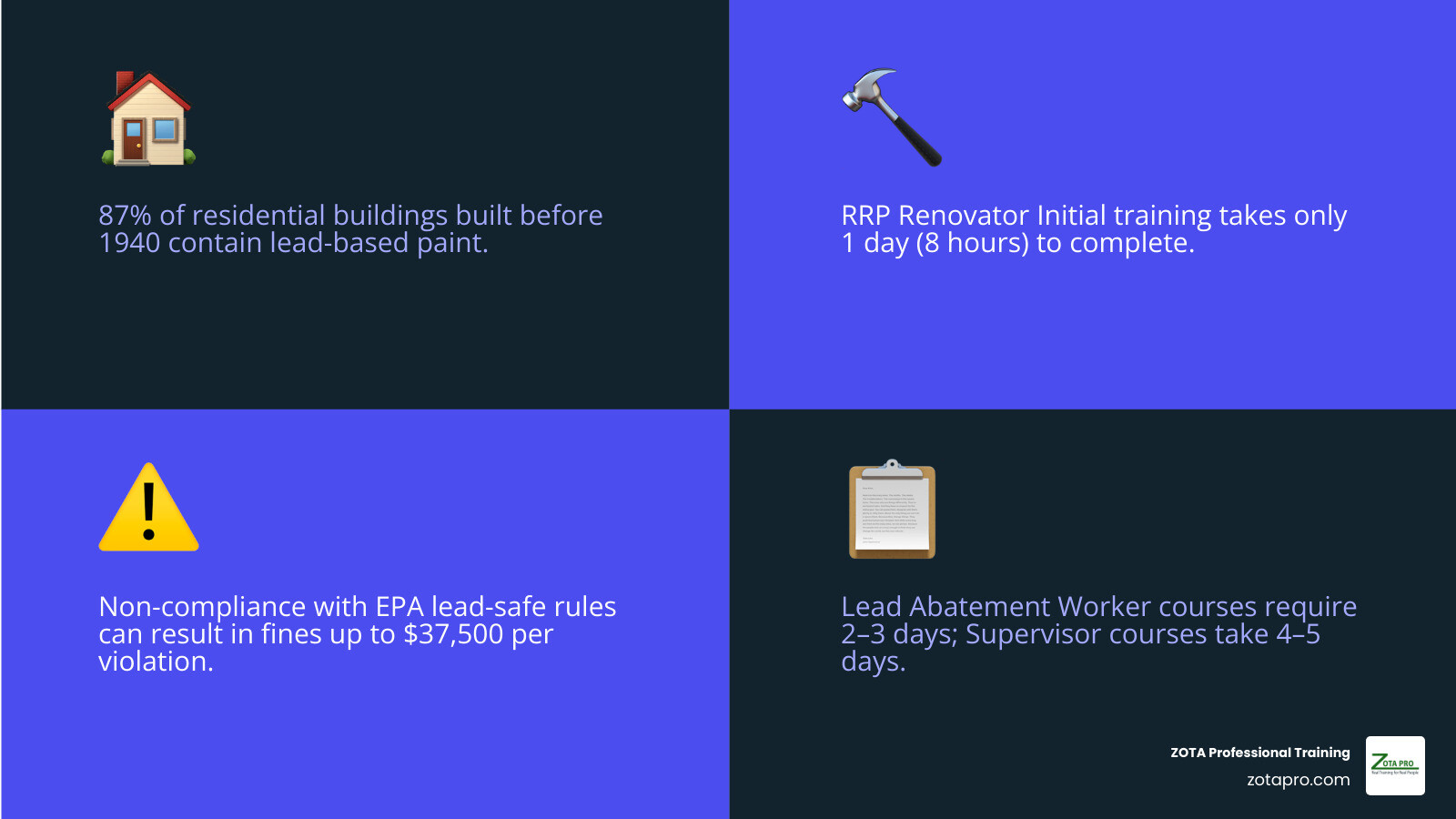
The EPA’s Lead-Safe RRP Rule has been in effect since April 2010. Non-compliance can mean fines up to $37,500 per violation. For a small renovation firm, that is not a risk worth taking.
Lead-based paint is still present in millions of older structures. According to industry data, 87% of residential buildings built before 1940 contain lead-based paint, and roughly 24% of homes built between 1960 and 1978 still contain it. If your crew works on pre-1978 properties — even for routine repairs — certification is not optional.
I’m Bob Zak, Founder and CEO of ZOTA Professional Training, and with over 32 years in occupational health and safety, I’ve helped thousands of contractors navigate the lead abatement certification course process quickly and affordably. In this guide, I’ll walk you through every course type, cost, duration, and state-specific requirement you need to stay compliant and keep working.
Choosing the Right Lead Abatement Certification Course for Your Career
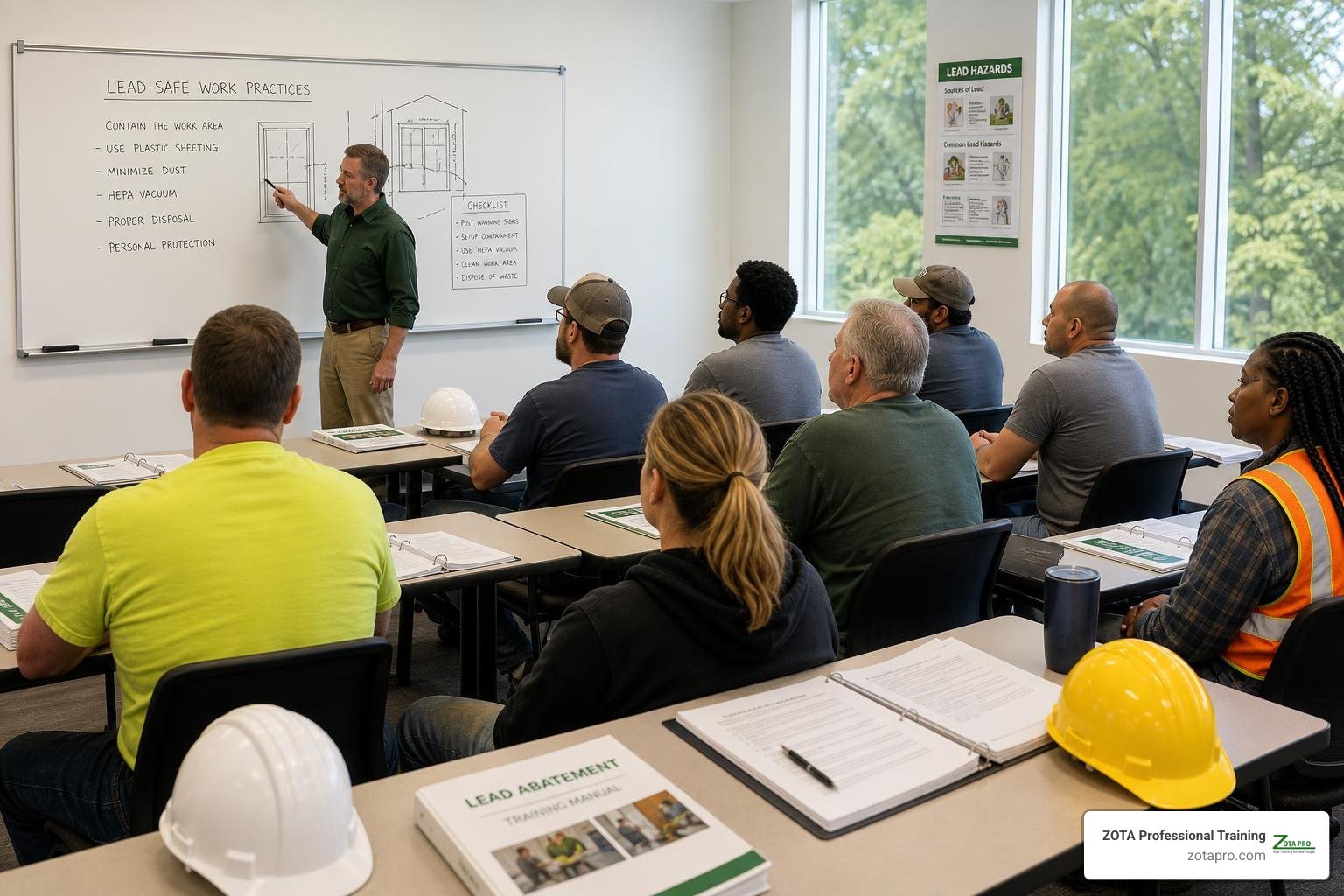
Choosing the correct training path is the most critical step in protecting your business from devastating fines and ensuring your team works safely. Many contractors confuse standard lead-safe renovation with permanent lead abatement. Enrolling in the wrong class can cost you thousands of dollars in wasted time and licensing fees.
To make an informed decision, we must look at how the regulatory environment has evolved. In 2026, the EPA finalized major updates to the Model Renovator Initial Training Course | US EPA . These revisions reflect strict new dust-lead action levels and dust-lead reportable levels that went into effect on January 12, 2026. Under these modern rules, previous terms like “dust-lead clearance levels” have been rebranded to dust-lead action levels, and “dust-lead hazard standards” are now officially dust-lead reportable levels.
These tighter standards mean that even minor renovation dust can trigger a violation if proper containment is not maintained. To understand whether your business needs simple, lead-safe work practices or permanent hazard elimination, you should review the core differences outlined in our guide on Lead Abatement vs. RRP Renovator.
Additionally, there are several foundational Facts Anyone Seeking Lead Abatement Certification Should Know before signing up. For example, standard Renovator (RRP) certifications are typically valid for five years, whereas professional abatement certifications often require refreshers every three years.
To help you choose the right direction, let us look at the comprehensive breakdown of course types, average costs, and durations below:
| Course Discipline | Duration | Average Cost | Core Curriculum Focus |
|---|---|---|---|
| EPA Lead Renovator (RRP) Initial | 1 Day (8 Hours) | $320 | Containment, EPA-approved test kits, cleaning verification, recordkeeping |
| Lead Abatement Worker Initial | 2-3 Days (16-24 Hours) | $545 | Hands-on abatement, personal protective equipment (PPE), safe waste disposal |
| Lead Abatement Supervisor Initial | 4-5 Days (32-40 Hours) | $745 – $800 | Project management, occupant protection planning, supervisor liability, reporting |
| Lead Inspector Initial | 3-4 Days (24-32 Hours) | $645 | X-ray fluorescence (XRF) operation, radiation safety, paint/dust/soil sampling |
| Lead Risk Assessor Initial | 2 Days (16 Hours) | $545 | Hazard identification, risk level reporting, post-abatement clearance strategies |
Who Should Enroll in a Lead Abatement Certification Course?
If your goal is to permanently eliminate lead hazards rather than just perform general maintenance, you need an abatement-specific discipline. The roles are strictly divided by responsibility and prerequisites:
- Lead Abatement Worker: This 2-to-3-day course is designed for the field crew performing hands-on lead removal, encapsulation, or enclosure. If you are looking to get your crew certified for physical labor on abatement projects, start with the Lead Abatement Worker Initial Course.
- Lead Abatement Supervisor: This 4-to-5-day course is mandatory for anyone planning, overseeing, or managing an abatement project. A certified supervisor must be physically present on-site during all active phases of work. They are responsible for writing the occupant protection plan and preparing the final abatement report. To step into this leadership role, you can enroll in the Lead Abatement Supervisor Initial Course.
- Lead Inspector: This 3-to-4-day course is for professionals who want to offer inspection services. It covers how to use XRF paint analyzers and take dust, soil, and water samples to determine if lead-based paint is present.
- Lead Risk Assessor: This advanced 2-day course is for professionals who want to evaluate the hazard level of a property and recommend specific corrective actions.
Prerequisites & Experience Requirements: While anyone can take the Lead Abatement Worker course, advanced disciplines have strict entry barriers. For example, to take the Lead Risk Assessor course, you must have already completed the Lead Inspector course. Furthermore, becoming a licensed Lead Abatement Supervisor generally requires at least one year of experience as a certified lead worker or two years of experience in the building trades or environmental remediation.
How to Register for a Lead Abatement Certification Course in Under an Hour
We know your time is valuable. You do not want to spend hours digging through confusing government websites just to sign up for a class. At ZOTA Professional Training, we have streamlined our registration process so you can secure your seat in less than an hour.
First, check out our comprehensive guide on EPA Lead Abatement Certification: How to Get Certified in 2025 to understand the exact steps required for your region. Once you know which course you need, you can visit our direct registration portal to Register for an RRP Certification Course or select an abatement discipline that fits your schedule.
When registering, keep in mind that the administrative side of lead training has gone completely digital. As of January 13, 2025, training providers are no longer permitted to send training notifications to the EPA by mail, fax, or hand delivery. All notifications must be submitted electronically using the Agency’s Central Data Exchange (CDX). This electronic shift ensures faster processing, meaning your course completion records are uploaded to the federal database immediately after you pass your course exam.

Federal vs. State Lead Certification Programs
One of the most confusing aspects of lead compliance is navigating the “maze” of federal versus state jurisdiction. Many contractors assume that an EPA certificate automatically allows them to work anywhere in the country. Unfortunately, that is not how it works.
Under the Toxic Substances Control Act (TSCA) sections 402 and 404, the EPA allows individual states, territories, and Tribes to develop and administer their own lead licensing programs. This has created a highly fragmented regulatory landscape:
- EPA-Authorized States: Currently, 40 states run their own unique, state-specific lead certification programs. If you operate in one of these states, you must comply with state-specific laws, and the state agency may not accept standard federal EPA training.
- EPA-Controlled States: There are 11 states and territories (including New York, Florida, South Carolina, Montana, South Dakota, Wyoming, Idaho, Nevada, Arizona, New Mexico, and Alaska) where the EPA directly manages the lead program. In these areas, federal credentials apply, though some EPA-controlled states will accept authorized state licenses to simplify federal licensure.
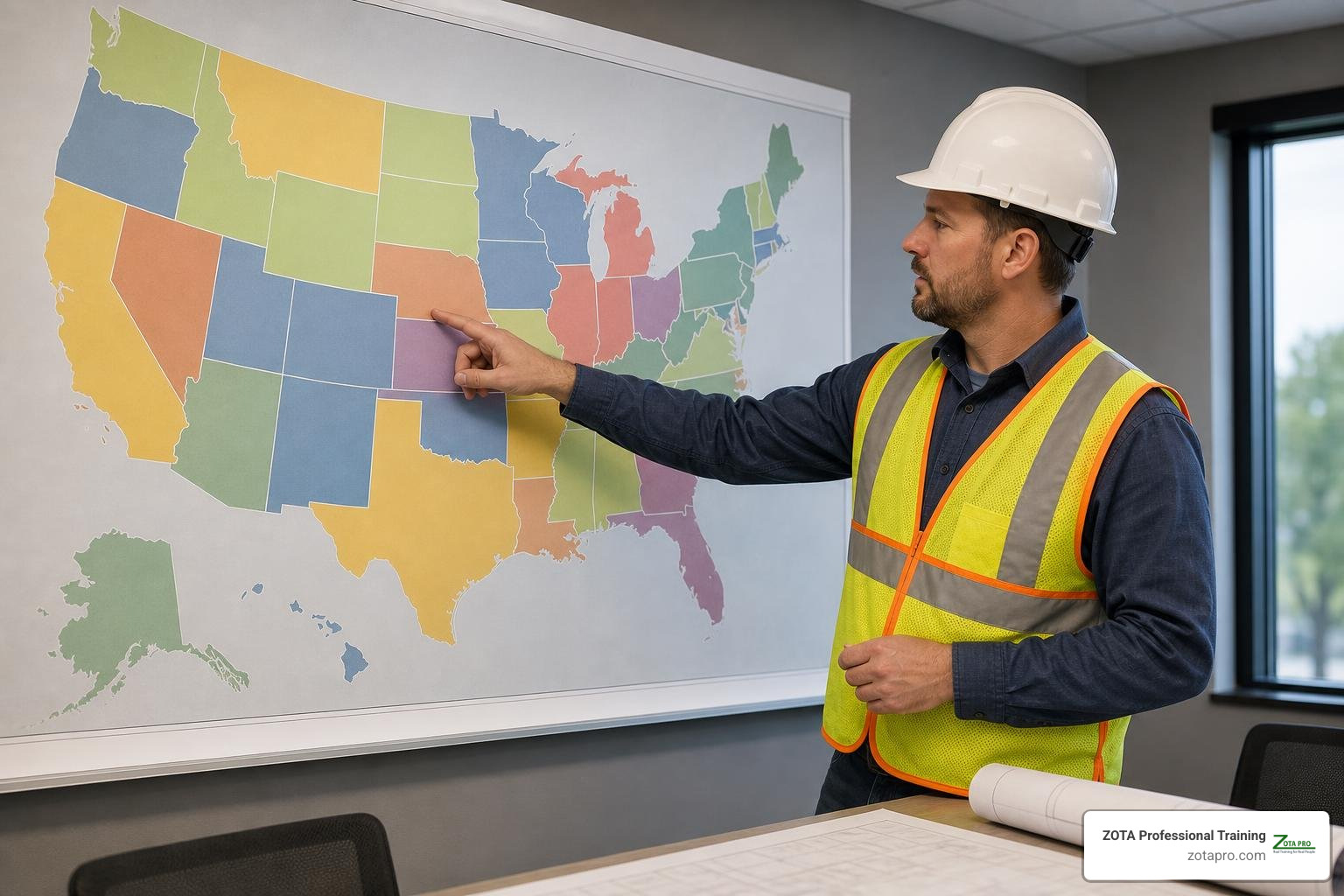
The Reciprocity Trap: If you plan to bid on projects across state lines, you must verify reciprocity agreements beforehand. For instance, taking an EPA-accredited course in Florida (an EPA-controlled state) does not automatically license you to perform work in North Carolina (an EPA-authorized state).
Furthermore, to obtain your official state or federal license for professional abatement disciplines (Supervisor, Inspector, or Risk Assessor), you must pass a mandatory third-party examination in addition to your course exam. This third-party exam usually costs around $70 to $75 per attempt.
Failing to understand these jurisdictional boundaries can result in work stoppages and severe civil penalties. The EPA and authorized state agencies actively enforce these laws, with civil fines reaching up to $37,500 per day for uncertified firms or individuals. To learn more about how proper credentials can open doors to lucrative municipal and federal contracts, read our analysis of the EPA Lead Abatement Certification Benefits for Contractors and Inspectors.
How to Become a Certified Lead Professional in North Carolina
If you operate in North Carolina, you are working within an EPA-authorized state with highly specific rules. You cannot simply take any national online course and begin working.
Since July 31, 2010, all training providers and their renovator or dust sampling technician courses taught in North Carolina for certification purposes must be accredited directly by the state. This program is managed by the North Carolina Health Hazards Control Unit (HHCU).
To become a certified lead professional in North Carolina, you must follow a strict, state-mandated process:

All lead management activities in the state are governed under N.C. General Statutes §130A-453.22 through 453.31 and the administrative rules in 10A NCAC 41C .0900-.0907. These regulations split lead hazard management into two primary programs:
- Lead Abatement (LHMP): For permanent hazard elimination projects.
- Lead Renovation, Repair, and Painting (LHMP-RPR): For standard renovation work that disturbs lead paint.
If you are a training provider looking to offer classes in North Carolina, or a contractor trying to verify if a course is valid for state certification, you must contact the Health Hazards Control Unit directly at 919-707-5950 to obtain the necessary application forms and verify accreditation status.
Frequently Asked Questions about Lead Certification
Staying compliant means having clear answers to your regulatory questions. Here are the most common inquiries we receive from contractors and environmental professionals.
What is the difference between lead abatement and RRP renovator certifications?
The difference comes down to the intent of the work and the permanence of the solution:
- Lead Abatement: Abatement refers to any set of measures designed to permanently eliminate lead-based paint hazards. This includes physical soil removal, paint stripping, encapsulation, or complete enclosure. Abatement projects are typically ordered by public health departments or housing authorities and must be overseen by a certified Lead Abatement Supervisor.
- Lead Renovation, Repair, and Painting (RRP): RRP projects are routine construction, remodeling, or maintenance activities that disturb lead-based paint but do not intend to permanently eliminate it. This includes activities like window replacement, remodeling a kitchen, or repainting a room. Anyone performing RRP work in pre-1978 target housing or child-occupied facilities must be a Certified Renovator and follow lead-safe work practices.
How long are lead certification credentials valid before requiring a refresher?
The validity of your credentials depends on your discipline and your local jurisdiction:
- Renovator (RRP) Certification: Typically valid for 5 years. You must complete a half-day (4-hour) refresher course before your current certificate expires. If you let your certificate expire by even one day, you must retake the full 8-hour initial course.
- Abatement Worker, Supervisor, Inspector, and Risk Assessor: Typically valid for 3 years in most jurisdictions (though some states like Virginia allow up to 5 years for proficiency-based refresher courses).
At ZOTA Professional Training, we offer flexible hybrid and online refresher options to help you keep your credentials active without losing valuable time on the job site.
What are the penalties for performing lead-based paint activities without certification?
The financial consequences of working without proper certification are severe. The EPA enforces the Lead-Safe RRP Rule and abatement standards strictly:
- Federal Civil Penalties: The EPA can issue civil fines of up to $37,500 per violation, per day for uncertified individuals or firms performing work in pre-1978 housing.
- State-Level Enforcement: State agencies (like the HHCU in North Carolina or the DPOR in Virginia) can issue additional stop-work orders, revoke general contracting licenses, and impose independent state fines.
- Criminal Liabilities: In cases of willful or egregious violations—such as knowingly exposing children to toxic lead dust and falsifying cleanup records—contractors can face criminal prosecution and jail time.
Conclusion
Obtaining your lead certification is more than just a legal box to check—it is a critical investment in your business’s reputation, your workers’ safety, and your financial security. With regulatory standards tightening in 2026, staying ahead of dust-lead action levels is the only way to avoid devastating fines.
At ZOTA Professional Training, we make regulatory compliance simple. We provide EPA-accredited lead, asbestos, mold, and OSHA safety certification courses in flexible formats, including in-person, hybrid, and fully online options. Whether you need multilingual (English/Spanish) training for your crew or nationwide on-site support for a large team, we have you covered.
Don’t risk your livelihood on an uncertified job site. Take the next step toward career advancement and absolute compliance today by visiting our RRP and Lead Certification Portal to find a local or online class that fits your schedule!