

Core Types and Standards for OSHA Safety Training
OSHA safety training encompasses foundational 10-Hour and 30-Hour Outreach courses, specialized hazard programs (such as lockout/tagout and confined space entry), and HAZWOPER certifications designed to educate workers and maintain regulatory compliance across industrial jobsites. These programs ensure entry-level personnel and supervisors understand site hazards, protective controls, and safety standards.
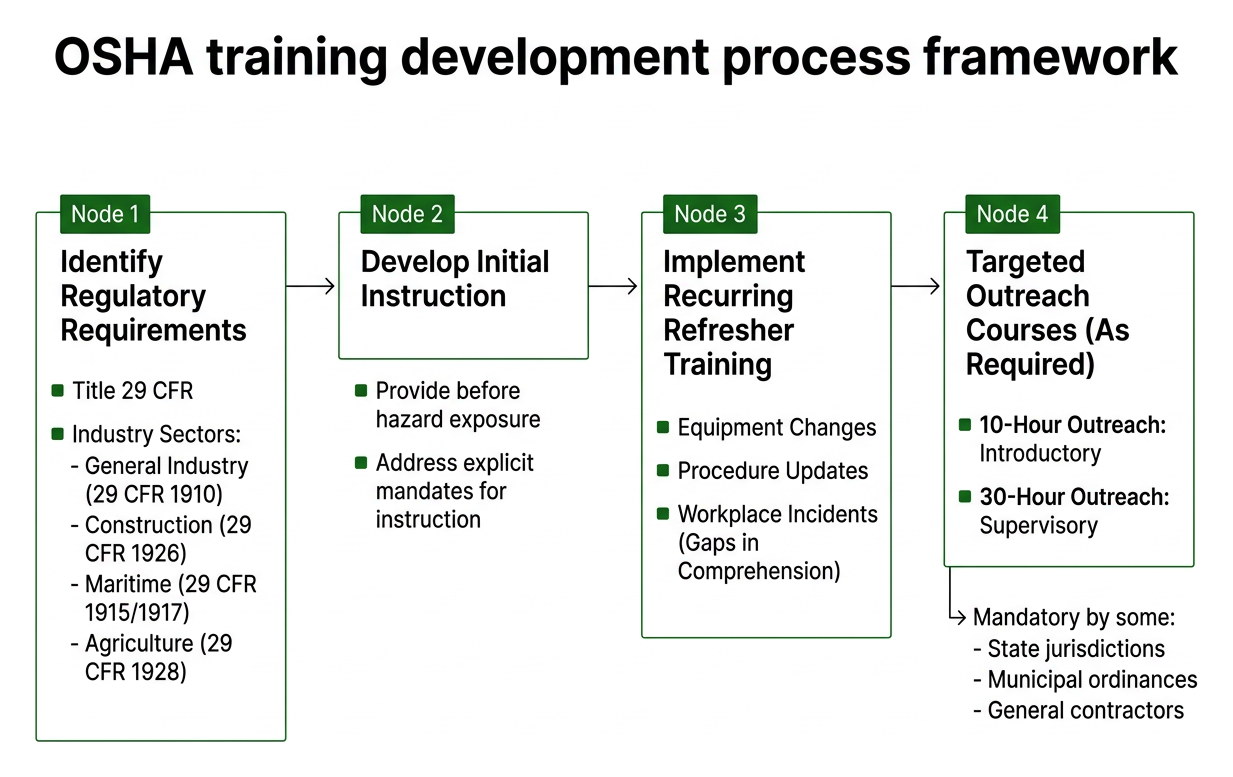
Federal safety regulations rest on the Occupational Safety and Health Act of 1970 and its General Duty Clause, which requires every employer to maintain a workplace free from recognized hazards. Under Title 29 of the Code of Federal Regulations (29 CFR), safety mandates are divided into specific industry sectors: General Industry (29 CFR 1910), Construction (29 CFR 1926), Maritime (29 CFR 1915/1917), and Agriculture (29 CFR 1928).
More than 100 federal standards contain explicit mandates for instruction. According to the official Training Requirements in OSHA Standards, employers cannot simply assume a new hire understands jobsite hazards. Initial instruction must occur before exposure to risks, with recurring refreshers whenever equipment changes, procedures update, or workplace incidents reveal gaps in comprehension. Meeting these osha compliance requirements that keep businesses safe protects both worker health and business operations.
Comparing OSHA Safety Training: 10-Hour vs. 30-Hour Outreach Courses
The OSHA Outreach Training Program offers introductory and supervisory courses designed to build hazard awareness. While federal OSHA does not legally mandate outreach cards nationwide, many state jurisdictions, municipal ordinances, and general contractors make them mandatory conditions of employment.
| Course Feature | OSHA 10-Hour Outreach | OSHA 30-Hour Outreach |
|---|---|---|
| Primary Audience | Entry-level tradespeople and general laborers | Foremen, supervisors, safety coordinators, and managers |
| Curriculum Focus | Basic hazard recognition, fall protection, personal protective equipment (PPE), worker rights | Comprehensive hazard abatement, managing safety programs, job hazard analyses, regulatory subparts |
| Mandatory Daily Cap | Maximum 7.5 hours of instruction per day | Maximum 7.5 hours of instruction per day |
| Completion Credential | Official Department of Labor (DOL) 10-Hour Wallet Card | Official Department of Labor (DOL) 30-Hour Wallet Card |
| Industry Tracks | Construction, General Industry, Maritime, Disaster Site | Construction, General Industry, Maritime |
Deciding who needs osha 10 vs osha 30 training comes down to job responsibilities. Entry-level field staff benefit from foundational instruction such as 10 hour construction industry training. Conversely, team leads and plant managers need broader compliance coursework through 30 hour general industry training to manage complex site safety programs effectively.
Mandatory Industry Standards and HAZWOPER Courses

Outreach cards provide foundational awareness, but high-risk operations demand specialized certifications. Operations involving toxic materials fall under 29 CFR 1910.120, which governs Hazardous Waste Operations and Emergency Response. Workers evaluating their project needs should review the distinctions between 40 hour vs 24 hour hazwoper training to match their on-site exposure risk.
Beyond emergency response, standard operations require targeted coursework:
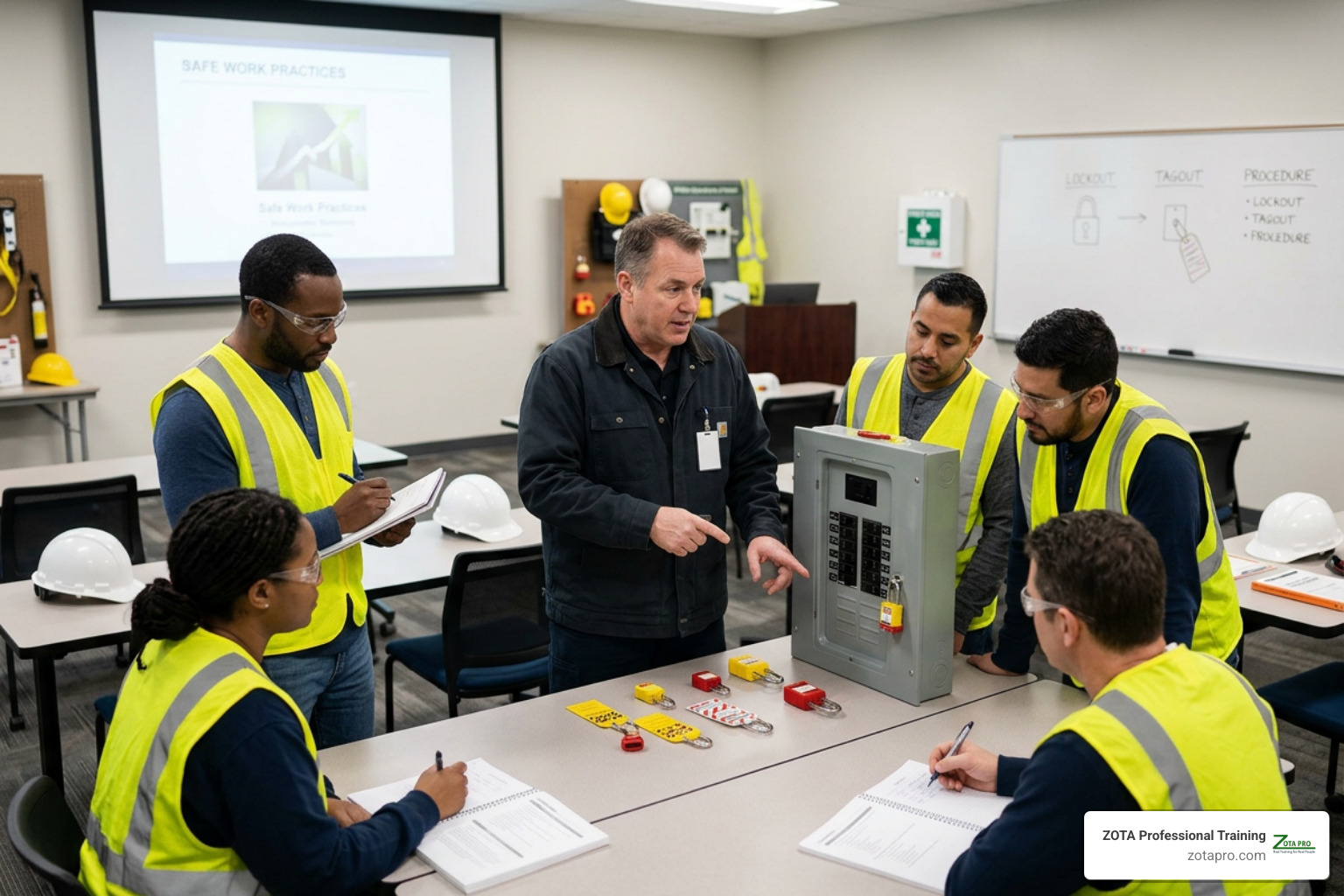
- Hazardous Energy Control: Preventing accidental machinery startup using hazardous energy lock out tag out protocols.
- Confined Space Entry: Mitigating atmospheric and physical hazards in confined spaces under 29 CFR 1910.146 and 1926 Subpart AA.
- Toxic Dust and Pathogens: Engineering controls for respirable crystalline silica, bloodborne pathogens, and airborne lead.
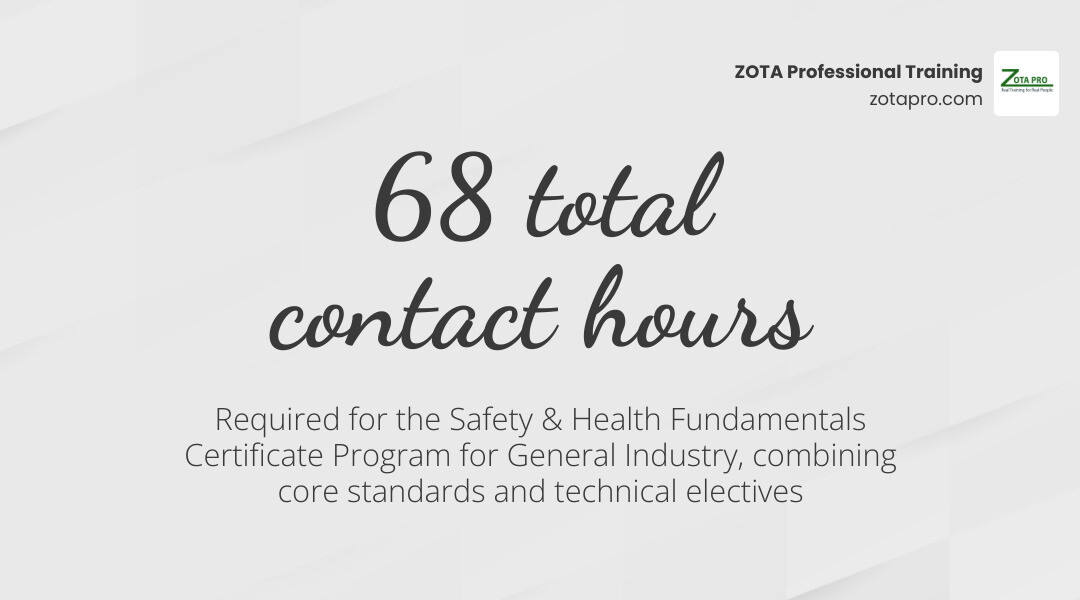
Professionals seeking comprehensive development can pursue programs like the Safety & Health Fundamentals Certificate Program for General Industry, which requires 68 total contact hours combining core standards and technical electives.
Delivering Compliant Training and Managing Credentials
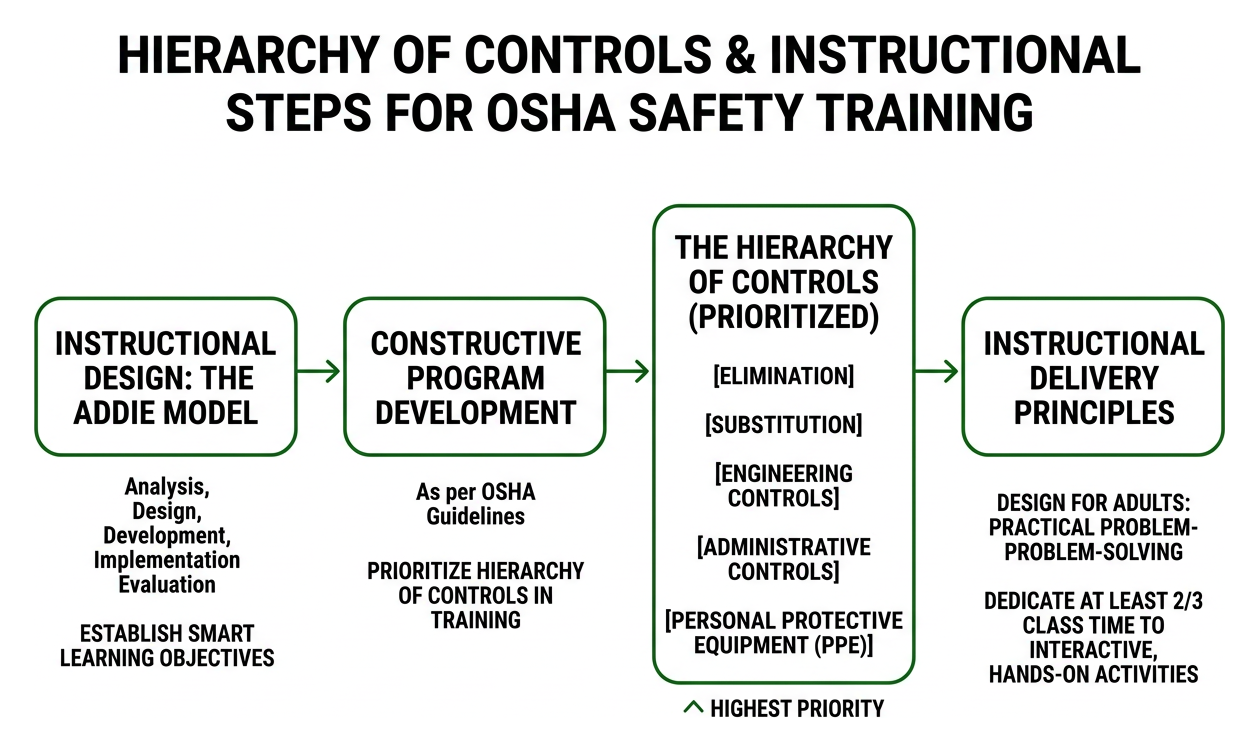
Effective safety education requires structured instructional design. Employers should build programs using the ADDIE model (Analysis, Design, Development, Implementation, Evaluation) and establish SMART learning objectives. As outlined in the federal Safety Management – Education and Training guidelines, programs must instruct workers in the hierarchy of controls—prioritizing elimination, substitution, and engineering controls over personal protective equipment.
Integrating these structured principles establishes sustainable, proactive safety programs for osha in the workplace.
Best Practices for Designing Adult OSHA Safety Training
Adults learn best through practical problem-solving rather than passive lectures. According to OSHA’s Resource for Development and Delivery of Training to Workers, effective instruction should dedicate at least two-thirds of class time to interactive, hands-on activities.
Key principles for successful instructional delivery include:
- Optimal Class Ratios: Maintain an instructor-to-student ratio near 25:1, adding a co-instructor whenever classes exceed 30 participants.
- Active Engagement: Use mock hazard hunts, equipment inspections, and tabletop emergency drills to reinforce retention.
- Formative Feedback: Gauge comprehension through ongoing skill demonstrations rather than relying solely on a high-stakes final exam.
Structured instructional design explains how osha compliance training courses help businesses stay safe while reducing lost-time incidents and equipment damage.
Ensuring Multilingual Access for Diverse Workforces
Under federal law, employers must provide instruction in a language and vocabulary that workers understand. Clear communication is critical for high-hazard topics, such as chemical labels governed by hazard communications globally harmonized system standards.
When training workers with limited English proficiency or varying literacy levels, programs should integrate:
- Primary-language materials and certified bilingual instructors.
- Visual training aids, including pictograms, color-coded signage, and video demonstrations.
- Safe reporting cultures where employees can ask questions and report near-misses without fear of retaliation.
Federal initiatives, including the Susan Harwood Training Grant program and targeted national campaigns, demonstrate the necessity of accessible materials to prevent severe osha violations and serious workplace injuries.
Obtaining DOL Cards, Replacements, and OTI Education Resources
Official 10-hour and 30-hour wallet cards are issued exclusively by the U.S. Department of Labor through OSHA-authorized trainers and OSHA Training Institute (OTI) Education Centers. OSHA regularly audits authorized instructors and publishes an Outreach Trainer Watch List to prevent fraudulent credentialing.
If a worker loses their plastic DOL wallet card, a replacement can only be issued through the original trainer if the course was completed within the previous five years. Because federal OSHA does not archive individual student rosters, maintaining organized internal training records is critical for every company.
At ZOTA Professional Training, we deliver accredited osha compliance training tailored for contractors, environmental specialists, and industrial facilities. Whether your team requires hybrid, on-site, or bilingual coursework, our programs ensure full regulatory alignment and practical protection for your workforce across every jobsite. To evaluate your organization’s regulatory standing and schedule upcoming courses, explore our guidance on maintaining compliant osha in the workplace standards.