

Core OSHA Construction Bridge Building Fall Protection Standards
OSHA construction bridge building standards mandate fall protection at a 6-foot trigger height for walking-working surfaces under 29 CFR 1926 Subpart M, a 10-foot threshold for scaffolds and temporary work bridges under Subpart L, and strict working over water safety measures—including Coast Guard-approved life vests, ring buoys, and lifesaving skiffs—under 29 CFR 1926.106. Establishing robust physical barriers and understanding essential OSHA safety standards for construction workers are the absolute baseline for keeping bridge crews safe across unforgiving highway, canyon, and river projects.
OSHA divides conventional fall protection into two main approaches: fall prevention systems (passive or active barriers that physically prevent a worker from reaching an edge) and fall arrest systems (systems designed to safely stop a worker who is already falling).
| Fall Protection Category | Primary Systems Included | Function & Purpose | Common Bridge Construction Applications |
|---|---|---|---|
| Fall Prevention (Passive & Restraint) | Standard Guardrails, Parapets, Travel Restraint Lanyards | Stops workers from physically reaching an unprotected fall hazard. | Completed bridge decks, piers, abutments, and long-term staging areas. |
| Fall Arrest (Active Catching) | Personal Fall Arrest Systems (PFAS), Safety Net Systems | Safely stops a worker after a fall begins, absorbing shock forces. | Steel girder erection, leading-edge formwork, and catenary scaffolding. |
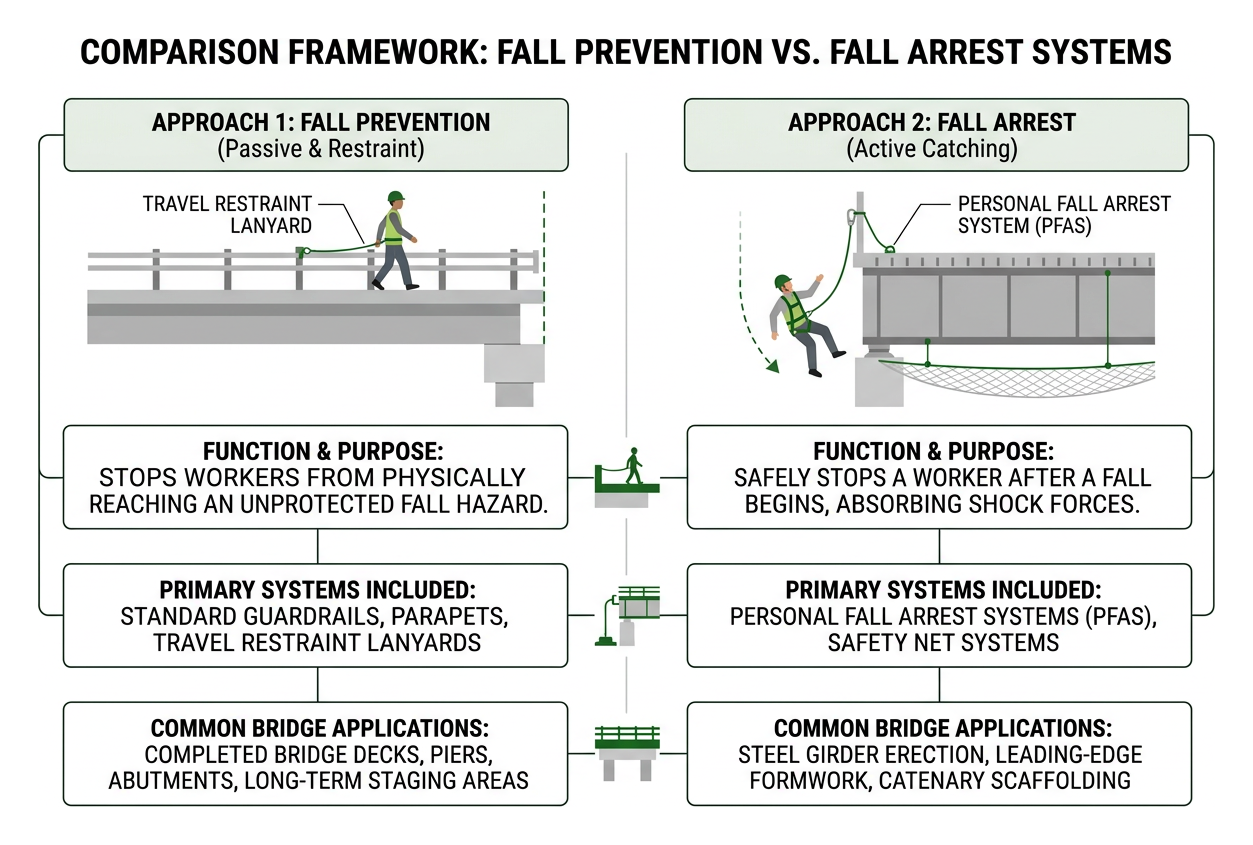
Conventional Systems and Height Thresholds in OSHA Construction Bridge Building
Under 29 CFR 1926 Subpart M, OSHA establishes a 6-foot trigger height for walking-working surfaces with unprotected sides or edges. However, bridge operations frequently mix multiple standards. While general deck work triggers fall protection at 6 feet, temporary work staging and scaffolding follow 29 CFR 1926 Subpart L, which triggers fall protection at 10 feet.
Standard guardrails are the primary passive defense on elevated spans. To meet OSHA criteria:
- Top Rail Height: Must be installed between 39 and 45 inches above the working surface.
- Top Rail Strength: Must withstand a downward or outward force of at least 200 pounds without failing. (Fun fact: that is roughly equal to a full-grown worker slipping and slamming their entire weight against the rail alongside their toolbox).
- Midrail Strength: Installed midway between the top edge and deck level, capable of resisting at least 150 pounds of force.
- Toeboards: Minimum 3.5 inches in vertical height, capable of withstanding 50 pounds of force to prevent tools and debris from falling onto lower work areas or waterway vessels.
When guardrails are unfeasible, safety nets serve as a reliable secondary barrier. Safety nets must be installed as close as practicable beneath the working deck—and never more than 30 feet below the walking-working surface. Netting must extend outward from the outermost work surface between 8 to 13 feet depending on the vertical drop distance. Practical guidelines from the Technical Advice: Fall Protection in Bridge Construction, Inspection, and Maintenance document emphasize that routine net drop-testing and clearance verification protect workers from striking structural piers below during a fall. Identifying these elevated risks early is vital to eliminating common construction hazards.
Personal Fall Arrest Systems and Scaffold Classifications in OSHA Construction Bridge Building
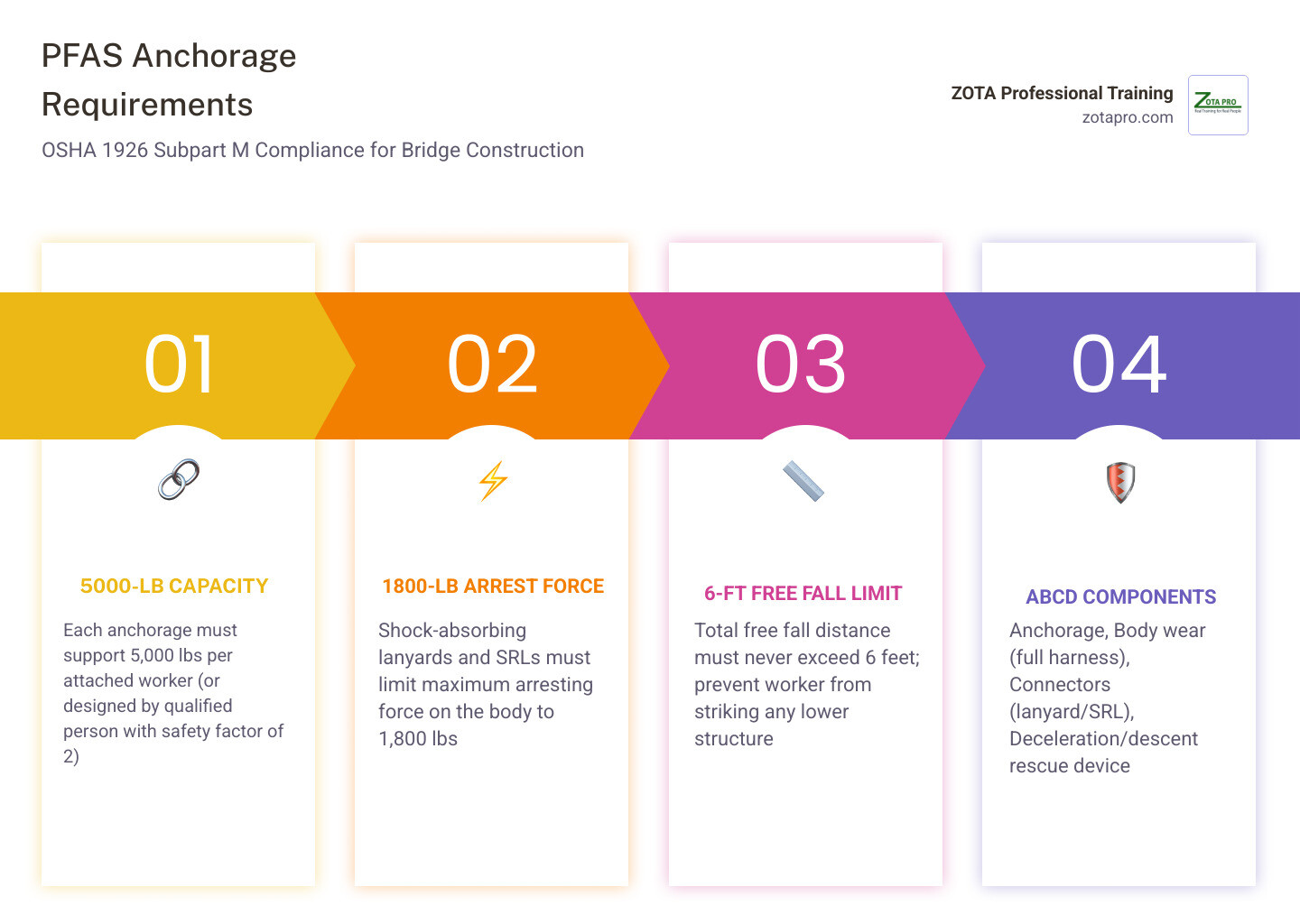
When passive barriers are impossible, a Personal Fall Arrest System (PFAS) becomes mandatory. Every PFAS relies on the fundamental A-B-C-D system components:
- A – Anchorage: An unyielding secure point of attachment capable of supporting at least 5,000 pounds per attached worker (or designed by a qualified person as part of a complete system maintaining a safety factor of two).
- B – Body Wear: A full-body harness that distributes impact forces across the thighs, pelvis, waist, chest, and shoulders.
- C – Connectors: Shock-absorbing lanyards, self-retracting lifelines (SRLs), or deceleration devices engineered to limit maximum arresting forces on the human body to 1,800 pounds.
- D – Deceleration / Descent Rescue: Energy absorbers that limit the total free fall distance to no more than 6 feet and prevent the worker from contacting any lower structure.
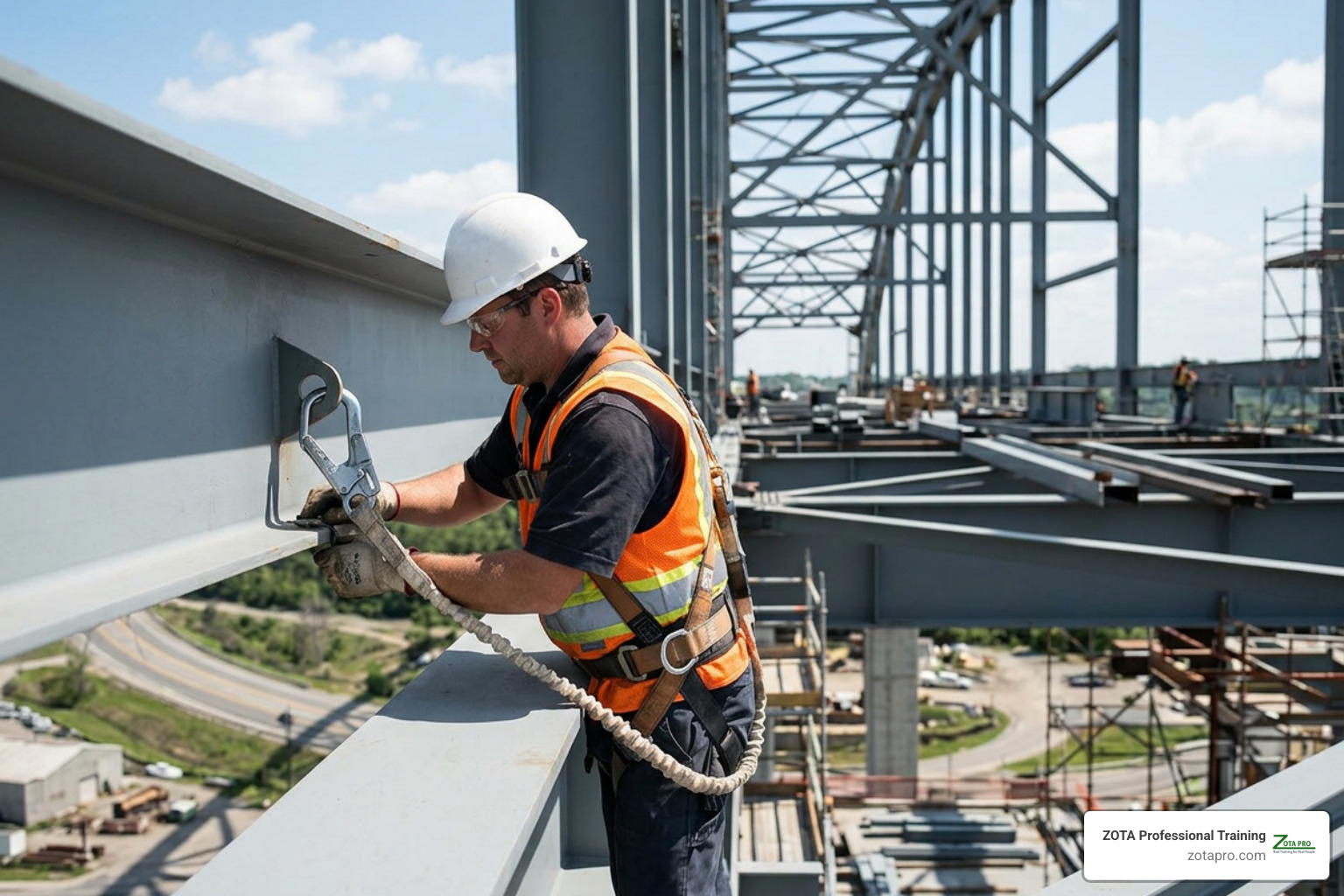
A common point of confusion during river crossings involves temporary structures like work docks and work bridges. Contractors often classify these as material staging paths. However, OSHA standard interpretations clarify that temporary platforms, catwalks, and narrow concrete screed bridges qualify as scaffolds under 29 CFR 1926.450(b).
OSHA outlines in its guidance on fall protection requirements for work docks/bridges used during bridge construction that the 10-foot scaffold threshold applies. Similarly, OSHA’s interpretation regarding fall protection requirements for employees working from a “work bridge” in concrete construction work reinforces that even if a manufacturer stamps equipment with “not a scaffold,” any elevated temporary working platform over 10 feet must feature compliant guardrails or PFAS. Workers moving along these spans need proper gear and comprehensive OSHA personal protective equipment training to avoid dangerous missteps.
Critical Safety Protocols for Complex Bridge Tasks and Environmental Hazards
Bridge engineering presents dynamic hazards ranging from shifting concrete loads to rapid river currents. Specialized bridge building operations demand strict mechanical checks, structural load assessments, and specialized employee training.
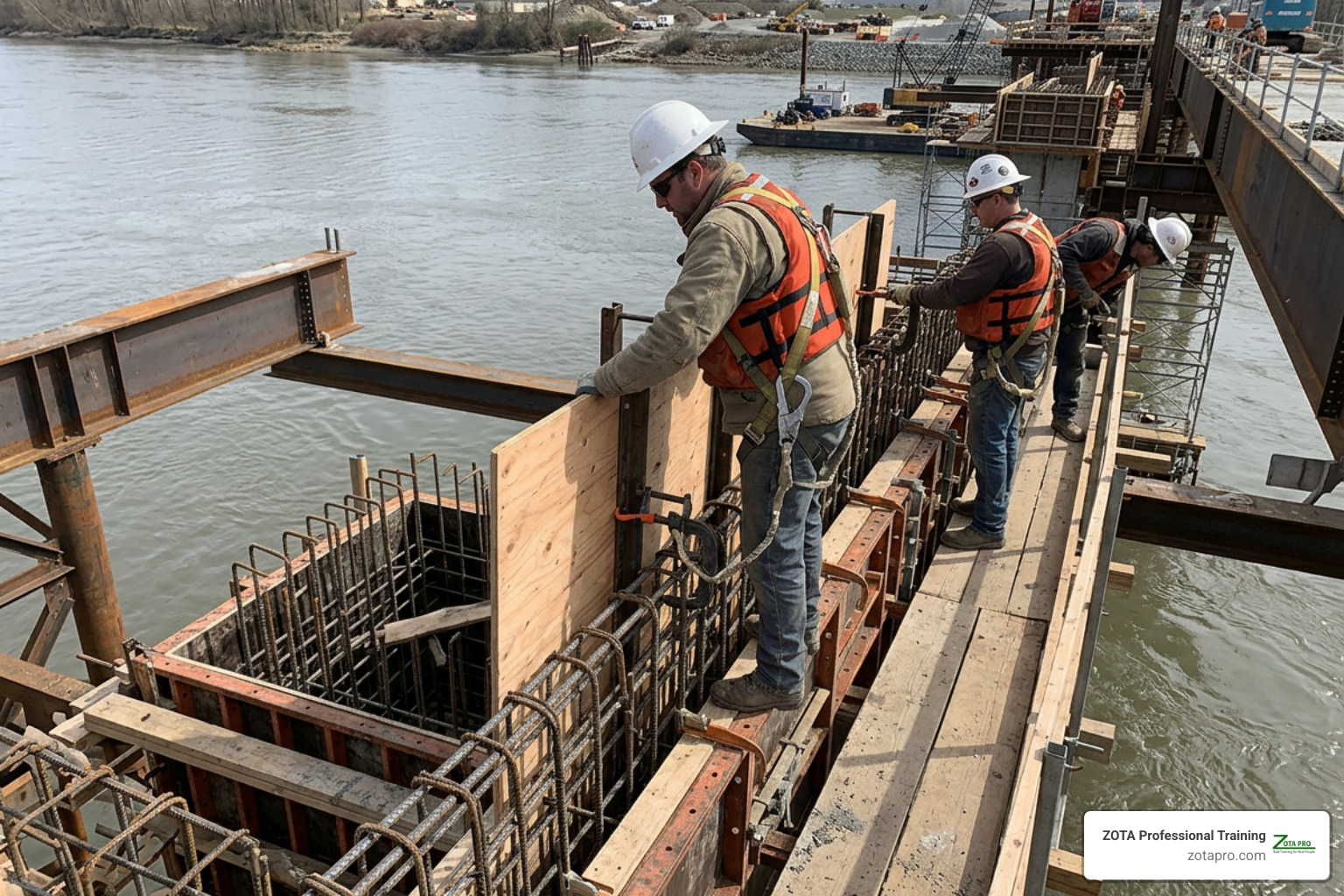
Comprehensive site management starts with meeting the formal OSHA training requirements for the construction industry before crews set foot on elevated steel or floating barges.
Specialized Tasks: Formwork Integrity, Steel Erection, and Leading Edges
Bridge deck and substructure work involves intense structural stresses. When pouring concrete columns and pier caps, formwork must strictly conform to 29 CFR 1926.703(a)(1) and ACI-347 engineering limits.
The catastrophic danger of formwork failure was documented in the Investigation of the June 14, 2007, Incident at U.S. Highway 90 across St. Louis Bay, Pass Christian, MS. In that incident, high-slump concrete placed at an excessive rate (11 feet 8 inches per hour versus the recommended 2 to 8 inches per hour) generated an estimated hydrostatic pressure of 5,050 psf on forms rated for only 1,000 psf. The column formwork burst, demonstrating that monitoring pour rates, mix slump, and lateral concrete pressures is a vital life-safety duty.
Structural steel erection brings distinct tripping and fall risks. Under 29 CFR 1926.754(c)(1), shear connectors (such as headed steel studs) cannot be attached to top flanges in the fabrication shop if they create tripping hazards for ironworkers walking top steel. OSHA clarified that bridge construction will not be exempted from the sheer connector requirements of 1926.754(c)(1). Shear studs must be field-welded only after deck installation is completed, turning the deck into a flat walking platform.
Furthermore, bridge rehabilitation frequently employs suspended containment scaffolds. In its clarification of 1926.451(a)(6) requirements for scaffolds and bridge-painting projects, OSHA confirmed that chain-link envelope scaffolds cannot be evaluated by simple visual checks. They require rigorous structural analysis by a registered professional engineer to guarantee a 4:1 safety factor for structural components and a 6:1 factor for suspension cables. Supervisors managing these complex operations benefit tremendously from advanced OSHA 30-Hour Construction Industry Training.
Working Over Water Requirements and Emergency Rescue Operations
Building over navigable waterways introduces the risk of drowning alongside fall hazards. Under 29 CFR 1926.106, employers must implement three non-negotiable marine safety measures:
- Coast Guard-Approved PFDs: Employees working over or adjacent to water where the danger of drowning exists must wear U.S. Coast Guard-approved life jackets or buoyant work vests.
- Ring Buoys: Readily accessible ring buoys with at least 90 feet of line must be positioned along the bridge structure and docks at intervals not exceeding 200 feet.
- Dedicated Lifesaving Skiff: At least one motorized, readily accessible rescue boat must be stationed in the water immediately below operations, equipped for immediate emergency launch.
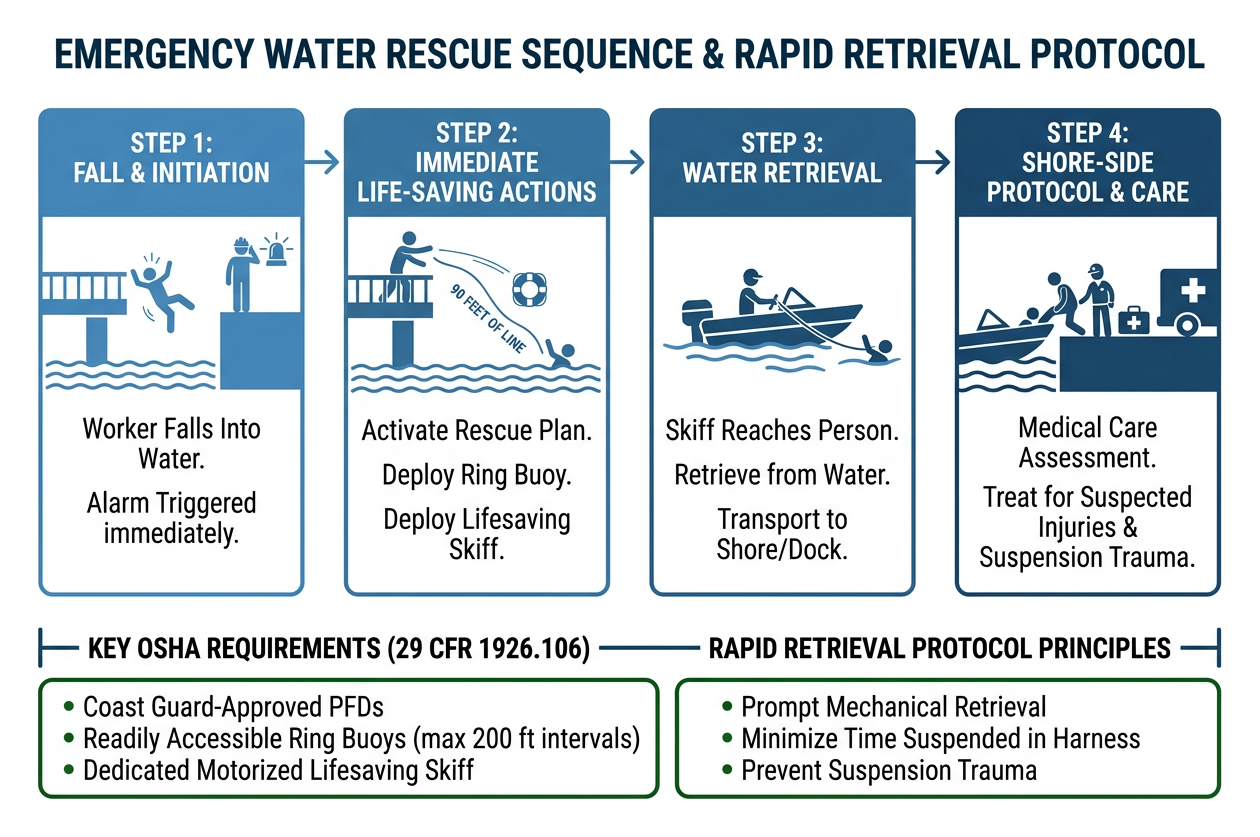
Water safety protocols must also account for suspension trauma. If a worker falls into a harness over water or land, venous pooling in the legs can cause unconsciousness or death within minutes. Emergency rescue plans must detail prompt mechanical retrieval methods to rescue suspended employees rapidly. Frontline field crews should hold foundational OSHA 10-Hour Construction Industry Training to recognize these life-threatening hazards instantly.
Fall Protection Programs, Competent Persons, and Alternative Plans
A safe bridge project relies on clear safety roles. OSHA distinguishes between two primary safety designations:
- Competent Person: One capable of identifying existing and predictable fall hazards in the surroundings, with the authorized power to take prompt corrective measures or stop work immediately.
- Qualified Person: One who holds a recognized degree, certificate, or professional standing (such as a structural PE) and has successfully demonstrated the ability to solve engineering problems related to bridge erection, anchorage design, and scaffold loading.
Before any crew member steps onto a bridge span, a Competent Person must inspect all personal fall arrest gear, lifelines, and guardrails at the start of each work shift.
When conventional fall protection systems (guardrails, nets, or PFAS) are demonstrably unfeasible or create a greater hazard during unique leading-edge operations, 29 CFR 1926.502(k) permits an Alternative Fall Protection Plan. This plan must:
- Be prepared specifically for the site by a Qualified Person.
- Be approved and overseen by a Competent Person.
- Document why conventional systems cannot be used.
- Designate clearly demarcated Controlled Access Zones (CAZ) restricting entry to trained personnel.
- Include a safety monitoring system if no other physical barrier exists.
At ZOTA Professional Training, we deliver expert, bilingual safety courses designed to help bridge contractors maintain OSHA compliance and protect field crews nationwide. Earning recognized safety certifications for construction to advance your career equips site leaders with the skills needed to design safe rigging and structural access.
Understanding the differences between OSHA 10 and OSHA 30 training helps project executives choose the right training pathways for laborers, foremen, and safety coordinators. By pairing compliant fall protection systems, qualified engineering, and hands-on workforce training, your bridge projects will consistently stay safe, productive, and fully compliant.