

Why a Certified Lead-Based Paint Inspector Matters
A lead-based paint inspector is a certified professional who identifies whether lead-based paint is present in a home or child-occupied facility and documents where it is found. For a pre-1978 renovation project, hire an inspector certified by the EPA or your authorized state, tribal, or territorial program before work begins – especially if painted surfaces are damaged or will be disturbed.
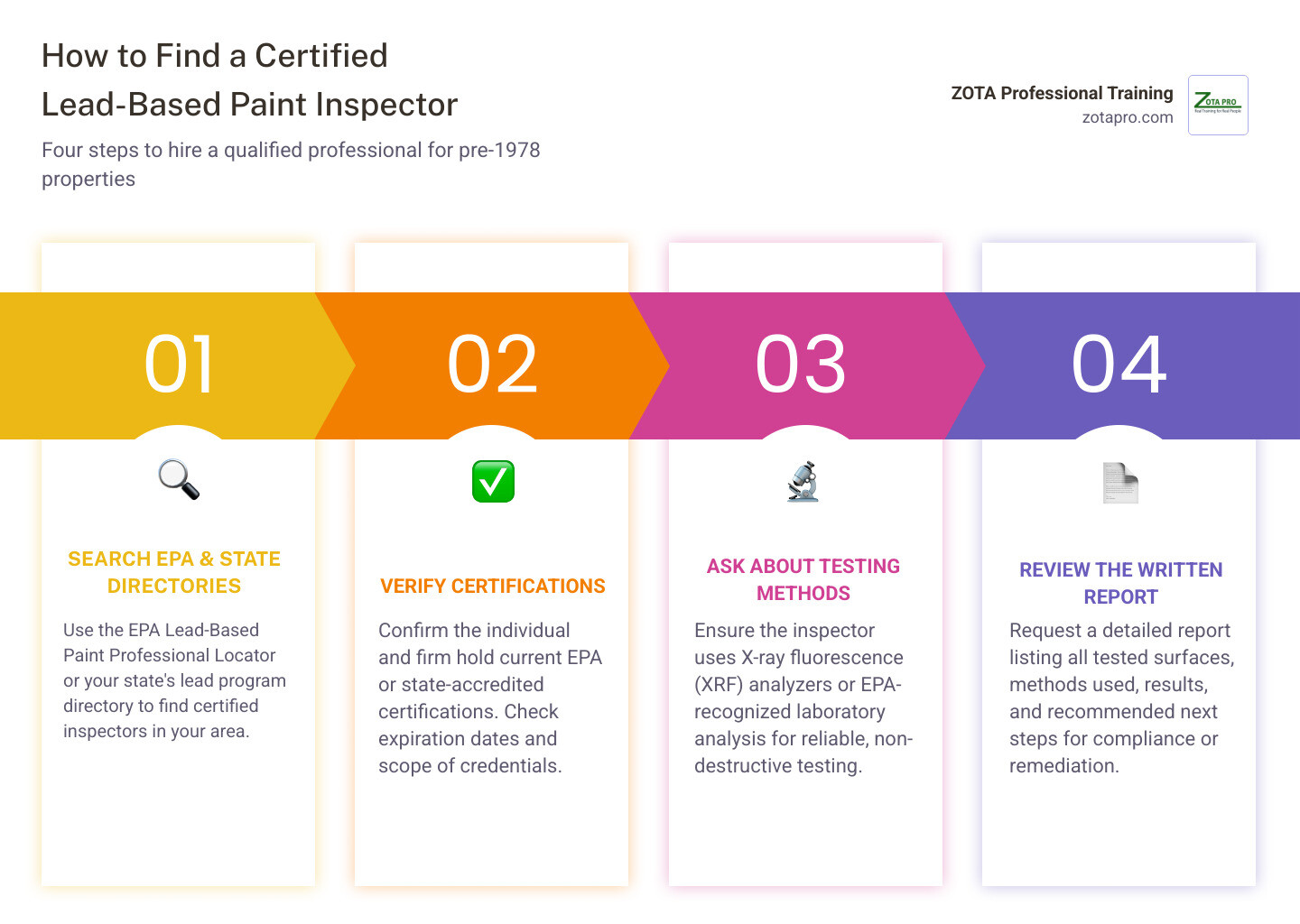
To find the right professional:
- Search the EPA Lead-Based Paint Professional Locator or your state lead program directory.
- Verify the individual’s current certification and the firm’s certification, if required.
- Ask whether they use X-ray fluorescence (XRF) testing and/or EPA-recognized laboratory analysis.
- Request a written report that identifies tested surfaces, methods, results, and next steps.
This is not a minor concern. About three-quarters of U.S. homes built before 1978 still contain some lead-based paint. When old paint peels, chips, or turns into dust during repair work, it can create a serious exposure risk – particularly for young children.
A qualified inspection gives contractors and property owners a defensible starting point. It can help you plan lead-safe renovation work, determine whether a risk assessment or abatement is needed, and meet local rules that may apply to rentals, tenant turnover, or child-occupied buildings.
I am Bob Zak, Founder and CEO of ZOTA Professional Training, with more than 32 years of occupational health and safety experience. I have helped contractors build the practical knowledge needed to work safely alongside a lead-based paint inspector and meet EPA, asbestos, mold, and OSHA training requirements.
How to Choose a Certified Lead-Based Paint Inspector

Selecting the right professional requires looking beyond a simple online search. Because lead regulations carry strict legal liability and public health implications, hiring someone without proper state or federal accreditation can invalidate your compliance records and expose occupants to serious health risks.
When evaluating candidates, consult the official EPA Lead-Based Paint Professional Locator or your authorized state health department database. Confirm that both the individual inspector and their employing firm hold active licenses. Never hesitate to ask for a copy of their state-issued credential card and certificate of liability insurance.
To maintain compliance and objectivity, hire a third-party inspector who has no financial stake in performing abatement or repair work on the property. Independent inspectors eliminate conflicts of interest, ensuring you receive an unbiased report and valid post-abatement clearance testing. Whether you manage commercial multi-family portfolios or single-family properties, you can explore comprehensive EPA lead certification programs to better understand what certified experts are required to deliver on-site.
What Does a Lead-Based Paint Inspector Do?
A lead inspector performs a thorough, surface-by-surface investigation to determine the presence, location, and exact concentration of lead-based paint across all coated building components. Rather than guessing which layers of historic enamel contain toxic pigments, inspectors evaluate every interior and exterior architectural feature—including baseboards, window sills, door frames, soffits, and siding.
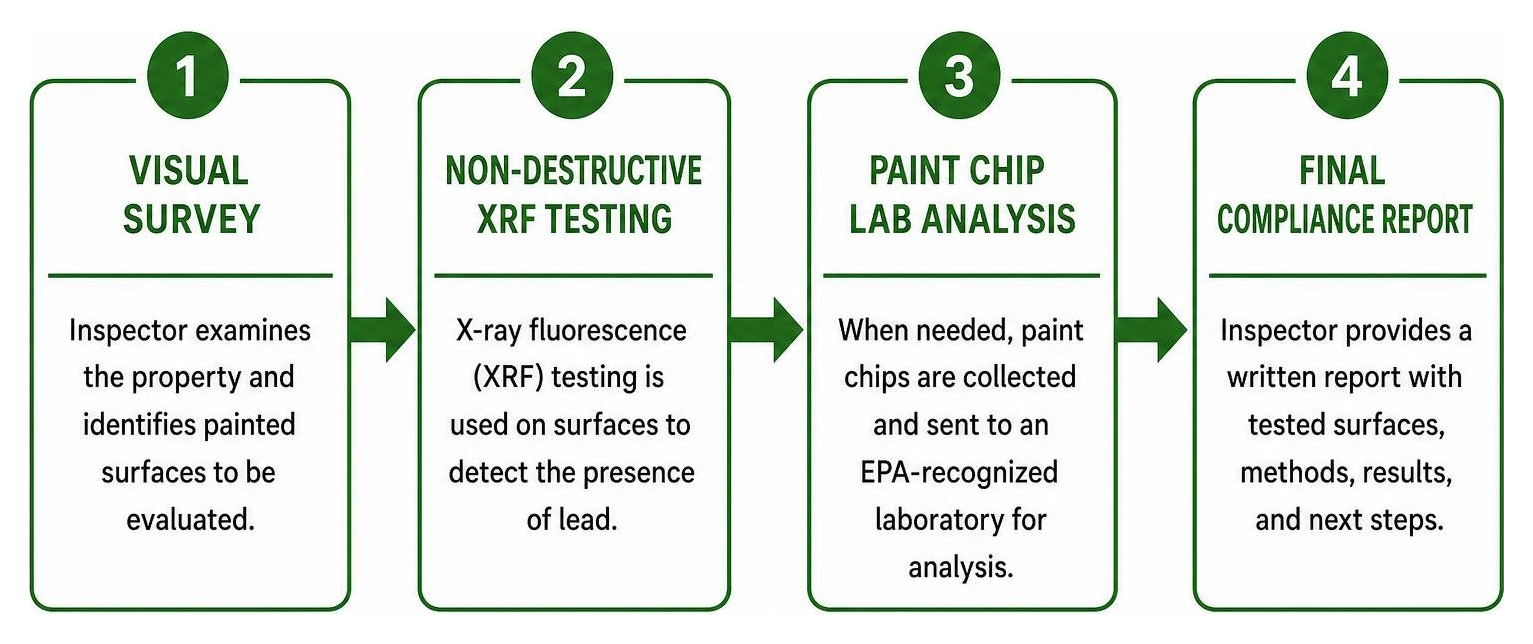
During this process, inspectors primarily use non-destructive testing tools alongside selective physical sampling. When field conditions require laboratory confirmation, the inspector collects physical paint chips and submits them to an environmental laboratory accredited under the National Lead Laboratory Accreditation Program (NLLAP). Every step follows standardized protocols established by the U.S. Department of Housing and Urban Development (HUD) Guidelines for the Evaluation and Control of Lead-Based Paint Hazards in Housing (specifically Chapter 7).
Federal regulations under § 745.226 – Certification of individuals and firms engaged in lead-based paint activities: target housing and child-occupied facilities require inspectors to document all testing locations, instrument calibration logs, and analytical findings in a comprehensive written report. To learn more about standard on-site procedures, read our guide understanding what happens during a lead paint inspection.
Lead Inspector vs. Risk Assessor: Understanding the Roles
Property owners frequently confuse lead inspectors with lead risk assessors. While their skill sets overlap, their legal scopes of practice serve distinct regulatory functions.
- Lead Inspector: Identifies the presence and exact location of lead-based paint on every painted surface, regardless of whether the paint is intact or deteriorating. An inspection tells you where lead exists.
- Lead Risk Assessor: Identifies lead hazards. In addition to conducting paint testing, a risk assessor samples settled dust on floors and window sills, evaluates bare residential soil, inspects deteriorating paint films, determines the cause of paint failure, and designs occupant protection plans with actionable interim controls.
Under regulations like the Texas Environmental Lead Reduction Rules (TELRR) and standard EPA frameworks, certified risk assessors are also authorized to perform all duties of a certified inspector. For an in-depth breakdown of these career tracks and scopes, see our article comparing lead inspectors and risk assessors and review our overview of lead paint certification types.
| Responsibility / Feature | Certified Lead Inspector | Certified Lead Risk Assessor |
|---|---|---|
| Primary Objective | Determine lead presence and concentration on all painted surfaces | Identify active lead hazards in paint, dust, and bare soil |
| Testing Methods | XRF analyzer, selective paint chip sampling | XRF, dust wipes, soil core sampling, visual degradation scoring |
| Hazard Evaluation | No (reports presence/absence only) | Yes (evaluates severity and exposure pathways) |
| Actionable Recommendations | No (does not prescribe hazard controls) | Yes (provides interim controls and abatement strategies) |
| Post-Abatement Clearance | Conducts visual inspection and clearance dust sampling | Conducts visual inspection and clearance dust sampling |
| Prerequisites | No prior experience or degree required | Experience and education prerequisites mandated |
How to Become a Certified Lead-Based Paint Inspector
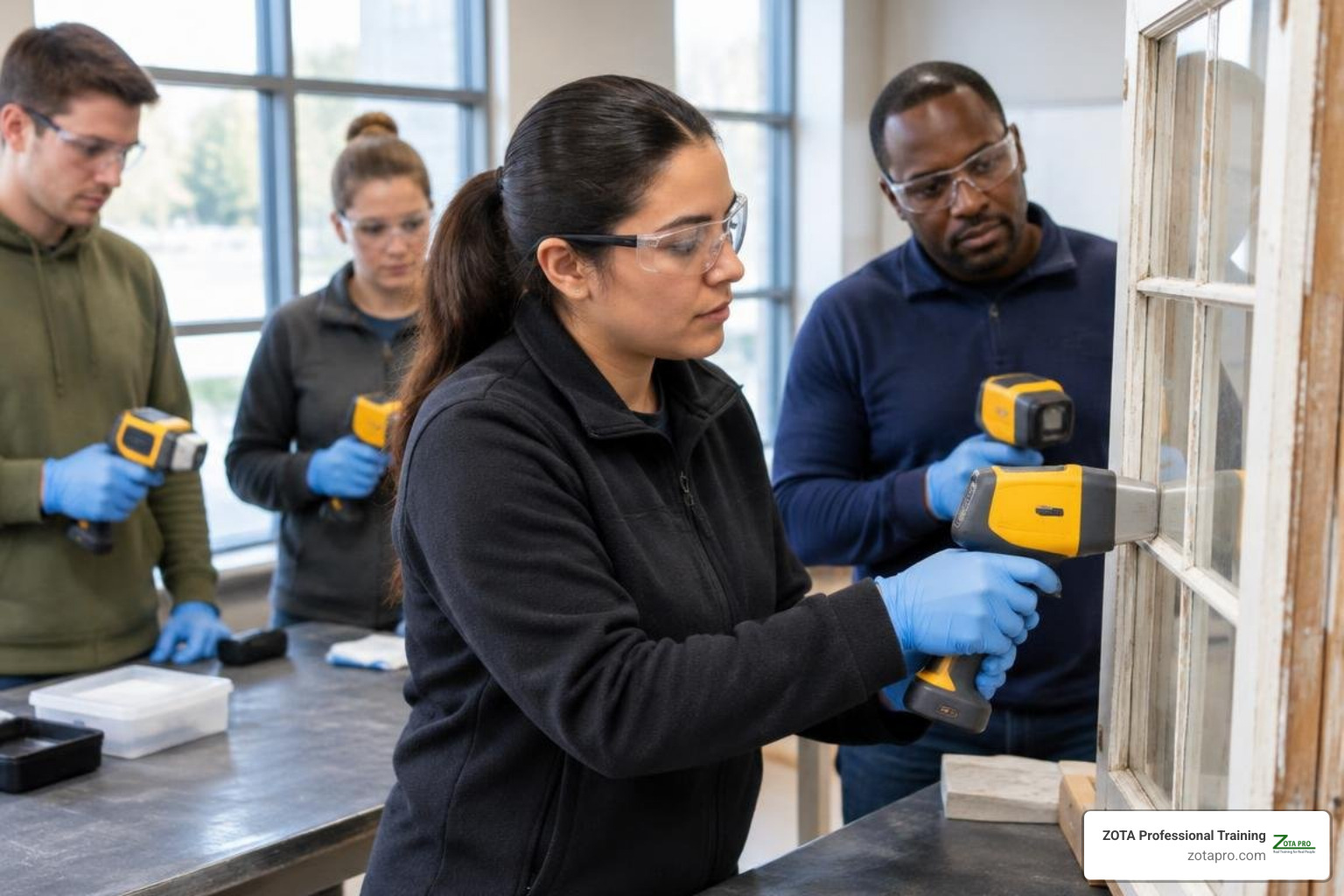
Entering this high-demand environmental field requires completing an accredited training curriculum and satisfying state or federal licensing benchmarks. Unlike risk assessors or project designers, entry-level inspectors generally have no prerequisite college degree or prior construction background to qualify for initial training.
- Complete Accredited Training: Candidates must attend an accredited 24-hour (3-day) EPA Lead Inspector Initial Course, which combines classroom instruction on HUD guidelines with practical, hands-on training covering XRF operation, sample documentation, and quality control.
- Apply for Interim Certification: After passing the initial course exam, trainees receive a course completion certificate. Under EPA rules, this certificate serves as an interim license valid for up to 6 months while your formal application is processed.
- Pass the Third-Party Exam: Candidates submit an application and pass a government-administered third-party exam (such as the 75-question state licensing exam). In states like Illinois, candidates must pass this exam within 6 months of application approval, with up to three attempts permitted.
- Maintain Certification: To keep credentials active, inspectors must take an approved EPA Lead Inspector Refresher Course every 3 years (or up to 5 years depending on state program structure).
State application fees vary; for example, the non-refundable initial license fee in Missouri is $100, while Illinois charges a $100 licensing fee plus a $50 third-party examination fee as outlined in the License Qualifications for Lead Supervisor, Inspector and Risk Assessor standard. For complete federal application timelines and photo requirements, consult the Lead-Based Paint Abatement and Evaluation Program: Individual Certification guidelines. At ZOTA Professional Training, we provide flexible, bilingual (English/Spanish) hybrid courses and nationwide on-site sessions to help professionals complete their certifications smoothly.
Testing Methods, Legal Mandates, and Certification Types
Understanding regulatory thresholds and testing protocols helps property owners protect building occupants and avoid severe financial penalties. Maintaining proactive lead documentation not only safeguards tenant health but also unlocks critical liability shields and operational advantages, as highlighted in our guide on EPA lead abatement certification benefits for contractors and inspectors.
Standard Lead Testing Procedures and Work Practice Standards
State and federal programs enforce strict work practice standards to guarantee reliable testing data. Under 40 CFR § 745.325 – Lead-based paint activities: State and Tribal program requirements, inspectors must execute documented methodologies backed by rigorous quality assurance procedures.
Field testing relies on two primary methodologies:
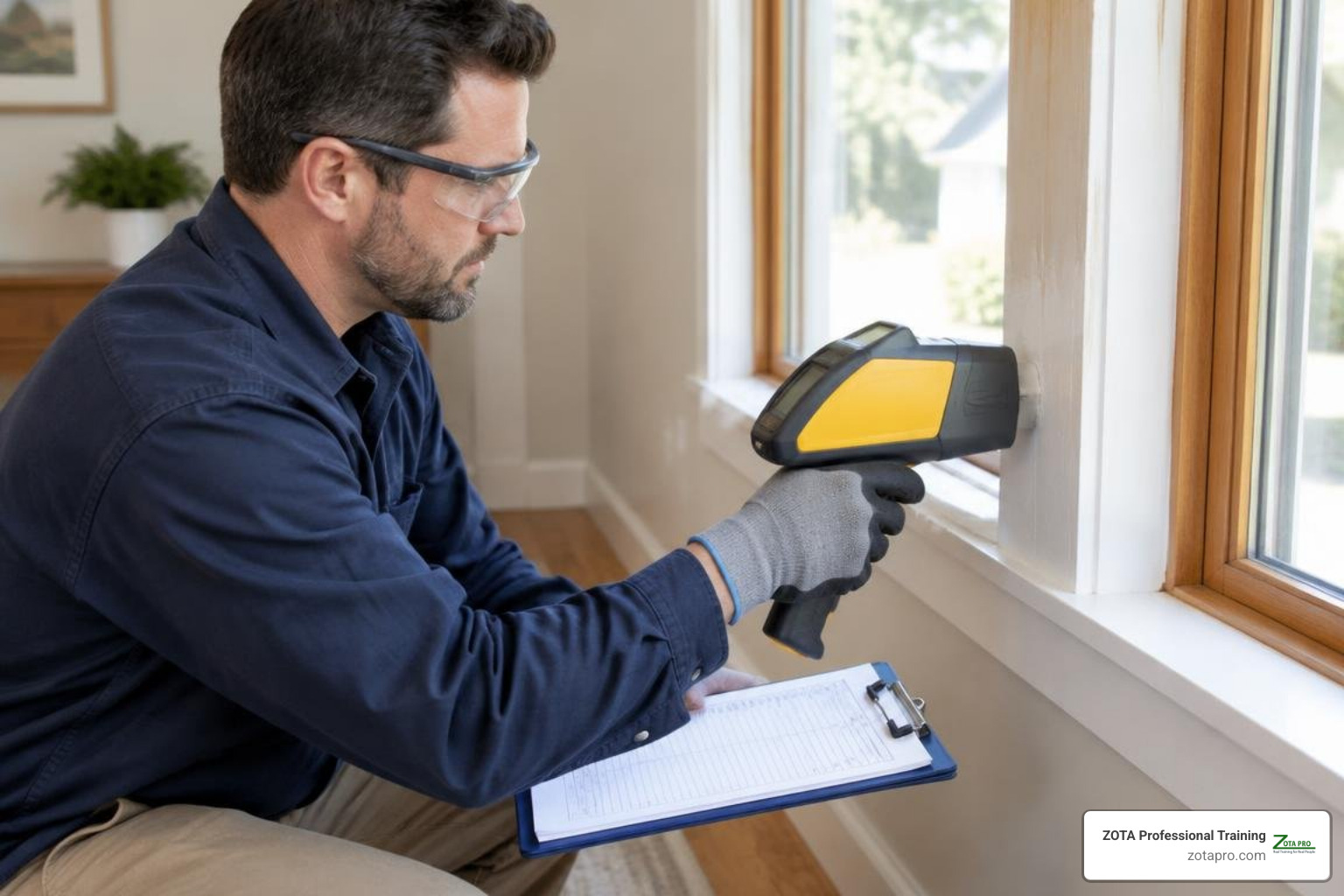
- X-Ray Fluorescence (XRF) Analyzers: Portable XRF devices use sealed radioactive isotopes or low-power X-ray tubes to excite lead atoms within paint layers. The instrument instantly quantifies the lead concentration per unit area without damaging surfaces. Lead-based paint is federally defined as paint containing 1.0 milligram per square centimeter ($1.0text{ mg/cm}^2$) or greater, or 0.5% by weight.
- Paint Chip Extraction: When surface curvature or material substrates create inconclusive XRF readings, inspectors collect small paint chip samples (taking care to capture all paint layers down to the substrate) and submit them to an NLLAP-accredited lab.
- Dust Wipe Clearance Testing: Following lead hazard reduction or abatement work, inspectors collect dust wipe samples using single-use, pre-moistened wipes across measured floor and window surface templates. Clearance standards—such as those detailed in the Lead-Safe Wisconsin: Lead Inspector Study Guide—require dust-lead levels to remain below strict thresholds (typically $< 10 mutext{g/ft}^2$ for interior floors and $< 100 mutext{g/ft}^2$ for interior window sills).
When Lead Inspections Are Legally Required for Pre-1978 Housing
Federal and municipal laws dictate specific milestones when lead evaluations become mandatory for pre-1978 residential properties and child-occupied facilities:
- Renovation and Remodeling Triggers: Under the EPA Renovation, Repair, and Painting (RRP) Rule, any contractor disturbing more than 6 square feet of interior painted surfaces or 20 square feet of exterior paint in pre-1978 target housing must assume lead is present unless a certified inspector proves otherwise. Learn more about project planning in our guide on determining if a lead inspection is required before renovating.
- Tenant Turnover Mandates: States like New Jersey enforce comprehensive rental inspection laws requiring all pre-1978 rental units to undergo inspections at tenant turnover or on a scheduled municipal cycle.
- Property Sales and Title X Compliance: Federal Title X disclosure rules require sellers and landlords to disclose known lead-based paint and provide buyers with a 10-day window to conduct an independent lead inspection.
Lead-Safe vs. Lead-Free Certificates: What Every Property Owner Should Know
Understanding the difference between Lead-Safe and Lead-Free certificates is vital for ongoing property management and budgeting.
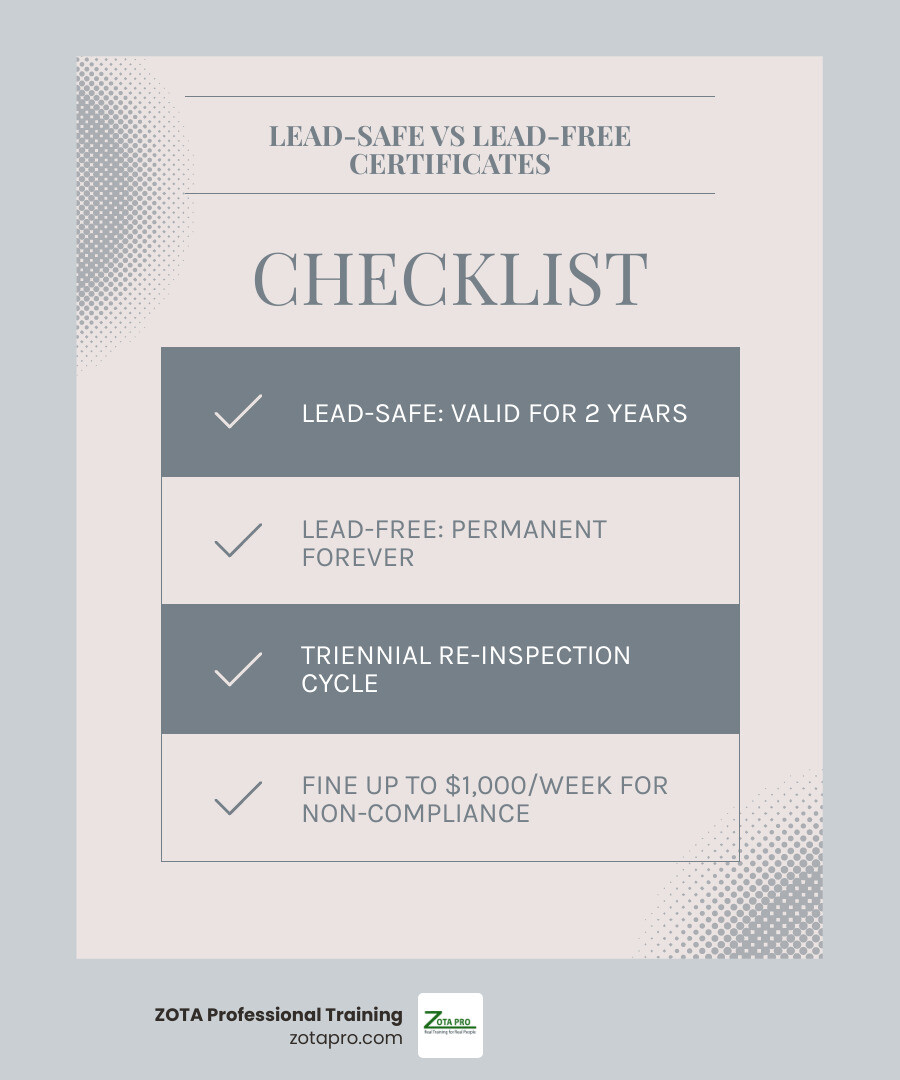
- Lead-Safe Certificate: Indicates that at the time of inspection, the property contained no active lead hazards or deteriorated paint, and dust levels met federal clearance standards. Lead-based paint may still be safely sealed underneath topcoats. A Lead-Safe certificate is typically valid for 2 years, and properties must be re-inspected on a 3-year cycle or upon tenant turnover. During visual evaluations, any paint damage larger than a hairline crack or nail hole can cause an inspection failure.
- Lead-Free Certificate: Confirms that a comprehensive XRF or paint chip evaluation detected no lead-based paint at or above regulatory thresholds anywhere on the structure. A Lead-Free certificate is permanent and good forever, permanently exempting the dwelling from cyclical rental inspections and turnover testing requirements.
Failing to comply with mandated inspection timelines carries severe consequences. For example, under municipal enforcement rules, property owners who fail to correct violations within 30 days face ongoing fines of up to $1,000 per week until certified inspections or remediation efforts are initiated.
To ensure your rental property remains compliant with local lead ordinances, keep the following documentation organized:
- Official inspection reports signed by a certified inspector
- Calibration logs for any XRF analyzer used on-site
- NLLAP accredited laboratory results for paint chip or dust wipe samples
- Valid Lead-Safe (2-year) or Lead-Free (permanent) certificates
- Proof of tenant disclosure and signed EPA Protect Your Family from Lead in Your Home pamphlets
Whether you are a landlord preparing for cyclical tenant inspections, an environmental technician advancing your credentials, or a contractor expanding your compliance capabilities, our team at ZOTA Professional Training provides the hands-on expertise you need. Take the next step in your career and get certified with accredited EPA lead training today.