

Is 30 Hour OSHA Training Online Free Actually Possible?
If you’re looking for 30 hour OSHA training online free, here’s the short answer:
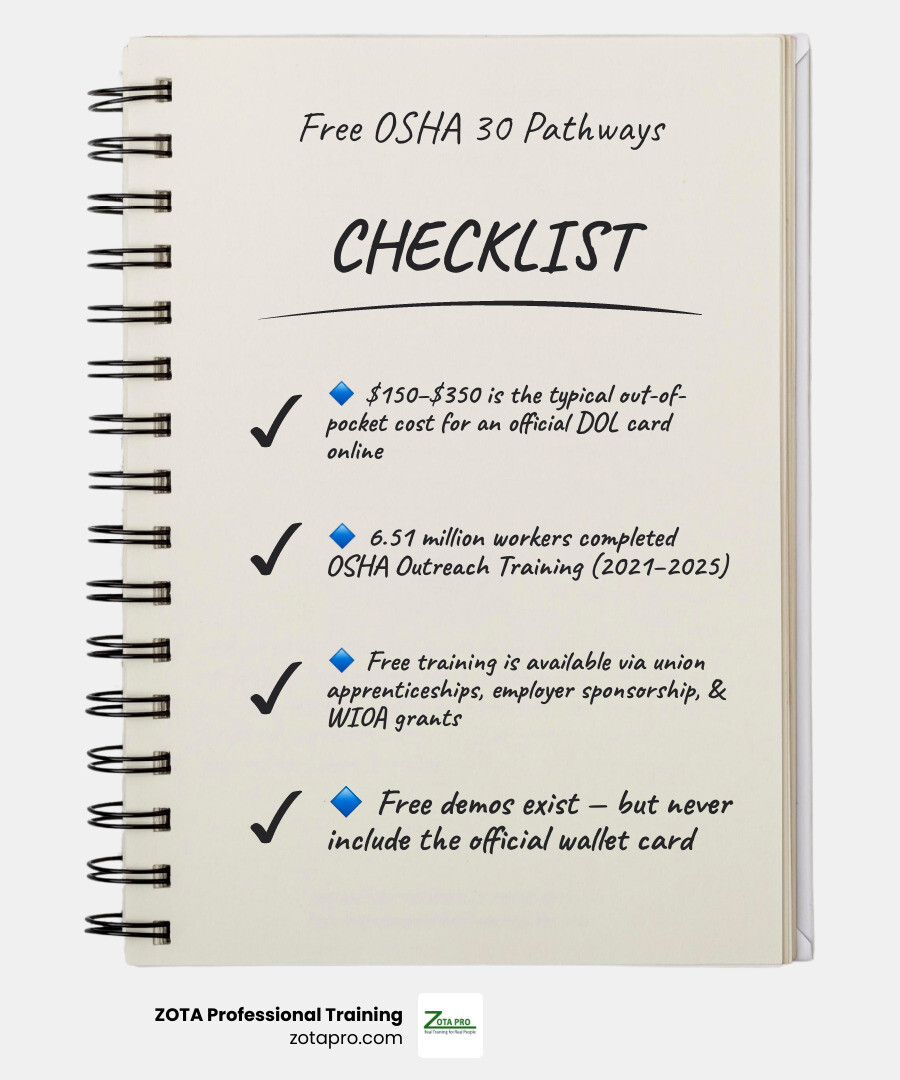
- Truly free official DOL cards don’t exist. The U.S. Department of Labor requires authorized providers and charges processing fees.
- Free course content does exist. Some platforms let you access training modules at no cost — but the official wallet card costs extra (typically $150–$350 online).
- Free training for workers is possible through unions, employer sponsorship, WIOA grants, and state-subsidized programs.
So the word “free” depends entirely on who’s paying — not whether the training itself costs money.
Between 2021 and 2025, more than 6.51 million workers completed training through the OSHA Outreach Training Program. That scale reflects just how critical this credential has become across construction and general industry. Yet confusion about what’s genuinely free — and what’s a scam — remains widespread.
I’m Bob Zak, Founder and CEO of ZOTA Professional Training, with over 32 years in occupational health and safety. I’ve helped thousands of contractors navigate 30 hour OSHA training online free pathways and avoid costly mistakes. In this guide, I’ll walk you through exactly what’s legitimate and what’s not.
The Reality of 30 Hour OSHA Training Online Free Options
When you search for a 30 hour osha training online free course, you will likely encounter sites claiming to offer complete safety training at no charge. However, understanding how the regulatory framework operates will save you from wasting hours on invalid courses.
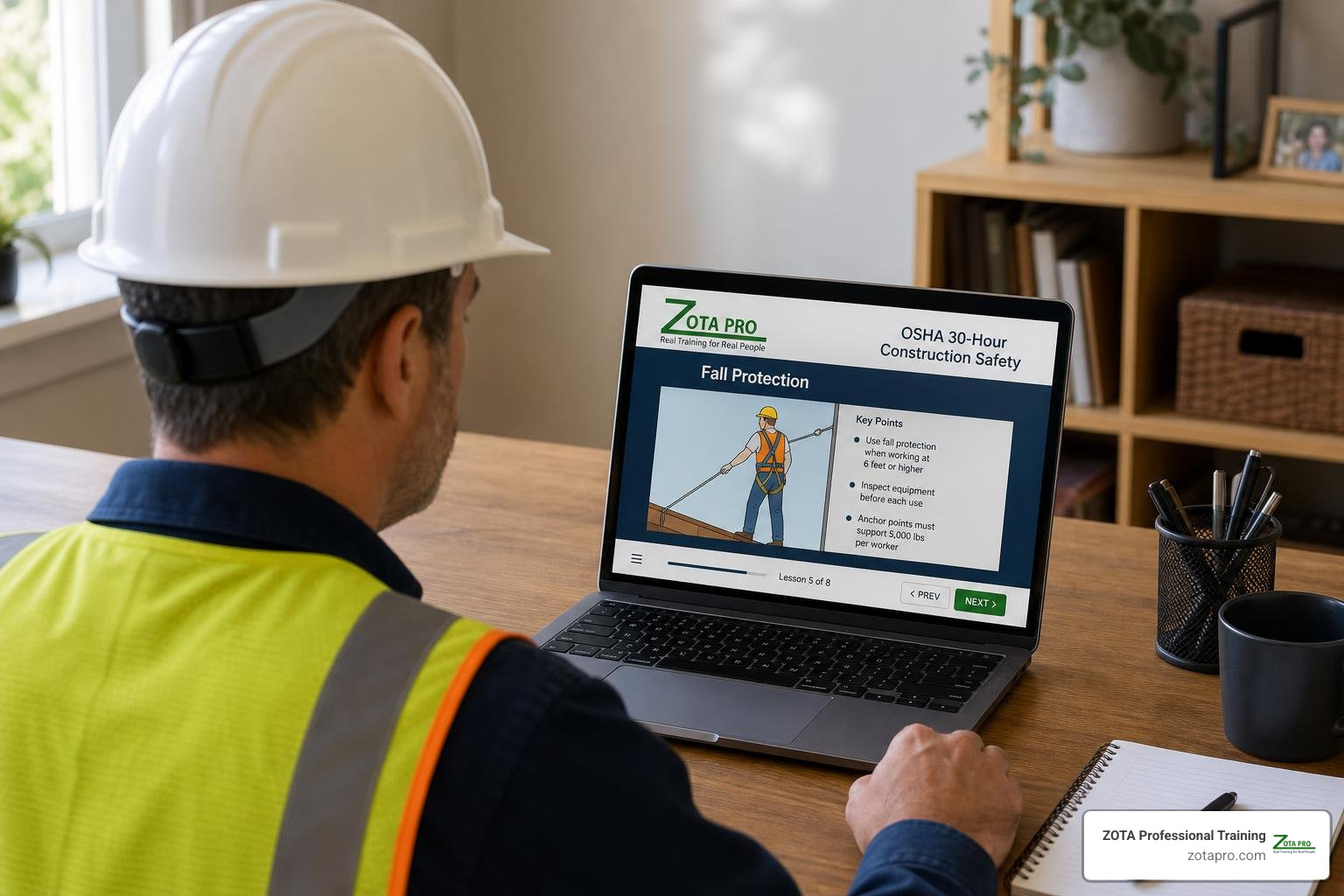
The OSHA Outreach Training Program is a voluntary program designed to promote workplace safety. While federal OSHA sets the curriculum guidelines, it does not directly train workers or issue cards to individuals. Instead, it authorizes specific training providers to deliver the material and distribute official Department of Labor (DOL) wallet cards.
Because authorized providers must pay processing fees to the government and maintain strict compliance standards, they cannot give away the official physical card for free. To maintain high instructional standards, legitimate courses are usually accredited by organizations like the International Association for Continuing Education and Training (IACET).
Before choosing a path, it is important to evaluate who in your workforce needs this level of training. You can read more about selecting the right level of education in our guide on Who Needs OSHA 10 vs OSHA 30 Training?
Free Demos vs. Legitimate 30 Hour OSHA Training Online Free Pathways
To capture search traffic, many websites advertise “free OSHA 30 training” when they actually mean one of two things:
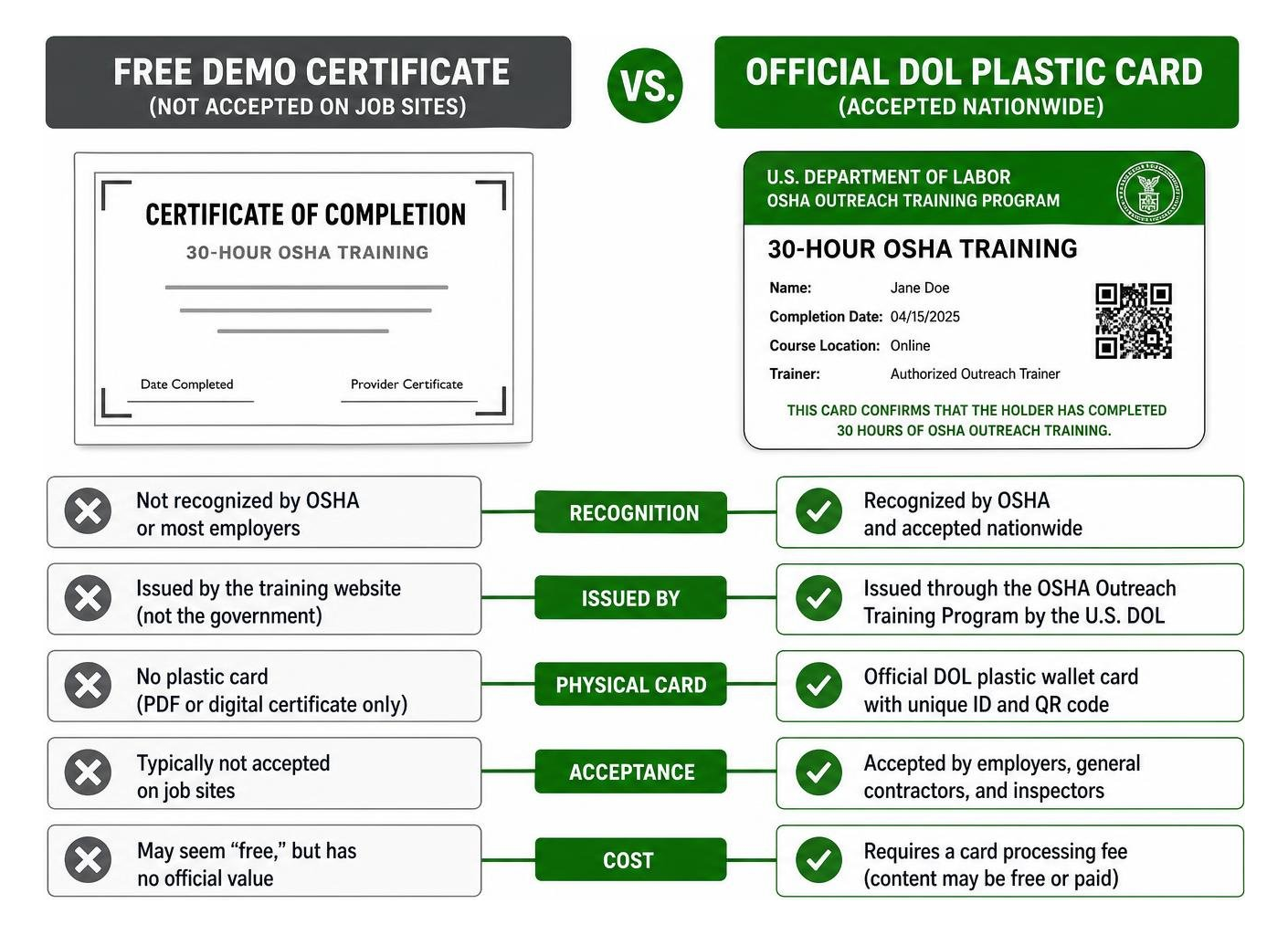
- A Free Course Demo: Legitimate providers often offer a 10-minute trial or a couple of free modules. This lets you test their learning management system (LMS), experience their interactive simulations, and review sample case studies before paying.
- Free Content with a Paid Card Upgrade: Some platforms allow you to study all 30 hours of educational content for $0.00. However, if you pass the final exam and need the official DOL plastic card to get on a job site, you must pay a processing fee (often around $159).
If you complete a completely free course that does not issue an official DOL wallet card, you will only receive a basic “provider certificate.” Most general contractors and regulatory inspectors do not accept these certificates as proof of compliance. To learn more about how these credentials compare, check out our breakdown of What is the Difference Between OSHA 10 and OSHA 30 Training?
How to Get a Free OSHA 30 Card Through Employer Funding, Unions, and Grants
If you are a worker, you can absolutely get your official OSHA 30 card for free. The key is utilizing established funding pathways where an external entity covers the cost of your OSHA Compliance Training.
- Union Apprenticeship Programs: Joint Apprenticeship and Training Committees (JATCs) and local unions frequently provide OSHA 30 courses to their members at no cost.
- Workforce Innovation and Opportunity Act (WIOA) Grants: If you are currently unemployed or transitioning careers, your local American Job Center can often fund your safety training through federal WIOA grants.
- Employer Sponsorship: Many employers pay for their supervisors’ training directly or offer reimbursement. Because safety training reduces costly workplace accidents, companies view this as a necessary operational expense.
- Workers’ Compensation Subsidies: Major insurance carriers (such as Liberty Mutual, Zurich, or Travelers) sometimes subsidize or fully fund safety training for policyholders to minimize claims.
- State-Subsidized Programs: Some state agencies offer heavily subsidized safety classes. For example, the Texas Division of Workers’ Compensation (DWC) offers in-person OSHA 30 courses to state residents for just $30, while Nevada’s Safety Consultation and Training Section (SCATS) provides free state-sponsored safety training.
Red Flags of Fraudulent 30 Hour OSHA Training Online Free Websites
The high demand for safety cards has unfortunately led to fraudulent websites targeting unsuspecting workers.
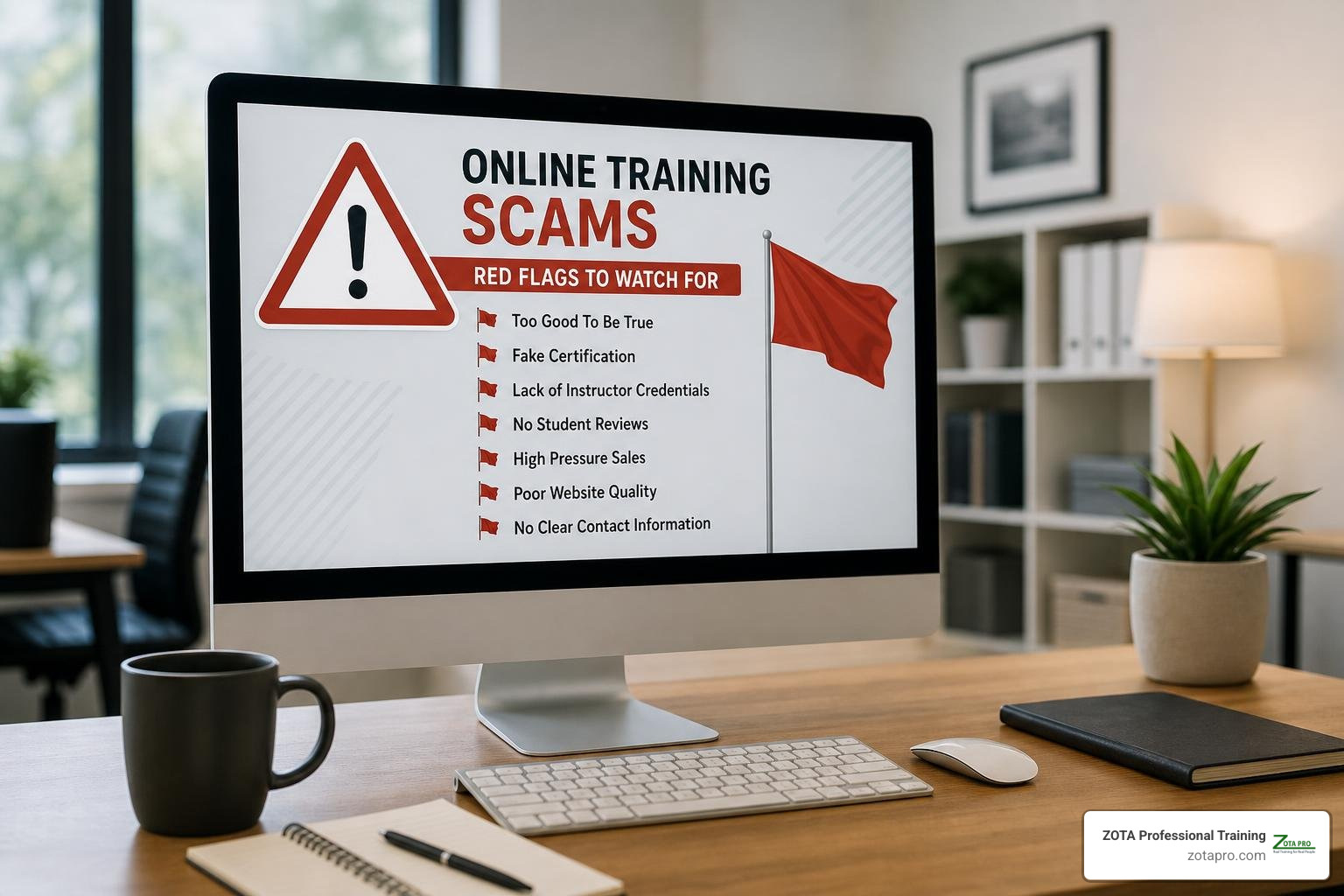
When evaluating online providers, watch out for these major red flags:
- Offering “OSHA Certification”: OSHA does not certify individuals. Any site promising an “official OSHA certificate of certification” rather than an outreach card is misleading you.
- Accelerated Timelines: Federal regulations strictly mandate that a 30-hour course must take at least 30 hours of actual instruction time. If a site claims you can finish in a single day, it is a scam.
- Unbelievably Low Prices: Legitimate DOL cards require processing fees. If a site offers a full course and card for under $50, you are likely buying a counterfeit card. Using a fake card can lead to severe OSHA Violations and fines for your employer.
Legitimate OSHA 30 Course Structure, Costs, and Career Benefits
If you cannot find a free pathway through an employer or grant, paying for a legitimate course is a highly profitable investment in your career.

Legitimate courses are built around federal standards: 29 CFR 1926 for Construction and 29 CFR 1910 for General Industry. The typical costs for these courses vary based on how they are delivered:
| Training Format | Typical Cost Range | Best For |
|---|---|---|
| Online Self-Paced | $150 – $350 | Individuals wanting to study at their own speed |
| Virtual Instructor-Led (VILT) | $200 – $400 | Rural workers or remote teams using Zoom |
| In-Person Classroom | $200 – $500 | Group training and hands-on learning |
What Topics Are Covered in OSHA 30 Construction and General Industry?
The 30-hour curriculum is designed for supervisors, safety directors, and workers with safety responsibilities. It is much more comprehensive than the 10-hour introductory course.
For those in commercial building, demolition, or renovation, the OSHA Compliance Training – 30 Hour Construction Industry Training features 21 to 27 modules. It focuses heavily on the “Focus Four” hazards (Falls, Struck-By, Caught-In/Between, and Electrocution), alongside personal protective equipment (PPE) and health hazards like silica, lead, and asbestos.
For manufacturing, warehousing, logistics, and healthcare, the OSHA Compliance Training – 30 Hour General Industry Training consists of 17 to 19 modules. It covers walking-working surfaces, exit routes, emergency action plans, hazard communication, machine guarding, and lockout/tagout (LOTO).
Course Duration, Online Delivery, and Expiration Rules
To prevent student fatigue and ensure high-quality learning, federal rules restrict online Outreach training to a maximum of 7.5 hours of seat time per day. This means a 30-hour course will take a minimum of four calendar days to complete.
Additionally, online students must complete the entire course within a 180-day window from their enrollment date. Online courses also feature a “three-strike rule” on quizzes and exams. If you fail any module quiz or the final exam three times, you will be locked out of the course and must register again.
Once you pass, your physical DOL card is mailed to you (typically within two to six weeks). Under federal rules, this card never expires. However, because safety regulations evolve, many employers, local unions, and specific states require workers to take refresher training every three to five years. You can read more about these standards in our guide to OSHA Training Requirements for the Construction Industry.
Verifying Authorized Providers and Maximizing Career Advancement
Before spending time or money on a course, always verify that your provider is officially authorized by checking the list of approved online trainers on osha.gov.
At ZOTA Professional Training, we provide flexible, high-quality safety courses. Our unique strength is offering flexible, multilingual (English/Spanish) hybrid and group training with nationwide on-site support. Whether you need online flexibility or structured group training for your entire crew, we tailor our programs to keep your business compliant and safe.
Earning your OSHA 30 card is one of the fastest ways to increase your earning potential. On average, OSHA 30 card holders earn $2 to $5 more per hour than uncertified peers. This translates to an extra $6,000 to $12,000 annually, compounding to well over $150,000 in incremental lifetime earnings over a 20-year career.
With the Bureau of Labor Statistics projecting a 4% growth in occupational health and safety positions through 2032, there has never been a better time to upgrade your credentials. Explore how you can take the next step in your professional development with our guide to Safety Certifications for Construction to Advance Your Career in 2025.