

What Federal Law Requires Before You Sign a Lease in an Older Home
The lead based disclosure form for renters is a federally required document that landlords must provide before a tenant signs a lease for any residential property built before 1978.
Here is what you need to know at a glance:
| Key Fact | Detail |
|---|---|
| Who must provide it? | Landlords, lessors, and their agents |
| Which properties? | Residential housing built before 1978 |
| When is it required? | Before the lease is signed |
| What must be included? | Known lead hazards, available records, and the EPA pamphlet |
| How long must it be kept? | At least 3 years from lease start date |
| Penalty for non-compliance? | Up to $19,507 per violation, plus triple damages |
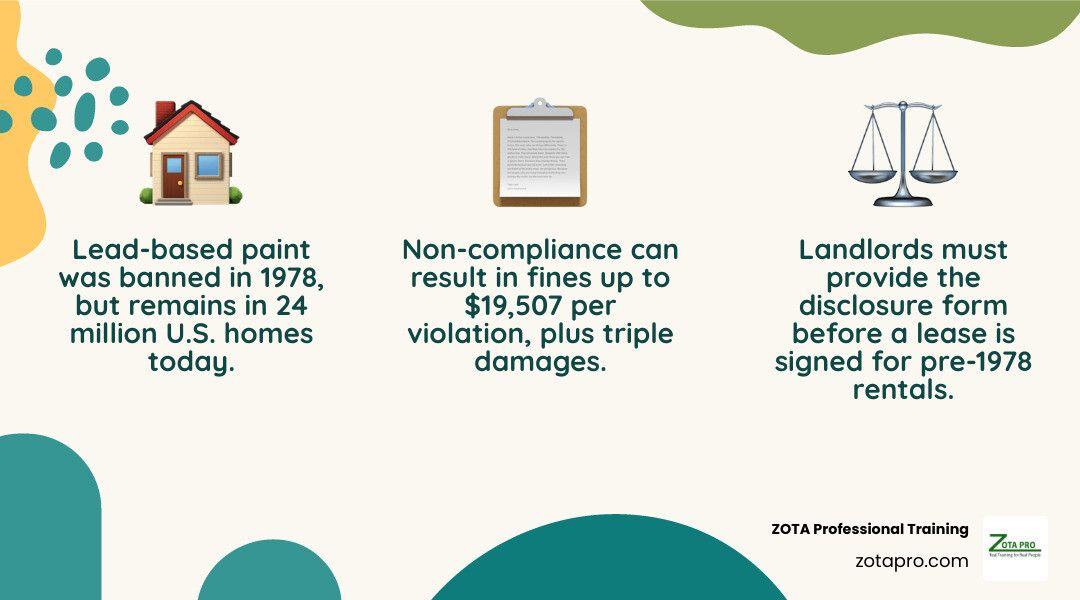
Lead-based paint was banned for residential use in the United States in 1978 — but it is still present in an estimated 24 million homes across the country. For young children and pregnant women, exposure to lead dust from deteriorating paint can cause serious, permanent health damage. That is why federal law requires landlords to be upfront about what they know before a tenant ever moves in.
If you are a contractor or property manager working on pre-1978 buildings, understanding the disclosure process is only one piece of the puzzle. How renovations are handled in those same buildings is equally critical — and equally regulated.
I’m Bob Zak, Founder and CEO of ZOTA Professional Training, with over 32 years of experience in occupational health and safety, including working directly with EPA lead regulations that govern everything from the lead based disclosure form for renters to certified renovation practices. In this guide, I’ll walk you through exactly what the form requires, who it applies to, and what happens when the rules aren’t followed.
What is the Lead Based Disclosure Form for Renters and Why is it Required?

When we talk about renting an older home, safety should always be the top priority. The lead based disclosure form for renters is not just a routine piece of lease paperwork; it is a vital shield mandated by federal law.
Passed under the Residential Lead-Based Paint Hazard Reduction Act of 1992 (commonly known as Title X), and specifically governed by Section 1018 (42 U.S.C. 4852d), this rule requires housing providers to give tenants clear, written information about lead hazards before they are legally bound by a lease.
The primary culprit we are fighting is lead dust. As lead-based paint ages, cracks, or is disturbed during normal wear and tear, it breaks down into microscopic dust particles. This dust settles on floors, windowsills, and hands, making it incredibly easy to inhale or ingest. By utilizing a standardized Lead Paint Disclosure, we ensure that renters are fully aware of any known risks before choosing where their families will live.
Which Properties Require a Lead Based Disclosure Form for Renters?
The Lead-Based Paint Disclosure Rule applies to most private, public, federally owned, or federally assisted “target housing” built before 1978. Because 1978 was the cutoff year when the federal government officially banned lead-based paint for residential use, any property constructed prior to this date is legally presumed to contain lead.
However, we should note that there are a few specific exemptions to this rule:
- Short-Term Leases: Leases of 100 days or less, such as vacation rentals, where no lease renewal or extension can occur.
- Zero-Bedroom Units: Dwellings like studio apartments, lofts, or dormitory housing, unless a child under the age of six resides or is expected to reside there.
- Elderly or Disabled Housing: Housing designated specifically for seniors or persons with disabilities, provided no children under the age of six live on the premises.
- Certified Lead-Free Properties: Any pre-1978 property that has been officially certified as “lead-free” by a state-licensed, certified inspector.
To dive deeper into the exact regulatory definitions and exemptions, you can review the Lead-Based Paint Disclosure Rule Fact Sheet. Understanding the baseline presence of Lead Based Paint in older buildings helps us keep our rental communities safe.
Key Components of the Lead Based Disclosure Form for Renters
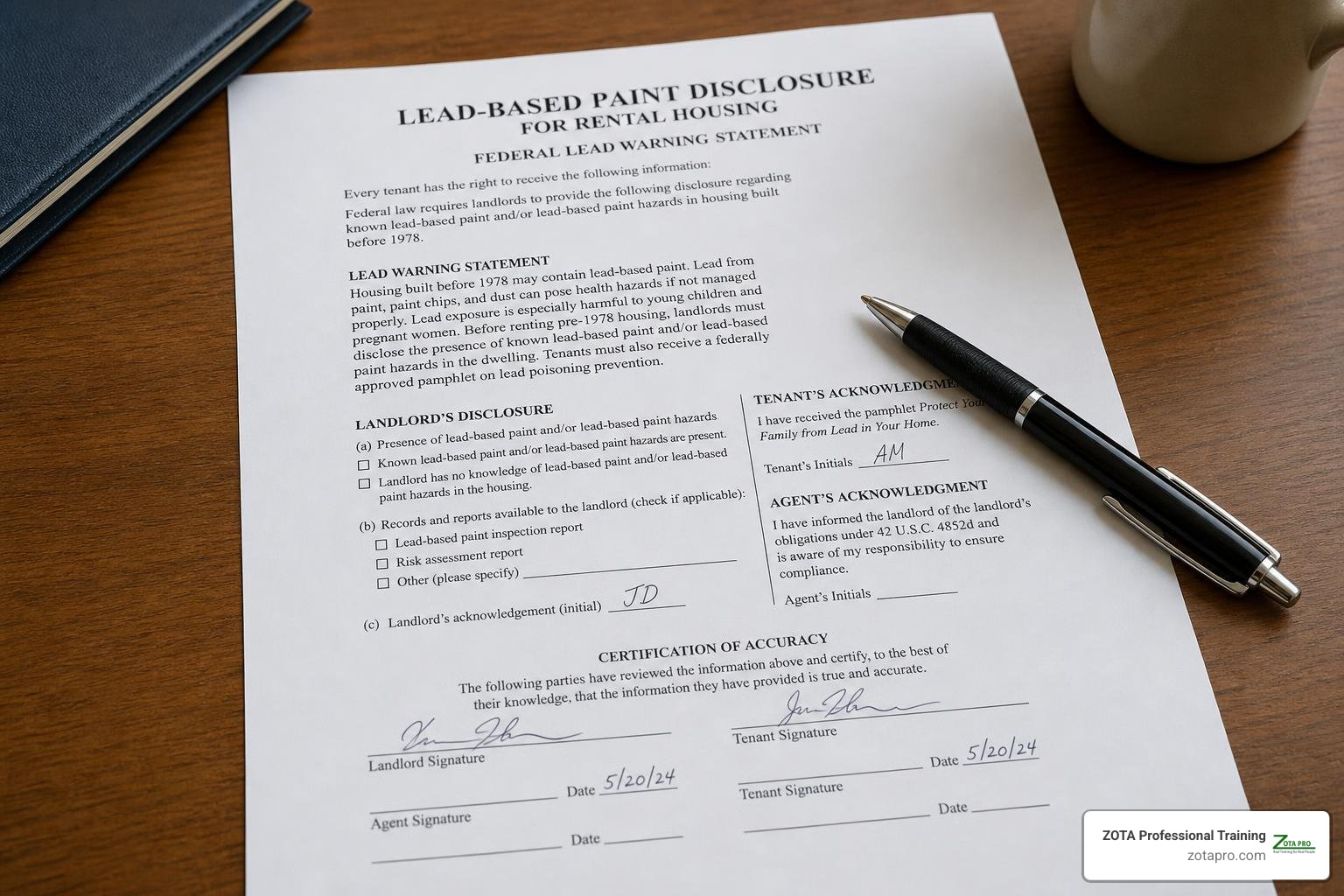
A compliant disclosure form is highly structured and must contain several distinct elements. According to EPA and HUD guidelines, a complete form must include:
- The Lead Warning Statement: A federally mandated legal warning emphasizing that lead exposure is especially dangerous to young children and pregnant women.
- Lessor’s Disclosure Section: This is where the landlord must check boxes indicating whether they have actual knowledge of lead-based paint hazards in the property, and list any available records or reports they are providing.
- Lessee’s Acknowledgment Section: The tenant must initial and sign to confirm they received the disclosure, any accompanying reports, and the mandatory EPA educational pamphlet.
- Agent’s Responsibility Section: If a real estate agent or property manager is involved, they must sign the form to certify they have informed the landlord of their legal obligations under 42 U.S.C. 4852d.
The EPA estimates the public reporting and recordkeeping burden for completing this form to be just 0.12 hours (about 7.2 minutes) per response. You can view a typical federal template to see how these sections look in practice on the sample lessor’s disclosure form.
The ‘Protect Your Family from Lead in Your Home’ Pamphlet
Providing the disclosure form alone is not enough to satisfy federal law. Landlords must also hand renters the federally approved educational pamphlet titled Protect Your Family from Lead in Your Home.
This document is packed with practical advice on how to identify lead hazards, prevent exposure, and protect high-risk household members like young children and pregnant individuals. Because we serve diverse communities, we always emphasize that this brochure is available in multiple languages (including Spanish, Arabic, Vietnamese, and Russian) to ensure all tenants can easily read and apply these life-saving tips. We encourage you to check out our resources on how to Protect Family From Lead to keep your household safe.
Landlord Obligations, Tenant Rights, and Compliance Penalties
Now that we understand what the form is, let’s look at how the compliance process works in the real world. Both landlords and tenants have distinct roles in this process, and keeping up with Lead Paint Safety is a shared responsibility that protects everyone.
For modern property managers, electronic disclosures are fully legal under the federal E-SIGN Act. However, landlords must first obtain documented, explicit consent from the tenant, explain how they can withdraw consent, and clearly state their right to receive paper copies of the documents at any time.
Recordkeeping Rules and State-Specific Variations
At the federal level, landlords and real estate agents must retain a signed copy of the completed lead disclosure forms for at least three years from the start date of the lease. However, local jurisdictions often enforce much stricter requirements:
- Washington, D.C.: Property owners must keep the signed original of the lead disclosure form on record for at least 6 years from the date of the most recent signature, as they are subject to audits by the D.C. Department of Energy and Environment (DOEE). Furthermore, D.C. requires disclosures for properties built before 1986 because local laws also cover lead-bearing plumbing and water service lines. You can access the official LEAD DISCLOSURE FORM FOR DC RENTAL PROPERTIES to see these unique local additions.
- Wisconsin: The state’s Certification and Field Compliance team actively monitors rental transactions. Failing to disclose known lead hazards or provide the required form is treated as a direct violation of both state and federal laws.
Penalties for Non-Compliance and Landlord Violations
Failing to provide a lead based disclosure form for renters is a serious legal violation. The EPA and HUD calculate penalties per violated element, per transaction. This means a landlord who fails to provide the pamphlet, fails to disclose records, and fails to get signatures on a single lease has committed multiple distinct violations.

| Type of Penalty | Description | Financial Impact |
|---|---|---|
| Federal Civil Penalty | Levied by the EPA/HUD for each non-compliant transaction element | Up to $19,507 per violation (inflation-adjusted) |
| Civil Liability (Tenant Lawsuits) | Awarded to tenants in private civil court actions | Treble (3 times) the actual damages incurred |
| Additional Costs | Legal fees associated with enforcement | Tenant’s attorney fees and court costs |
To put this in perspective, if a property manager oversees a 9-unit pre-1978 building and rents out each unit twice without complying with the disclosure rule, they have completed 18 rental transactions. If audited, the compounding civil penalties can easily run into hundreds of thousands of dollars. We have seen real-world examples of how severe this can get, such as when a Realtor Lied To Clients About Lead Paint In Home, resulting in devastating financial and professional consequences.
What Tenants Should Do If They Suspect Lead Hazards
If you live in an older rental property and notice deteriorating, peeling, or cracking paint, or if you suspect your landlord did not provide the proper disclosures, here are the immediate steps we recommend:
- Submit a Written Request: Ask your landlord in writing to repair any peeling paint. Under the EPA’s Lead Renovation, Repair, and Painting (RRP) Rule, any repairs in a pre-1978 building that disturb more than 6 square feet of interior paint or 20 square feet of exterior paint must be performed by an EPA-Certified Lead Renovator.
- Get Children Tested: If you have children under the age of six, have their blood lead levels tested by a pediatrician. The CDC’s current actionable blood lead reference value is 3.5 μg/dL.
- Report Violations: If your landlord refuses to provide a lead disclosure form or uses uncertified contractors for paint repairs, you can report them directly to the EPA at
epa.gov/lead/violation.
For tenants looking to secure their living space, we offer extensive Home Lead Safety Resources to help you identify hazards. If you want to dive deeper into how children are affected and how to protect them, read our guides on how to Protect Kids From Lead and maintain a Lead Safe Home.
For property managers, landlords, and contractors, the path to compliance is clear: get certified. If you want to know how to perform safe repairs, you can learn What Are The Requirements For Epa Lead Renovator Certification and ensure your team is trained to work safely. For more answers to common questions, explore our Faqs On Lead.
Keep Your Properties Safe and Compliant
Don’t risk costly EPA audits or compromise tenant health. At ZOTA Professional Training, we offer flexible, multilingual (English and Spanish) EPA-accredited lead certification courses to keep your business fully compliant. Explore our Lead Paint Disclosure training resources today to find a certification course near you!