

OSHA 30 Training Requirements at a Glance
OSHA 30 training is a 30-hour OSHA Outreach course for supervisors, foremen, safety coordinators, and experienced workers with broader jobsite safety duties. It teaches workers how to spot common hazards, understand safety rules and worker rights, and help prevent injuries before work begins.
| Quick answer | What to know |
|---|---|
| Who it is for | Construction and general industry supervisors, crew leaders, and safety-focused workers |
| Which course to take | Construction for building, renovation, demolition, and similar work; General Industry for warehouses, manufacturing, facilities, and other non-construction settings |
| Is it required? | Not by federal OSHA for every worker, but employers, general contractors, unions, and local or state rules may require it |
| How long it takes | 30 instruction hours; online courses have daily time limits, so they cannot be completed in one sitting |
| What you receive | An official U.S. Department of Labor OSHA Outreach completion card after passing an authorized course |
| Does the card expire? | Federal OSHA cards generally do not expire, but many employers require refresher training every 3 to 5 years |
For renovation contractors, OSHA 30 can be especially useful when leading crews through changing site conditions, fall risks, electrical work, confined spaces, and hazard communication. It is not a substitute for task-specific training, such as lead, asbestos, respirator, or equipment training, but it builds the broader safety knowledge leaders need to run safer projects.
Between 2021 and 2025, more than 6.51 million workers completed OSHA Outreach Training, showing how widely employers use these 10-hour and 30-hour courses as a safety baseline. The key is choosing the right industry track and confirming what your project owner, general contractor, state, or local jurisdiction requires.
I’m Bob Zak, Founder and CEO of ZOTA Professional Training, with more than 32 years of occupational health and safety experience, including service as an Occupational Health & Safety Manager at Ramsey County. I help contractors and professionals understand OSHA 30 training alongside the real-world compliance needs of renovation and regulated work.
Understanding OSHA 30 Training Rules and Standards

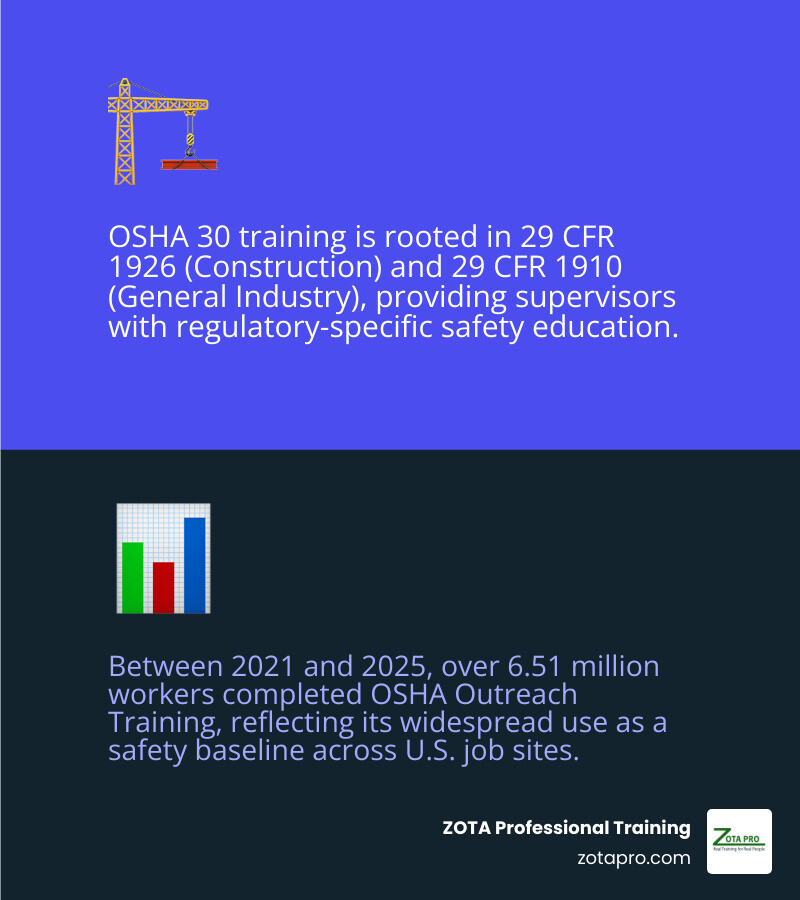
The OSHA Outreach Training Program provides basic and advanced safety education to help reduce incidents across job sites nationwide. OSHA outreach courses are rooted in specific title 29 of the Code of Federal Regulations (CFR): 29 CFR 1926 covers construction, while 29 CFR 1910 governs general industry.
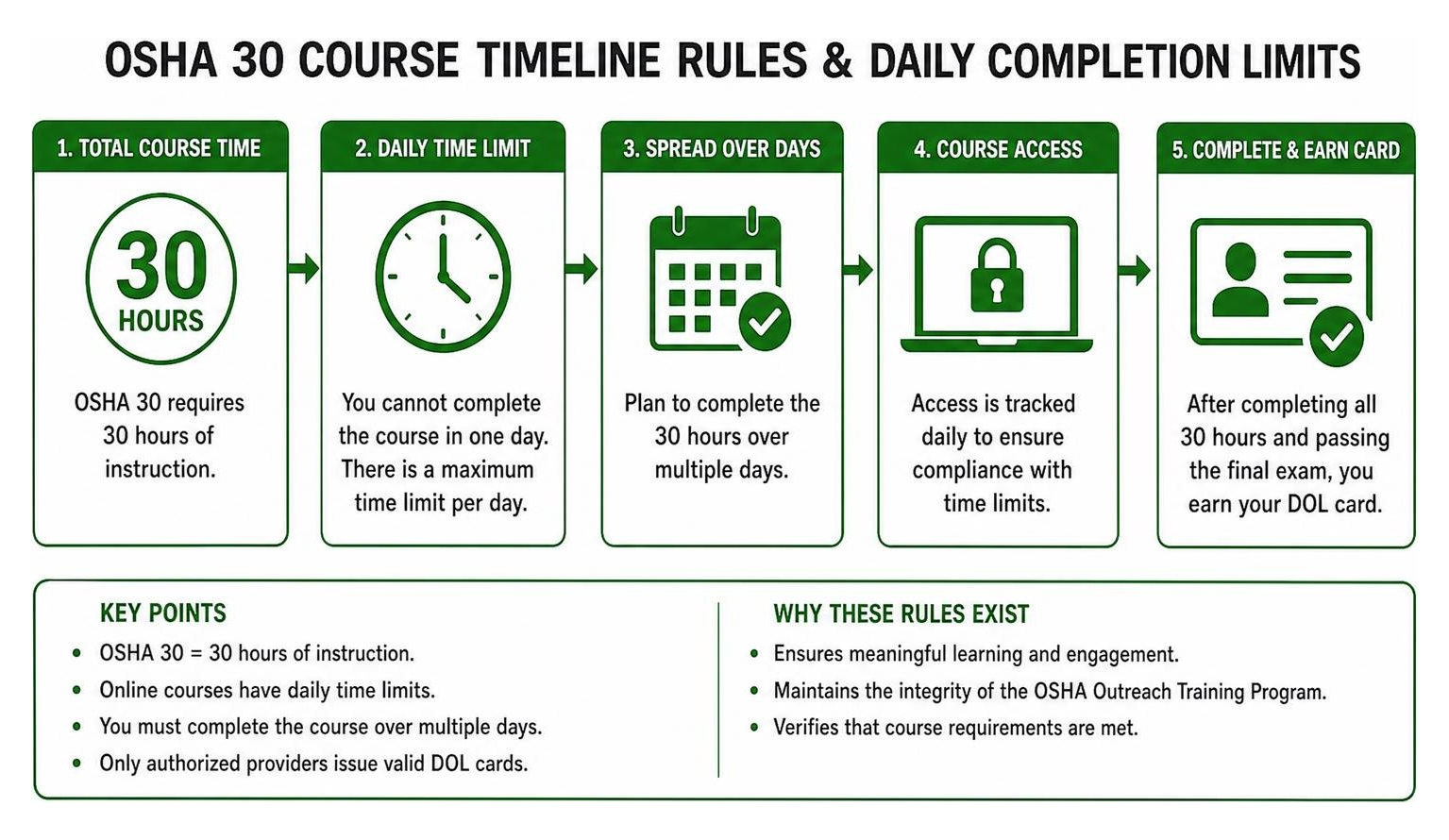
When you take an OSHA 30 training course, you earn an official U.S. Department of Labor (DOL) plastic wallet card. To ensure the integrity of the program, OSHA requires that online training be completed strictly through authorized providers. Unlisted vendors cannot deliver valid DOL cards, so verifying trainer authorization before enrolling is essential.
Who Needs OSHA 30 Training for Site Safety?

While federal OSHA regulations do not explicitly mandate OSHA 30 training for every worker nationwide, it is widely required by general contractors, site managers, state laws, and project owners. It is tailored specifically for:
- Construction foremen, superintendents, and crew leads
- Job site safety coordinators and EHS specialists
- Facility supervisors, warehouse leads, and operations managers
- Subcontractors aiming to pre-qualify for commercial or government bids
Certain states—such as New York, Nevada, Massachusetts, Connecticut, Missouri, New Hampshire, and Rhode Island—have state-specific plan regulations or statutes mandating OSHA 30 credentials for supervisors on covered public works or commercial projects.
If you are expanding your crew’s site qualifications, you can get started with OSHA 30-Hour Construction Industry Training to fulfill site prerequisites. You can also learn who needs OSHA 10 vs OSHA 30 training or review OSHA training requirements for the construction industry to ensure complete regulatory coverage.
Course Format, Time Constraints, and Passing Rules
The OSHA 30 training curriculum spans 30 instructional hours broken into core, elective, and optional safety modules. However, federal OSHA Outreach guidelines enforce strict scheduling limits to ensure real comprehension:
- Daily Limit: OSHA caps learning at a maximum of 7.5 hours per calendar day. This means a 30-hour course requires a minimum of 4 to 5 calendar days to complete.
- Completion Deadline: Enrolled students are given a strict 180-day (6-month) window from enrollment to complete all modules and required surveys.
- Quizzes and Exams: Courses typically contain 17 to 23 modules. Each module ends with a 10-question quiz, followed by a comprehensive final exam (typically 20 to 30 questions).
- Passing Requirements: Students must score at least 70% on all quizzes and the final exam within a maximum of 3 attempts. Failing an exam three times results in a system lockout, requiring the student to re-enroll.
- Card Delivery: Once you pass the final exam and fill out the mandatory end-of-course survey, a temporary completion certificate is available immediately. The physical plastic DOL wallet card is mailed via USPS First Class within 2 weeks.
To evaluate non-construction operations, you can explore OSHA 30-Hour General Industry Training details to review specific supervisory requirements.
OSHA 30 Construction vs General Industry Programs
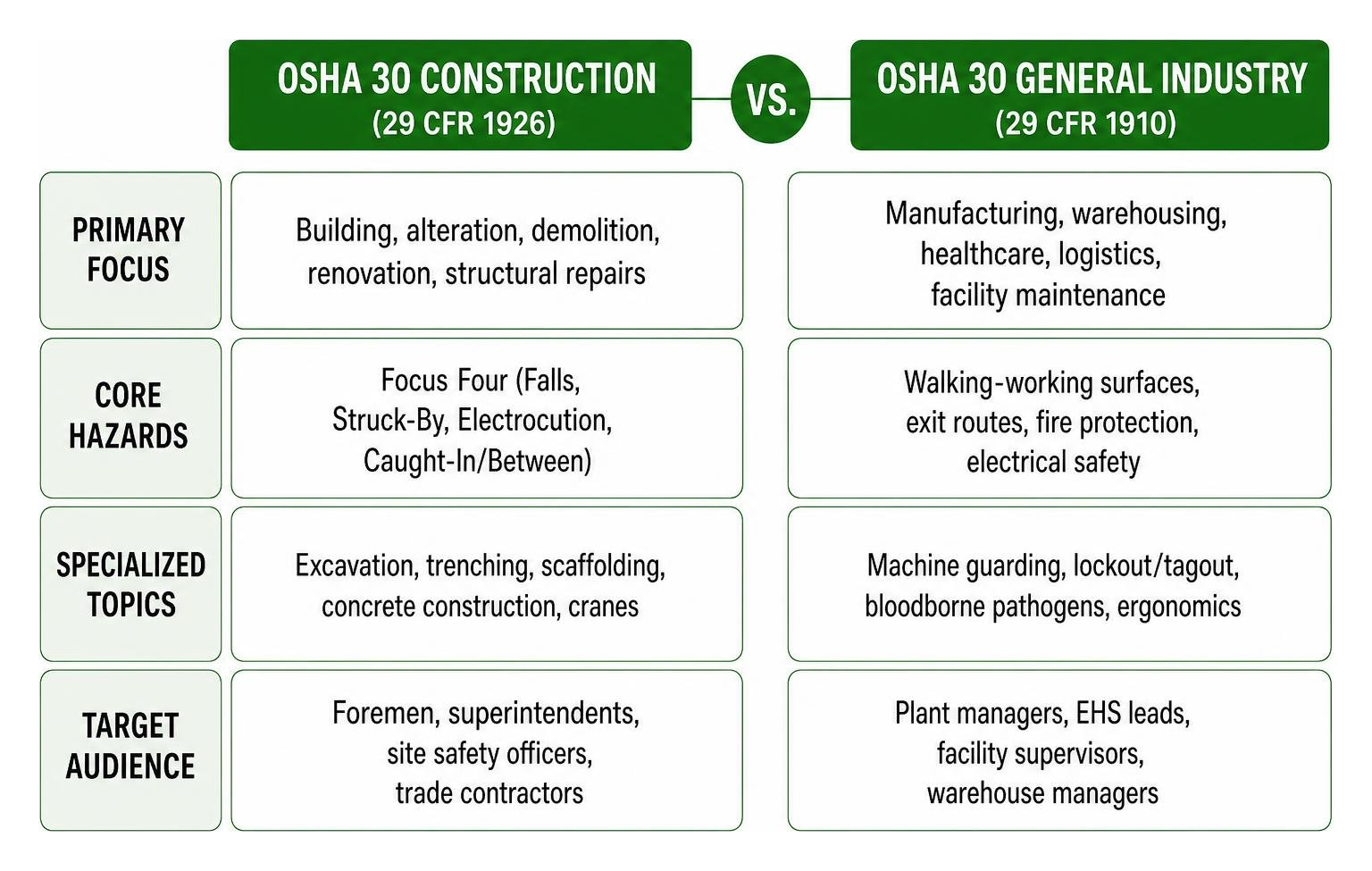
Choosing between Construction and General Industry depends directly on the primary operations taking place at your workplace.
| Feature / Standard | OSHA 30 Construction (29 CFR 1926) | OSHA 30 General Industry (29 CFR 1910) |
|---|---|---|
| Primary Focus | Building, alteration, demolition, renovation, structural repairs | Manufacturing, warehousing, healthcare, logistics, facility maintenance |
| Core Hazards | Focus Four (Falls, Struck-By, Electrocution, Caught-In/Between) | Walking-working surfaces, exit routes, fire protection, electrical safety |
| Specialized Topics | Excavation, trenching, scaffolding, concrete construction, cranes | Machine guarding, lockout/tagout, bloodborne pathogens, ergonomics |
| Target Audience | Foremen, superintendents, site safety officers, trade contractors | Plant managers, EHS leads, facility supervisors, warehouse managers |
Key Differences: OSHA 10 vs OSHA 30 Training
The primary distinction between OSHA 10 and OSHA 30 is the depth of training and level of site authority:
- OSHA 10-Hour: Designed for entry-level workers. It provides basic awareness of common job site hazards and worker rights.
- OSHA 30-Hour: Designed for crew leaders, foremen, safety directors, and managers. It provides comprehensive hazard recognition, site compliance strategies, and safety management tools.
While OSHA 10 costs less initially, investing in OSHA 30 is often required for taking on leadership roles. Before making your decision, you can understand the difference between OSHA 10 and OSHA 30 training, read our guide on OSHA 10 certification costs, or find out if free OSHA 30 training online is available to compare options.
DOL Card Validity, Expiration, and Replacement Rules
Under federal OSHA rules, official Department of Labor cards issued for construction and general industry do not expire. They feature an official issue date rather than an expiration date.
However, because regulations and job site practices evolve, most general contractors, union locals, and state authorities require workers to retake OSHA 30 training every 3 to 5 years. For example, under New York City’s Local Law 196 (Site Safety Training / SST), supervisors are required to maintain actively proctored certifications and periodic upgrades.
If your DOL card is lost or damaged, OSHA rules allow only one replacement card per student within 5 years of the original course completion date. If a replacement card is lost again or if the 5-year window has passed, you must retake the entire 30-hour course.
To maintain compliance across your organization, you can learn about OSHA in the workplace or explore general OSHA compliance training solutions.
Career Benefits, Costs, and Industry Comparison
An OSHA 30 training card is a valuable investment for safety professionals and tradespeople alike. Average individual pricing for an online OSHA 30 course runs around $159, with volume discounts frequently available for business teams and specialized educational pricing for K-12 career and technical education (CTE) programs.
Holding an OSHA 30 card significantly enhances earning potential. OSHA-trained workers in construction and industrial sectors frequently earn between $20 and $35+ per hour, as the credential qualifies candidates for higher-paying supervisory roles such as Assistant Superintendent, Foreman, and Site Safety Manager. For contractors, having OSHA 30-certified supervisors simplifies subcontractor pre-qualification and helps secure contract awards on commercial and government projects.
OSHA 30 vs Other Safety Credentials (HAZWOPER and EM 385)
While OSHA 30 training covers general workplace hazard recognition, specialized industries require dedicated safety certifications:
- HAZWOPER (24-Hour / 40-Hour): Governed by 29 CFR 1910.120, HAZWOPER is legally required for personnel working with uncontrolled hazardous waste sites, chemical spills, or emergency response.
- EM 385-1-1: Mandatory 16-hour, 24-hour, or 40-hour safety training standard established by the U.S. Army Corps of Engineers (USACE) for military and federal construction contracts.
If your job sites involve hazardous waste or military contracts, you can compare 40-hour vs 24-hour HAZWOPER courses, explore initial HAZWOPER training courses, or review safety certifications for construction career growth.
Advancing Your Career with ZOTA Professional Training
At ZOTA Professional Training, we provide flexible, high-impact safety solutions designed to keep your projects fully compliant and your crew safe. Whether you prefer online, hybrid, or customized group sessions with nationwide support, we help you meet regulatory demands efficiently.
Key benefits of completing OSHA 30 safety training with us include:
- Enhanced Site Safety: Reduces lost-time injuries, workplace incidents, and costly OSHA citations.
- Regulatory Peace of Mind: Fulfills general contractor mandates and state compliance standards.
- Career Growth: Unlocks supervisory opportunities and higher hourly earnings.
- Comprehensive Hazard Control: Equips safety leads to address fall risks, electrical hazards, chemical exposure, and emergency planning proactively.
Ready to upgrade your credentials or train your leadership team? You can enroll directly in OSHA 30-Hour Construction Industry Training today and take the next step toward a safer, more profitable project site.