

What Is EPA Lead Renovator Certification and Who Needs It?
EPA lead renovator certification is a federal requirement for any contractor paid to disturb painted surfaces in homes or child-occupied facilities built before 1978.
Here’s what you need to know at a glance:
- Who needs it: Any firm or individual paid to perform renovation, repair, or painting work that disturbs paint in pre-1978 housing or child-occupied facilities
- Individual training: Complete an 8-hour EPA-accredited course (includes 2 hours of hands-on learning)
- Firm certification: Apply through the EPA’s CDX portal and pay a $300 fee
- How long it lasts: 5 years for firms; 3 or 5 years for individual renovators depending on refresher type
- Where it applies: All U.S. states except the 15 that run their own authorized programs (including Alabama, Georgia, Oregon, and Washington)
This matters because roughly three-quarters of all U.S. homes built before 1978 still contain lead-based paint. Disturbing that paint without proper training and certification puts your clients, your crew, and your business at legal risk.
The good news? You don’t need a separate prep course before taking your certification training. The accredited 8-hour initial course is the path to certification — no additional preparation required.
I’m Bob Zak, Founder and CEO of ZOTA Professional Training and a safety professional with over 32 years of experience in occupational health — including helping thousands of contractors navigate EPA lead renovator certification requirements since founding ZOTA in 2004. In this guide, I’ll walk you through exactly what the certification process involves, what your on-the-job responsibilities are, and how to stay compliant long-term.
Understanding the EPA’s RRP Rule and Lead Safety Requirements
To understand why this certification is so strictly enforced, we have to look at the Environmental Protection Agency’s (EPA) Renovation, Repair, and Painting (RRP) Rule. Published to protect the public from the highly toxic effects of lead dust, the RRP Rule establishes clear safety standards for anyone working on older properties.
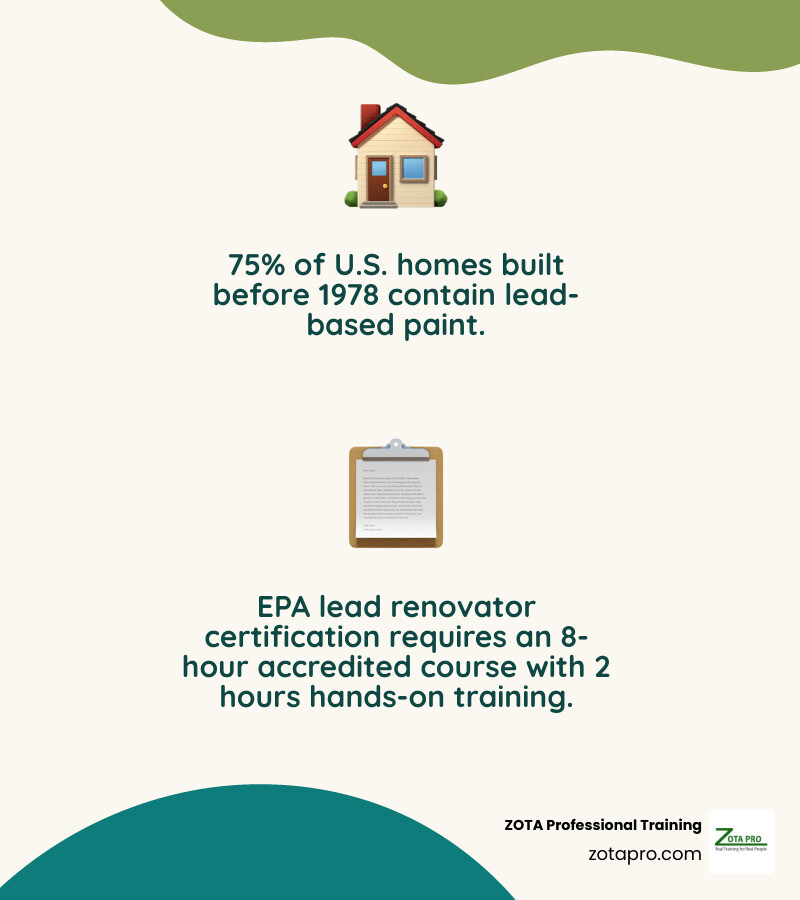
Lead-based paint was widely used across the United States before the federal government banned its residential sale in 1978. Because lead is a powerful neurotoxin that can cause irreversible brain damage, developmental delays in children, and high blood pressure in adults, the EPA takes paint-disturbing activities very seriously. In fact, approximately 75% of all homes built in the U.S. before 1978 still contain some lead-based paint.
The RRP Rule applies specifically to “target housing” and “child-occupied facilities.”
- Target Housing: Any residential dwelling built before 1978, excluding zero-bedroom dwellings (like studio apartments) or housing designated specifically for the elderly or disabled (unless a child under the age of six resides or is expected to reside there).
- Child-Occupied Facilities: Buildings built before 1978 that are visited regularly by the same child under six years of age. This includes daycares, preschools, and kindergarten classrooms.
If you are a general contractor, painter, plumber, electrician, property manager, or even a landlord performing DIY work on your own rental properties, the RRP Rule applies to you. Any paid work that disturbs more than 6 square feet of interior painted surface per room, or more than 20 square feet of exterior painted surface, triggers the need for compliance.
Failing to follow these guidelines can result in massive federal fines. Fortunately, obtaining your credentials is straightforward. To learn more about how this regulation shields your business from liability, check out our detailed guide on What is an RRP Certification and How Does It Benefit Contractors?. You can also review the federal framework directly on the Lead Renovation, Repair and Painting Program | US EPA page.
Step-by-Step Guide to Obtaining Your EPA Lead Renovator Certification
Many contractors believe they need to take a costly, time-consuming “prep course” before sitting for their lead renovator exam. Let us bust that myth right now: there is no prep course required.
The official certification pathway is designed to be highly accessible. You do not need to study complex textbooks on your own or take pre-exams. Instead, you simply enroll in an accredited training course, complete the classroom and hands-on modules, and take the certification exam at the very end of the class.

To get fully certified and legally operate on pre-1978 properties, you must complete a two-part process:
- Get Certified as an Individual: Complete the accredited 8-hour training course.
- Get Certified as a Firm: Submit an application and fee to the EPA (or your authorized state agency) to register your business.
We have simplified the steps to navigate this entire process in our guide on the Steps to Obtain EPA Lead Certification. If you are ready to jump straight into your individual training, you can sign up directly for our EPA Lead Renovator Initial Course.
Training Requirements for Individual EPA Lead Renovator Certification
For an individual to become a certified renovator, they must complete an 8-hour EPA-accredited training course. This course is divided into two distinct components:
- 6 Hours of Classroom Instruction: This covers the science of lead poisoning, the legal requirements of the RRP Rule, how to set up containment, and how to safely clean and verify the job site.
- 2 Hours of Hands-on Learning: Under the direct supervision of an accredited instructor, you will practice using EPA-recognized lead test kits, setting up heavy-duty plastic barriers, and performing the final cleaning verification protocol.
At the end of the 8 hours, you will take a 25-question multiple-choice exam. Because the course is comprehensive and hands-on, the vast majority of students pass the test on their first attempt without any prior preparation.
The curriculum we teach is based on the official Model Renovator Initial Training Course | US EPA, which is updated regularly to reflect the latest safety standards. To learn more about what to expect on your training day, read our breakdown of What Are the Requirements for EPA Lead Renovator Certification?.
How to Apply for EPA Lead Renovator Certification Firm Credentials
Once you have a certified individual on your team, you are halfway there. However, the EPA requires that the firm itself also be certified. Individual certification alone does not legally allow a business to advertise or perform lead-safe renovations.
To obtain your firm credentials, follow these steps:
- Navigate to the EPA’s Central Data Exchange (CDX) portal online.
- Complete the online application for “Renovation Firm Certification.”
- Pay the required fee of $300 (or $20 if you are registering a tribal firm).
- Submit your application.
The EPA typically processes firm applications within one to two weeks. Once approved, your certificate and a customized “Lead-Safe Certified Firm” logo will be sent directly to your CDX inbox.
Pro Tip: To ensure you receive your documents without delay, add lead.paint@epa.gov to your email contact list so the approval email doesn’t get sent to your spam folder. If you haven’t received your certificate after two weeks, log back into your CDX account and check your internal CDX inbox directly.
That firm certifications are valid for five years and are completely non-transferable. If you sell your business or change ownership structures, the new owner must apply for a brand-new certification. Additionally, you must amend your firm’s certification within 90 days of any major administrative changes, such as a change in your business name or physical address.
For a complete overview of the business registration process, visit our hub on EPA Lead Certification or read the federal guidelines on the Renovation, Repair and Painting Program: Firm Certification | US EPA page.
Key Responsibilities and Lead-Safe Work Practices on the Job Site
As a certified renovator, you are the designated lead safety expert on your job site. It is your responsibility to ensure that all work is performed in strict compliance with federal law.

Your primary duties on the job site include:
- Worker Training: You must provide documented, on-the-job training to all non-certified crew members, teaching them how to use lead-safe work practices.
- Physical Presence: You must be physically present on-site during critical stages of the project, including when warning signs are posted, when containment barriers are established, and during the final post-renovation cleanup and cleaning verification.
- Lead Testing: Before any work begins, you must use an EPA-recognized test kit or collect paint chip samples for laboratory analysis to determine if lead-based paint is actually present. If testing shows no lead, the RRP work practices are not required.
When lead is present, you must execute strict containment protocols:
- Interior Containment: You must isolate the work area by sealing all heating and cooling vents, covering doors and windows with heavy plastic sheeting, and laying down protective plastic on the floor extending at least 6 feet from the paint-disturbing activity.
- Exterior Containment: You must lay down heavy-duty plastic sheeting on the ground extending at least 10 feet from the work area. If the property line is too close to allow a 10-foot boundary, you must erect vertical containment barriers to prevent dust from drifting onto neighboring properties.
Furthermore, the EPA strictly prohibits certain high-dust renovation methods:
- Open-flame burning or torching of lead-based paint.
- Operating a heat gun at temperatures above 1100 degrees Fahrenheit.
- Using high-speed power tools (like sanders, grinders, or planers) without a shrouded HEPA vacuum attachment.
The 2026 Dust-Lead Action Levels
As of January 12, 2026, the EPA implemented highly stringent revised dust-lead action levels (previously referred to as dust-lead clearance levels). These updated standards drastically lower the amount of lead dust allowed to remain on floors and window sills after a project is completed. Because of these tighter limits, utilizing a dual-bucket mopping system and HEPA-filtered vacuums during final cleanup is more important than ever.
To ensure your team is using the correct cleanup procedures, consult the official Small Entity Compliance Guide to Renovate Right and review consumer safety expectations in the Lead-Safe Certified Guide to Renovate Right.
Pre-Renovation Education and Recordkeeping Compliance
Before a single hammer swings on a pre-1978 property, you must comply with the EPA’s pre-renovation education requirements. This involves distributing the official EPA pamphlet, “Renovate Right: Important Lead Hazard Information for Families, Child Care Providers and Schools,” to the property owners and occupants.
- Hand Delivery: You must deliver the pamphlet and obtain a signed and dated confirmation of receipt from the owner and tenants.
- Mailing Option: If hand delivery is not possible, you may mail the pamphlet. However, it must be sent via certified mail at least 7 days before the renovation begins, and you must retain the post office certificate of mailing.
- Self-Certification: If a tenant is unavailable or refuses to sign the receipt, you must document your good-faith delivery attempt (e.g., noting that you slipped the pamphlet under the door) on a self-certification form.
All compliance documentation must be kept on file for at least three years after the project is completed. To keep your business audit-proof, make sure you maintain a organized folder containing the following records:
- Signed “Renovate Right” pamphlet receipt forms or proof of mailing.
- Documentation of on-the-job training provided to non-certified workers.
- Lead testing results, including the brand and serial number of the test kits used.
- The signed RRP Work Practice Checklist, verifying that containment, wet-scraping, HEPA vacuuming, and cleaning verification were performed.
- Cleaning verification results, comparing your disposable wipes to the official EPA cleaning verification card.
Managing Recertification, Expirations, and State-Specific Rules
Staying compliant means keeping a close eye on your expiration dates. Both firm certifications and individual renovator certifications expire and must be renewed to avoid costly work stoppages.
For firms, you must submit your recertification application at least 90 days before your current 5-year certification expires. This “90-day rule” ensures the EPA has plenty of time to process your paperwork. If you apply late and your certification expires before the EPA approves the renewal, your firm cannot legally perform any RRP work until the new credentials are officially issued.

For individual renovators, maintaining your certification depends on which type of refresher course you choose. You must complete a 4-hour refresher course before your current 5-year initial certificate expires.
| Refresher Course Type | Certification Validity Period | Hands-On Training Required? |
|---|---|---|
| In-Person / Hybrid Refresher | 5 Years | Yes |
| Online-Only Refresher | 3 Years | No (Hands-on skipped this cycle) |
Note: If you choose the online-only refresher, you are only certified for 3 years, and you must take a course with a hands-on component during your next renewal cycle to maintain the alternating schedule.
To explore which renewal path works best for your schedule, read our guides on How Long Does EPA Lead Certification Last and How to Renew It and Online vs. In-Person EPA Lead Certification: Which is Better?.
State-Authorized RRP Programs vs. Federal EPA Jurisdiction
While the EPA administers the RRP program federally, 15 states and 1 tribe have received authorization to run their own individual lead renovator programs. If you operate in any of the following jurisdictions, you must apply directly to their state agency rather than the federal EPA CDX portal:
- Alabama
- Delaware
- Georgia
- Iowa
- Kansas
- Massachusetts
- Mississippi
- North Carolina
- Oklahoma
- Oregon
- Rhode Island
- Utah
- Vermont
- Washington
- Wisconsin
- The Bois Forte Band of Chippewa (Minnesota)
Firms working across state lines must be careful. For example, if you run a remodeling business in Georgia (state-run) but occasionally take jobs across the border in South Carolina (federally run), you must hold separate certifications from both the Georgia state program and the federal EPA.
For more details on navigating these regional boundaries, check the Renovation, Repair and Painting Program: Renovator Training | US EPA resource page.
Frequently Asked Questions about EPA Lead Renovator Certification
Navigating federal regulations can lead to plenty of questions. Here are the answers to the most common queries we receive from contractors.
What is the difference between a lead renovation (RRP) and a lead abatement project?
It is common to confuse RRP with lead abatement, but they are entirely different activities under federal law:
- Renovation, Repair, and Painting (RRP): These are temporary, localized construction activities. The primary goal is to remodel, repair, or paint a home, and lead-safe work practices are used simply to minimize exposure while disturbing the paint.
- Lead Abatement: This is a specialized, highly regulated process designed specifically to permanently eliminate lead-based paint hazards. Abatement projects are often ordered by state health departments or court systems, and they require specialized lead abatement supervisor or worker credentials, which are separate from RRP certifications.
What happens if my EPA lead renovator certification expires?
There is absolutely no grace period for an expired renovator certification. If your certification expires by even a single day, you are no longer legally certified. You cannot take the shorter 4-hour refresher course; instead, you must retake the full 8-hour initial training course to regain your credentials. Always schedule your refresher course at least a few months before your expiration date to protect your business.
How much does it cost to get and maintain EPA firm certification?
The federal fee for EPA firm certification or recertification is $300. This fee registers your business with the EPA for a period of five years. If you are operating a tribal firm, the fee is reduced to $20. Replacement certificates cost $15. If you submit an application and decide to withdraw it, the EPA offers a sliding scale refund policy depending on how quickly you cancel (ranging from a 100% refund within 10 days down to a 25% refund after 121 days).
Conclusion
Obtaining your EPA lead renovator certification is one of the smartest moves you can make for your contracting business. It protects your workers, keeps your clients safe from toxic lead dust, and shields your company from devastating federal fines. Best of all, you don’t need to waste time or money on a separate prep course — the official 8-hour training covers everything you need to succeed.
At ZOTA Professional Training, we make compliance simple. We offer flexible, accredited training courses, including hybrid and group training options with nationwide on-site support. Our classes are fully bilingual (English and Spanish) to ensure your entire crew gets the high-quality instruction they need.
Don’t let your certifications lapse or put off getting licensed. Visit our EPA Lead Certification page today to find an upcoming class in your area and secure your credentials!