
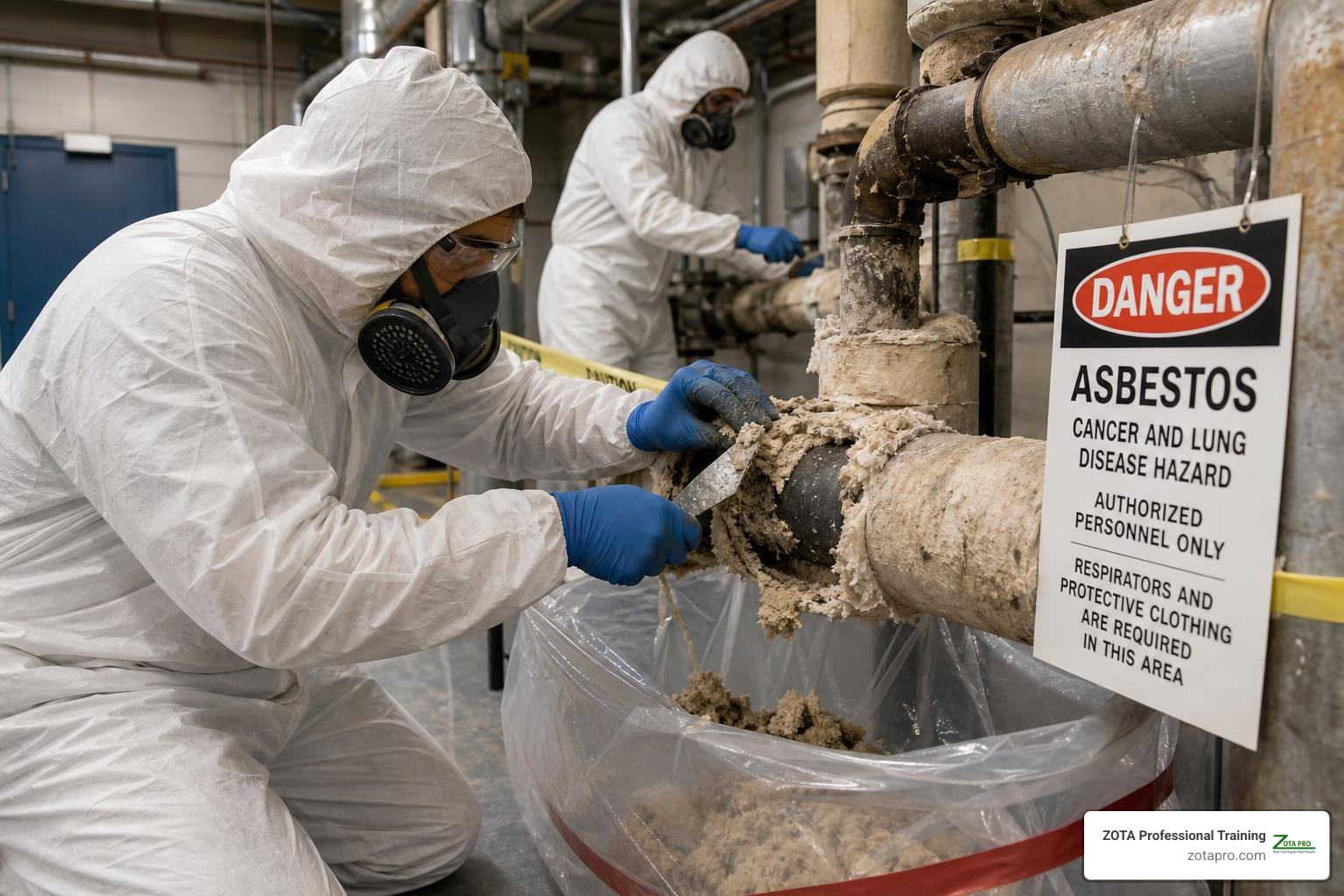
Why Every Contractor Needs to Understand Asbestos Class 1 Work
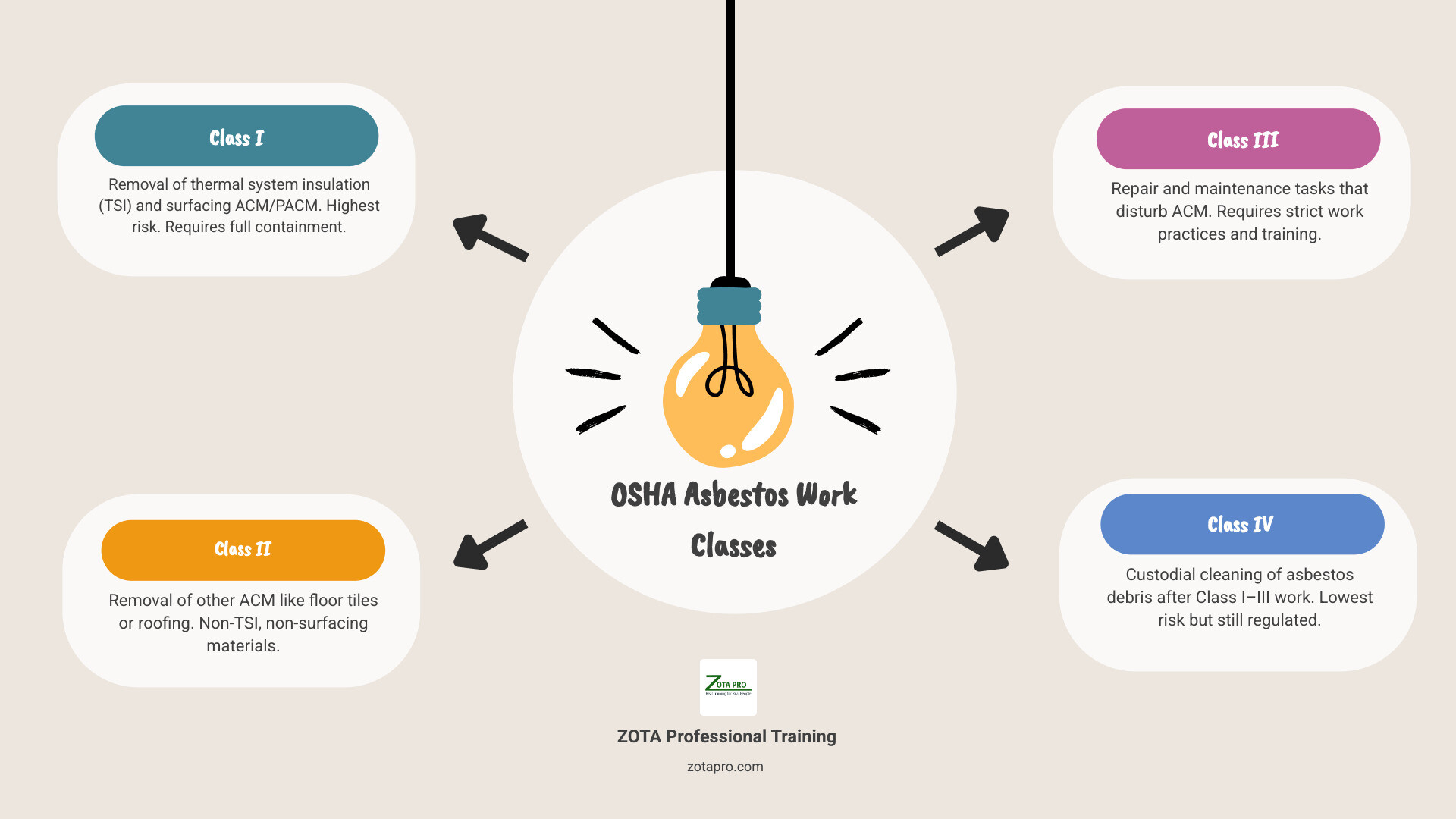
Asbestos Class 1 work is the highest-risk category of asbestos activity recognized by OSHA — and it comes with the strictest rules of any asbestos job classification. Here’s a fast overview of all four classes:
| Class | Type of Work | Example |
|---|---|---|
| Class I | Removal of Thermal System Insulation (TSI) and surfacing ACM/PACM | Removing pipe insulation or sprayed-on fireproofing |
| Class II | Removal of other asbestos-containing materials (non-TSI, non-surfacing) | Tearing out asbestos floor tiles or roofing shingles |
| Class III | Repair and maintenance that disturbs ACM | Cutting through a wall where ACM may be present |
| Class IV | Custodial tasks near ACM; cleanup after Class I–III work | Sweeping up debris after an abatement project |
If your renovation crew is working in a pre-1980 building, there’s a real chance they’ll encounter materials that fall under one of these classes — possibly Class I — without even realizing it.
OSHA governs all four classes under 29 CFR 1926.1101, the Construction Standard for asbestos. The consequences of misclassifying the work — or skipping required training — can mean serious health risks for your workers and major fines for your business.
I’m Bob Zak, Founder and CEO of ZOTA Professional Training, and with over 32 years in occupational health and safety, I’ve helped thousands of contractors understand exactly where their projects fall on the asbestos Class 1 through Class IV spectrum. In the sections below, I’ll walk you through each class clearly so you can keep your crew safe and your projects compliant.
Demystifying OSHA Asbestos Class 1 Work and Other Classifications

When we step onto a job site, understanding the boundaries of our work dictates the safety protocols we must deploy. OSHA’s construction standard, 29 CFR 1926.1101, organizes asbestos-related activities into four distinct classes. These classes are not arbitrary; they are strictly aligned with the potential for fiber release and the corresponding hazard level of the materials being handled.
Misclassifying a project is one of the quickest ways to trigger severe OSHA penalties and, worse, compromise worker health. Let us break down what defines these categories and how they differ under the law.
What is Asbestos Class 1 Work?
By official OSHA definition, asbestos Class 1 work involves activities that remove Thermal System Insulation (TSI) and surfacing Asbestos-Containing Material (ACM) or Presumed Asbestos-Containing Material (PACM).
- Thermal System Insulation (TSI): This includes ACM applied to pipes, boilers, tanks, ducts, or other structural components to prevent heat loss or gain.
- Surfacing ACM: This refers to materials that have been sprayed, troweled, or otherwise applied to surfaces. Examples include decorative plaster on walls, acoustical ceiling textures (like popcorn ceilings), and fireproofing materials on structural steel.
- Presumed Asbestos-Containing Material (PACM): Under OSHA standards, if a building was constructed no later than 1980, we must legally presume that all TSI and surfacing materials contain asbestos unless certified testing proves otherwise.
These materials are highly hazardous because they are often friable—meaning they can easily be crumbled, pulverized, or reduced to powder by hand pressure when dry. When disturbed, they release millions of microscopic fibers into the air.
Understanding the mineralogical makeup of these fibers explains why they are so dangerous. Serpentine asbestos (such as chrysotile) features curly, flexible structures, while amphibole asbestos (including amosite and crocidolite) consists of extremely sharp, needle-like crystals. To learn more about how these mineral properties affect safety standards, you can read the Scientific research on asbestos mineral properties. For practical tips on identifying these hazards in residential or commercial structures, check out our guide with More info on identifying asbestos in walls.
Comparing Class I to Class II, III, and IV Operations
While Class I work tackles the highest-risk materials, the other three classes cover progressively localized or indirect exposure risks:
- Class II Asbestos Work: This class involves the removal of ACM that is not TSI or surfacing material. Common examples include asbestos-containing vinyl floor tiles, mastic, roofing shingles, transite panels, and exterior siding. While these materials are generally non-friable when intact, they can become friable if cut, sanded, or broken during removal.
- Class III Asbestos Work: This level is limited to repair and maintenance operations where ACM (including TSI and surfacing material) is likely to be disturbed but is not being fully removed. The waste generated in Class III operations must fit entirely within a single standard glovebag or waste bag.
- Class IV Asbestos Work: This class covers custodial and maintenance activities where workers contact but do not intentionally disturb ACM, as well as the cleanup of dust and debris left behind by Class I, II, or III operations.
Regardless of the class, we must always keep exposure levels below OSHA’s Permissible Exposure Limit (PEL) of 0.1 fibers per cubic centimeter of air (0.1 f/cc) as an 8-hour time-weighted average (TWA), and the excursion limit of 1.0 f/cc averaged over a 30-minute period.
It is also vital to recognize the distinction between construction and general industry rules. While construction work is governed by 29 CFR 1926.1101, general industry facilities (like manufacturing plants or automotive shops) must follow 29 CFR 1910.1001. For a detailed breakdown of these differences, consult the OSHA General Industry vs Construction standards. If you are looking to hire or prepare for an abatement project, you can find More info on professional asbestos removal.
Strict Compliance Standards for Asbestos Class 1 Projects
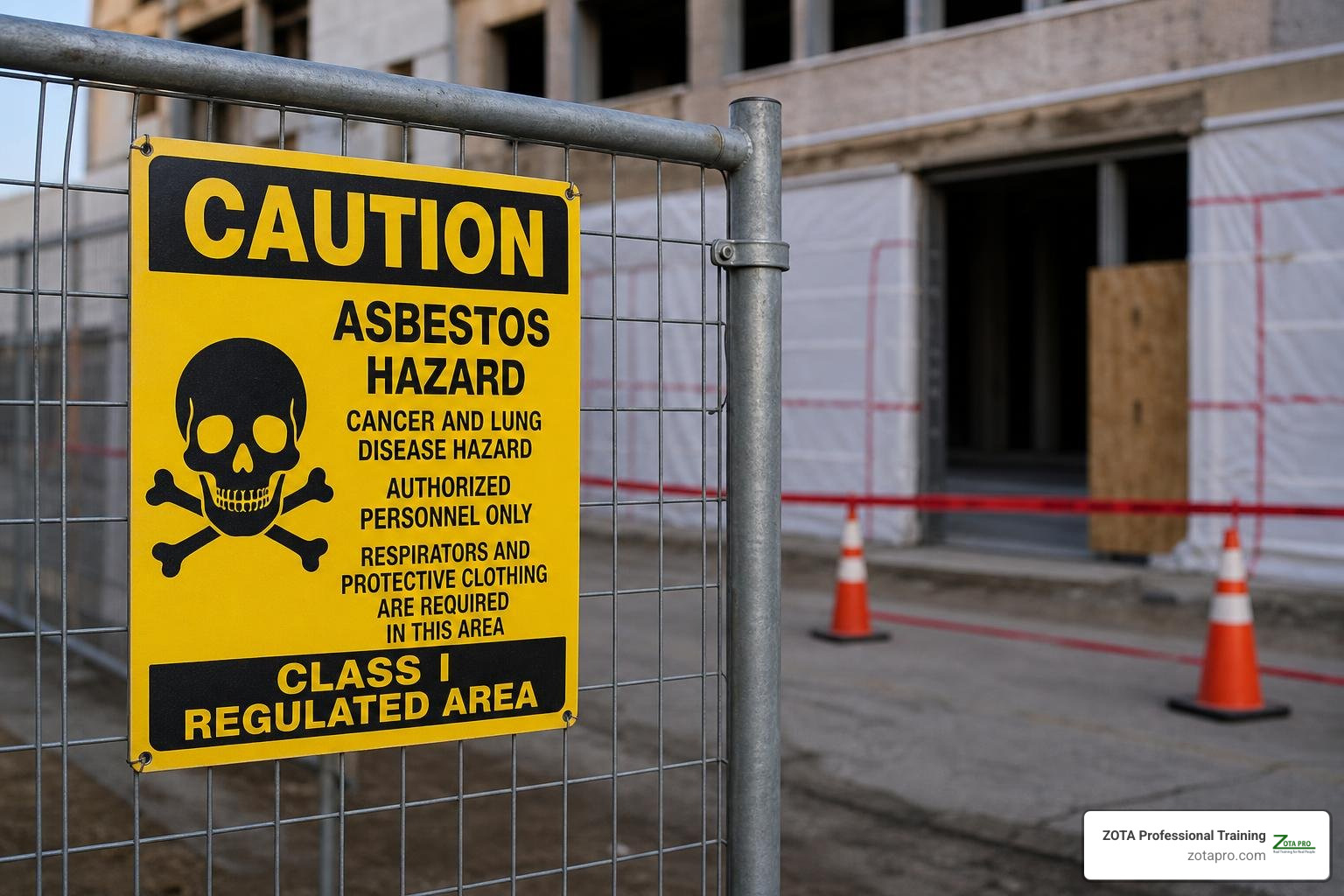
Because asbestos Class 1 work involves high-risk, friable materials, the safety standards are incredibly strict. Every Class I project must be supervised by a designated “Competent Person” who has the authority to intervene and shut down operations if safety protocols are breached.
Additionally, we must establish a clearly demarcated “regulated area” to isolate the work. Access is restricted to authorized personnel who are fully trained and wearing appropriate protective equipment. Warning signs must be posted at all entrances and read:
DANGER ASBESTOS MAY CAUSE CANCER CAUSES DAMAGE TO LUNGS AUTHORIZED PERSONNEL ONLY WEAR RESPIRATORY PROTECTION AND PROTECTIVE CLOTHING IN THIS AREA
Engineering Controls and Containment for Asbestos Class 1
For any Class I job involving the removal of more than 25 linear feet or 10 square feet of TSI or surfacing ACM, we must establish a Negative Pressure Enclosure (NPE).
- Pressure Differential: The NPE must maintain a minimum of -0.02 column inches of water pressure differential relative to the outside area to prevent airborne fibers from escaping.
- Air Exchanges: The containment system must provide at least 4 air changes per hour.
- Critical Barriers: All openings, including windows, doors, and vents, must be sealed with a double layer of 6 mil plastic sheeting. HVAC systems within the regulated area must be completely isolated.
- Glovebag Systems: When removing insulation directly from pipes, seamless 6 mil thick glovebags may be used. However, these systems cannot be used on surfaces where temperatures exceed 150°F.
- Wet Methods: We must use wet methods (amended water) to suppress dust during all handling and removal processes. Dry sweeping or using compressed air to clean up debris is strictly prohibited.
To dive deeper into these strict containment and engineering requirements, refer directly to the OSHA Construction Standard 1926.1101. For broader strategies on facility safety, read More info on managing asbestos safely.
PPE, Respiratory Protection, and Medical Surveillance
When it comes to respiratory protection during Class I projects, we cannot cut corners. OSHA automatically presumes that workers are exposed above the PEL until a Negative Exposure Assessment (NEA) is established.
- Respirator Selection: If exposure levels are expected to exceed 1.0 f/cc, workers must use a full facepiece Supplied-Air Respirator (SAR) operated in pressure-demand mode, equipped with an auxiliary positive-pressure Self-Contained Breathing Apparatus (SCBA). If exposures are below 1.0 f/cc and no NEA is available, tight-fitting Powered Air-Purifying Respirators (PAPRs) or SARs with HEPA egress cartridges are required. Filtering facepieces (dust masks) are strictly prohibited.
- Protective Clothing: Workers must wear full-body disposable coveralls, head coverings, and foot coverings.
- Medical Surveillance: This is mandatory for any employee who wears a negative pressure respirator or is exposed to asbestos above the PEL for 30 or more days per year, or who performs Class I, II, or III work for a combined total of 30 or more days annually. This includes chest X-rays, pulmonary function tests, and physical examinations.
For official guidance on respirator selection and compliance, you can review the OSHA respirator standard interpretations. For more details on choosing the correct protective suits, explore More info on asbestos removal clothing.
Decontamination, Waste Disposal, and EPA NESHAP Notifications
Proper hygiene and waste management are essential to prevent cross-contamination outside the regulated area.
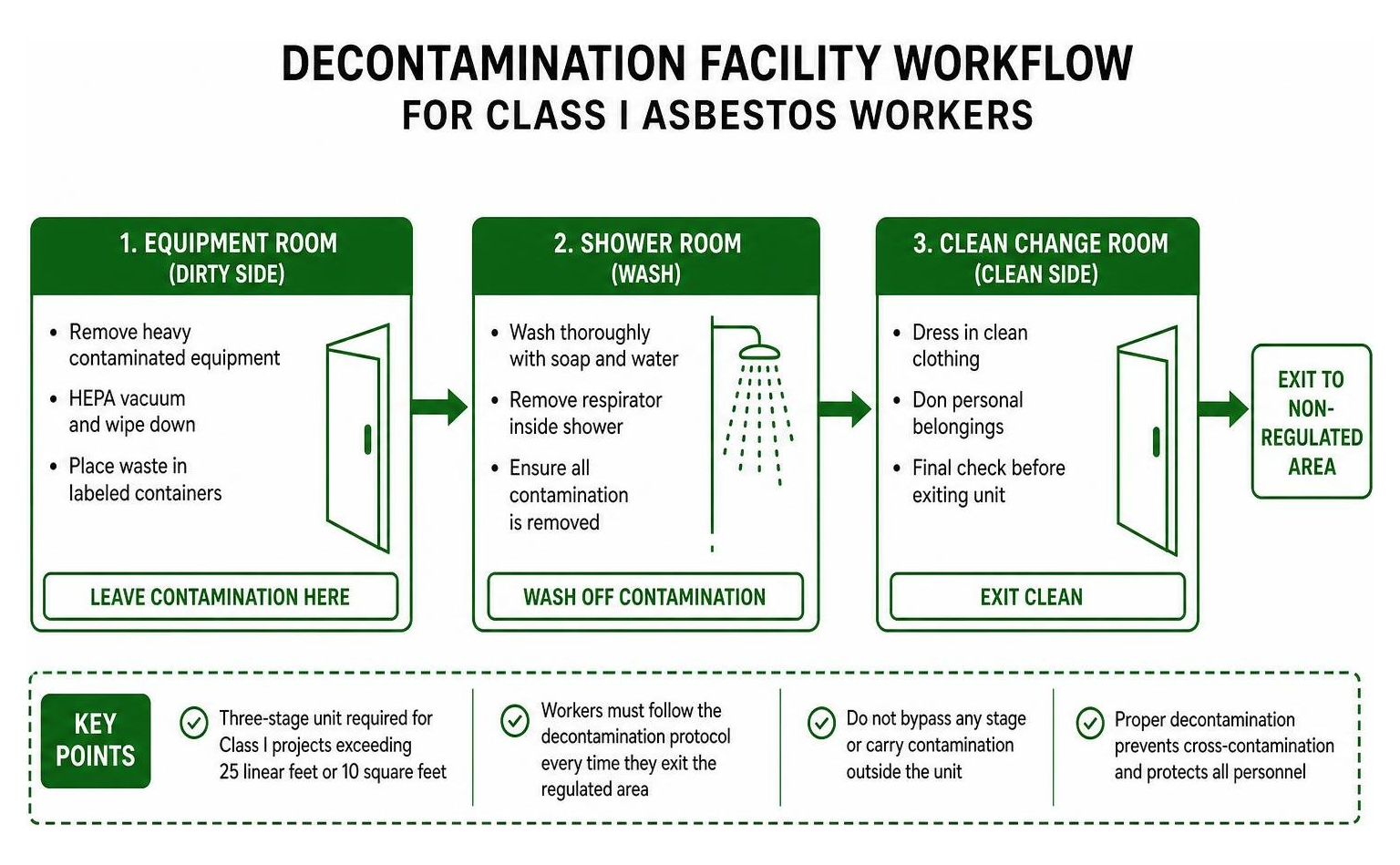
- Decontamination Facilities: For Class I projects exceeding 25 linear feet or 10 square feet, we must set up a three-stage decontamination unit adjacent to the regulated area. This includes an equipment room, a shower room (with hot and cold water), and a clean change room. Workers must follow a strict decontamination protocol every time they exit the work area.
- Waste Disposal: All asbestos waste must be sealed in leak-tight, labeled, impermeable containers (such as double 6 mil plastic bags) while still wet, and disposed of at approved hazardous waste landfills.
- EPA NESHAP Notifications: Under the EPA National Emission Standards for Hazardous Air Pollutants (NESHAP), we must submit a written notification to the EPA or state agency at least 10 working days before starting any demolition or renovation project that involves disturbing more than 160 square feet or 260 linear feet of Regulated Asbestos-Containing Material (RACM).
Before beginning any structural modifications, check out our guide with More info on checking for asbestos before remodeling.
Training and Certification Requirements for Workers
You cannot perform Class I asbestos work without proper, accredited training. At ZOTA Professional Training, we provide the essential courses required to keep your business compliant and your workforce safe.
- Class I Training Requirements: Workers performing Class I operations must complete a comprehensive 32-hour Asbestos Abatement Worker course accredited under the EPA Model Accreditation Plan (MAP).
- Other Classes: For comparison, Class II workers typically require an 8-hour course (unless state rules, like those in Texas, mandate the full 32-hour course), Class III requires 16 hours, and Class IV requires 2 hours of awareness training.
- Refresher Training: All certifications require annual refresher training to remain valid.
- The Cost of Non-Compliance: Working with asbestos without proper certification can lead to massive OSHA and EPA fines (up to $37,500 per violation for certain regulations), stop-work orders, and devastating long-term health liabilities.
We offer flexible, multilingual (English and Spanish) hybrid and group training options with nationwide on-site support to fit your schedule. To get your team certified, check out More info on EPA-accredited asbestos training and review our guide with More info on step-by-step asbestos certification. Keep your crew safe, stay compliant, and let us help you navigate your regulatory training needs today!