

Understanding OSHA 10 Training: Industry Types, Requirements, and Costs
At its core, osha 10 training focuses on fundamental hazard recognition and teaching non-supervisory workers how to identify, avoid, and report unsafe jobsite conditions. Between FY 2021 and FY 2025, more than 6.51 million workers were trained through the federal OSHA Outreach Training Program, demonstrating how vital this foundational safety instruction is across the country.
Understanding which standard governs your trade is essential before enrolling. The U.S. Department of Labor breaks safety regulations into distinct standards:
- 29 CFR 1926 standards: Enforces safety regulations governing construction, alteration, demolition, and structural repair work.
- 29 CFR 1910 standards: Governs general industry operations including warehousing, manufacturing, healthcare, automotive, and facilities maintenance.
To ensure you stay fully compliant with OSHA Training Requirements for Construction, review the primary differences between these training tracks below:
| Feature / Detail | OSHA 10 Construction | OSHA 10 General Industry |
|---|---|---|
| Primary Regulatory Standard | 29 CFR 1926 | 29 CFR 1910 |
| Target Audience | Entry-level construction, trade contractors, masons, electricians | Factory technicians, warehouse staff, logistics, healthcare workers |
| Primary Focus Areas | Focus Four hazards, scaffolding, ladders, demolition, excavations | Walking-working surfaces, machine guarding, hazard communication |
| Credential Issued | Official Construction Plastic DOL Wallet Card | Official General Industry Plastic DOL Wallet Card |
OSHA 10 Training vs OSHA 30 Training: Which Do You Need?
Choosing between 10-hour and 30-hour courses depends entirely on your position on the job site.
- OSHA 10-Hour Training: Designed specifically for entry-level workers and front-line trade personnel. It provides broad baseline knowledge of hazard recognition and worker rights.
- OSHA 30-Hour Training: Designed for site managers, project supervisors, safety coordinators, and foremen holding direct crew oversight responsibilities.
If you are unsure which level your job requires, review our guide on Who Needs OSHA 10 vs OSHA 30 Training and read our clear breakdown explaining What is the Difference Between OSHA 10 and OSHA 30 Training.
Construction workers taking the 10-hour course learn heavily about OSHA’s Focus Four hazards—the leading causes of jobsite fatalities:
- Falls: Unprotected edges, structural openings, and improper ladder or scaffold setup.
- Struck-By: Falling objects, swinging heavy equipment, and moving vehicles.
- Electrocution: Overhead power lines, ungrounded tools, and exposed wiring.
- Caught-In/Between: Trench cave-ins, unprotected machinery, and crushing hazards.
Construction vs General Industry Course Topics and Curriculum
While both tracks emphasize basic worker rights, filing OSHA complaints, and locating safety data sheets (SDS), the core modules differ significantly:
- Construction Topics: Deep dives into fall protection systems, personal protective equipment (PPE), tool safety, materials handling, stairways, and excavations. Gain hands-on insight with our specialized 10 Hour Construction Training.
- General Industry Topics: Heavy emphasis on walking-working surfaces, slip and trip prevention, hazard communication standards, bloodborne pathogens, electrical safety, machine guarding, and ergonomics. Explore comprehensive course details in our 10 Hour General Industry Training.
Cost, Free Alternatives, and OSHA-Authorized Providers
Prices for osha 10 training generally range between $59 and $89 for online self-paced options, while live group classroom sessions vary based on location and group size.
Be extremely cautious when selecting a provider. Federal OSHA explicitly warns that it cannot validate outreach cards issued by unauthorized vendors. Ensure your training provider is officially listed as an OSHA-authorized provider.
- Avoiding scams: Read our detailed OSHA 10 Certification Cost Guide to avoid overpaying or buying invalid cards.
- Exploring free options: Employers often cover all training costs, and high school CTE vocational programs often offer sponsored access. Learn more about legitimate options in our articles on Free Online OSHA 10 Courses and how you Get OSHA 10 Free.
How to Earn and Maintain Your Official OSHA 10 DOL Card
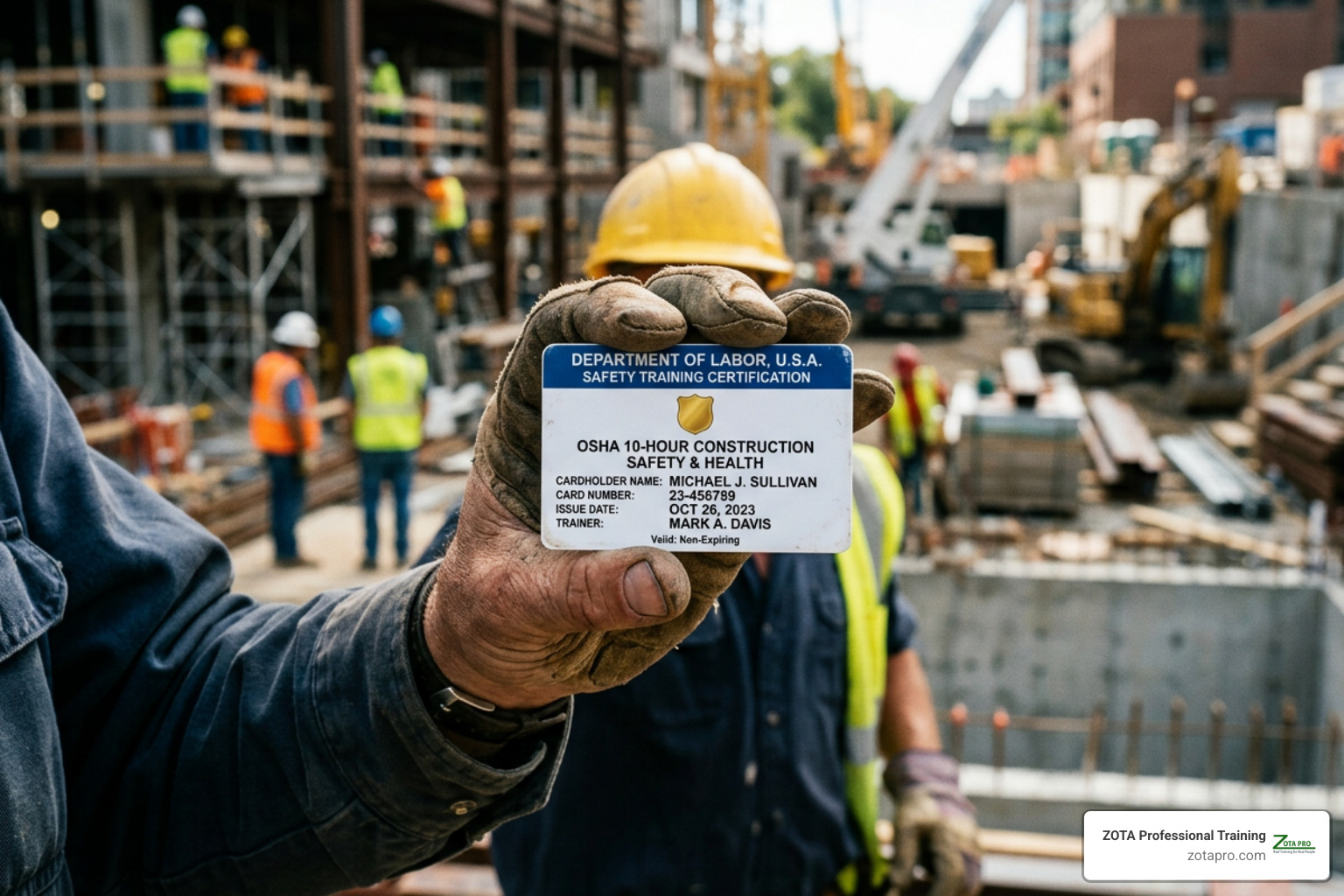
Upon successfully finishing your training and completing the mandatory end-of-course survey, an official plastic wallet-sized Department of Labor (DOL) card is mailed directly to you.
- Delivery Timeline: Plastic DOL cards generally arrive in the mail within 2 weeks of course completion.
- Temporary Documentation: Authorized providers grant an immediate, downloadable temporary completion certificate so you can start working on site right away while waiting for your official plastic card.
- Card Expiration: Under federal OSHA rules, DOL completion cards never expire. However, individual states, trade unions, municipal contracts, and specific employers frequently enforce 3 to 5 year refresher schedules.
Staying current with these standards ensures you understand all Essential Safety Standards required across modern jobsites.
Online OSHA 10 Training Rules, Technical Caps, and Exam Requirements
Federal OSHA enforces strict regulatory rules governing how online outreach courses operate to prevent users from rushing through safety modules.
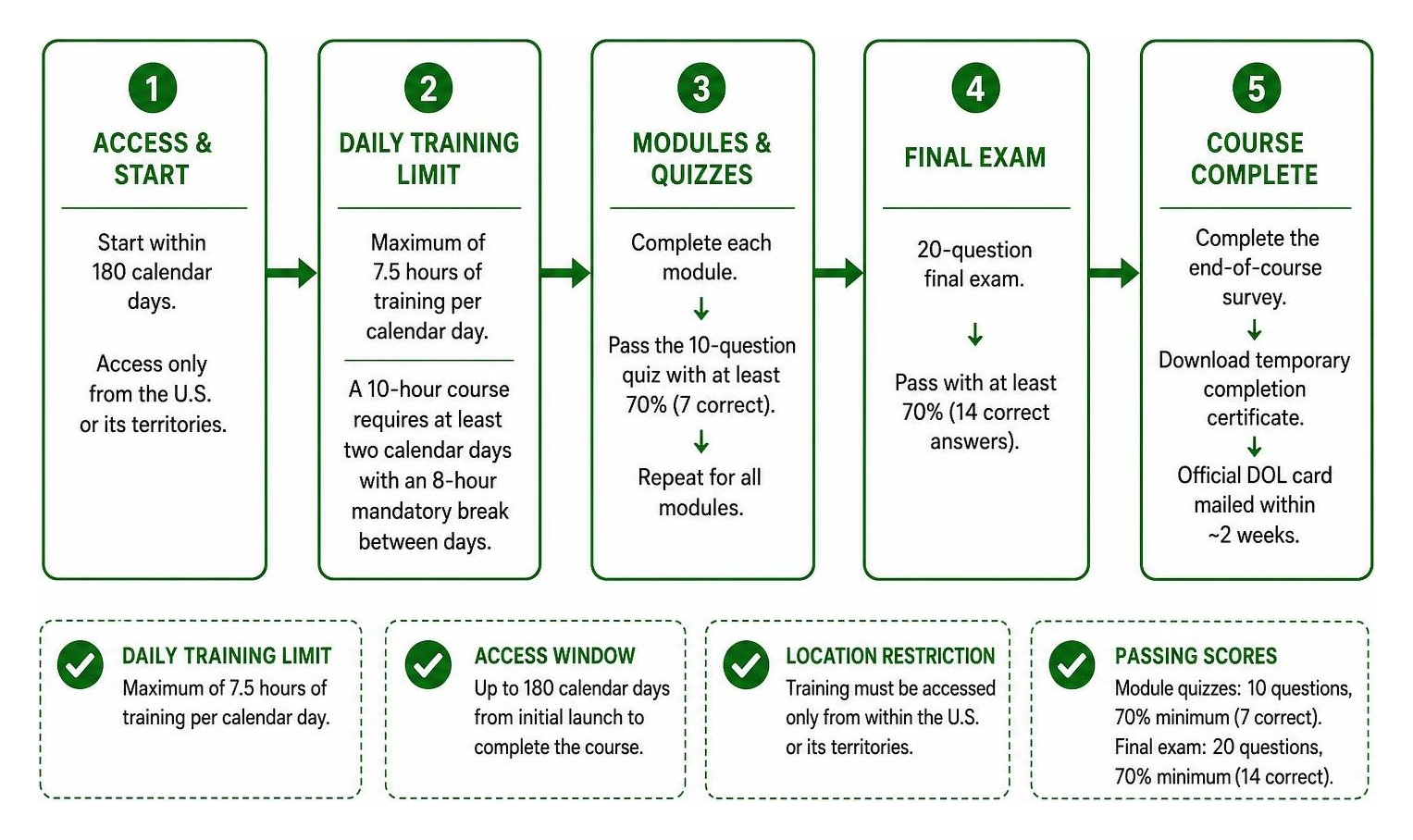
- Daily Training Limit: Online systems strictly cap learning time at a maximum of 7.5 hours per calendar day. Consequently, a 10-hour course must take at least two calendar days to complete, requiring an 8-hour mandatory break before resuming.
- Access Window: Learners are given up to 180 calendar days from initial launch to complete all coursework.
- Location Restrictions: Online training must be accessed strictly from within the United States or its territories.
- Module Quizzes: Each module ends with a 10-question quiz requiring a 70% passing score.
- Final Exam: The course ends with a 20-question final exam requiring a minimum score of 70% (at least 14 correct answers).
- 3-Attempt Rule: Students are permitted up to 3 attempts to pass module quizzes and the final exam. Failing all 3 attempts results in an automatic system lockout, requiring re-enrollment under federal OSHA rules.
Review our full overview on Top OSHA Required Trainings to prepare your team properly.
Legal Mandates, Employment Benefits, and Refresher Schedules
While federal OSHA does not enforce a universal national requirement for every worker to complete osha 10 training, many state laws (such as mandates in Nevada, New York, and Missouri), local municipalities, and general contractors make holding a card non-negotiable before setting foot on a project.
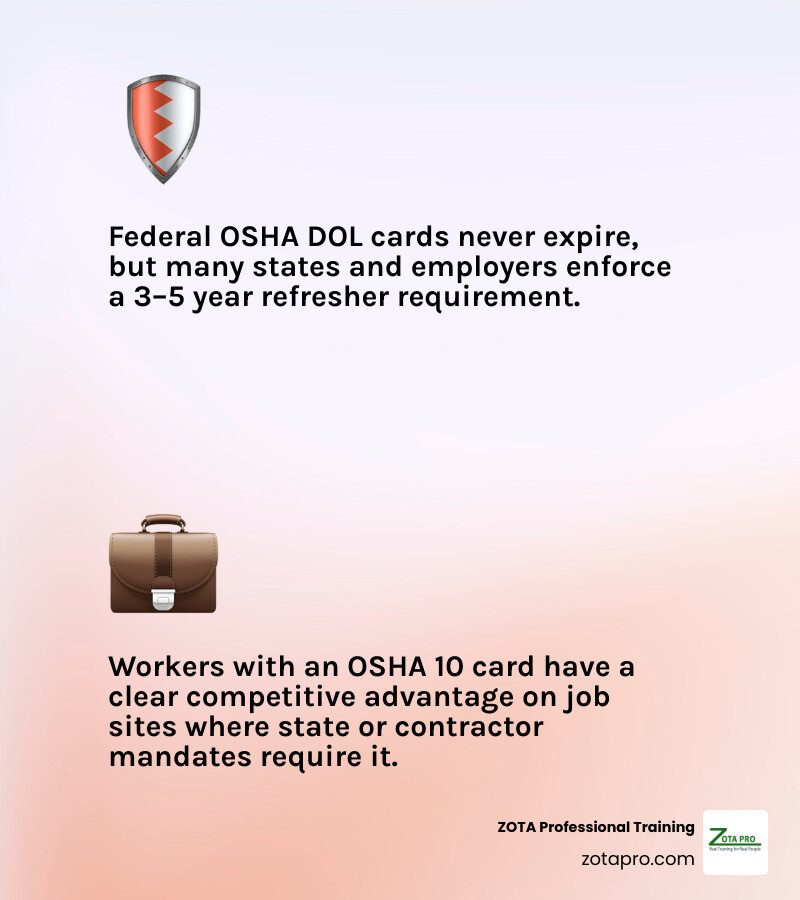
Having an official DOL card gives job applicants a clear competitive edge, proving to employers that they possess verified hazard recognition skills. Because jobsite requirements evolve, retaking the course every 3 to 5 years keeps your safety knowledge sharp and satisfies strict contractor policies.
Final Recommendations for OSHA Compliance
At ZOTA Professional Training, we specialize in helping contractors, environmental specialists, and commercial teams maintain seamless regulatory compliance. We provide flexible online, in-person, and hybrid training options—including bilingual English and Spanish group classes with nationwide on-site support.
When you are ready to certify your workforce and meet jobsite access standards without hassle, explore our comprehensive OSHA Compliance Training Options to get started today!