
OSHA Construction Training: What Your Crew Needs to Know
OSHA construction training helps workers spot and prevent jobsite hazards before someone gets hurt. For most renovation contractors, the first step is choosing the right OSHA Outreach course:
- OSHA 10-Hour Construction: Best for entry-level laborers and trade workers who need basic hazard awareness.
- OSHA 30-Hour Construction: Best for foremen, supervisors, and people responsible for safety planning or crew oversight.
- Check local and contract rules: OSHA Outreach training is generally voluntary under federal law, but a city, state, union, project owner, or employer may require a DOL card.
Both courses cover construction safety under 29 CFR 1926, including the Focus Four hazards: falls, electrocution, struck-by incidents, and caught-in/between hazards. Falls receive special attention because they are a leading cause of construction deaths.
For contractors working in older homes, Outreach training is a useful safety foundation, but it does not replace task-specific training for hazards such as lead, asbestos, respirator use, or silica exposure. More than 6.51 million workers completed OSHA Outreach Training between 2021 and 2025, showing how widely these cards are used across U.S. jobsites.
I am Bob Zak, Founder and CEO of ZOTA Professional Training, with more than 32 years of occupational health and safety experience, including service as an Occupational Health & Safety Manager. In the sections ahead, I will help you use OSHA construction training requirements to select the right training for each role on your renovation crew.
Essential OSHA Construction Training Standards: 10-Hour vs. 30-Hour Programs
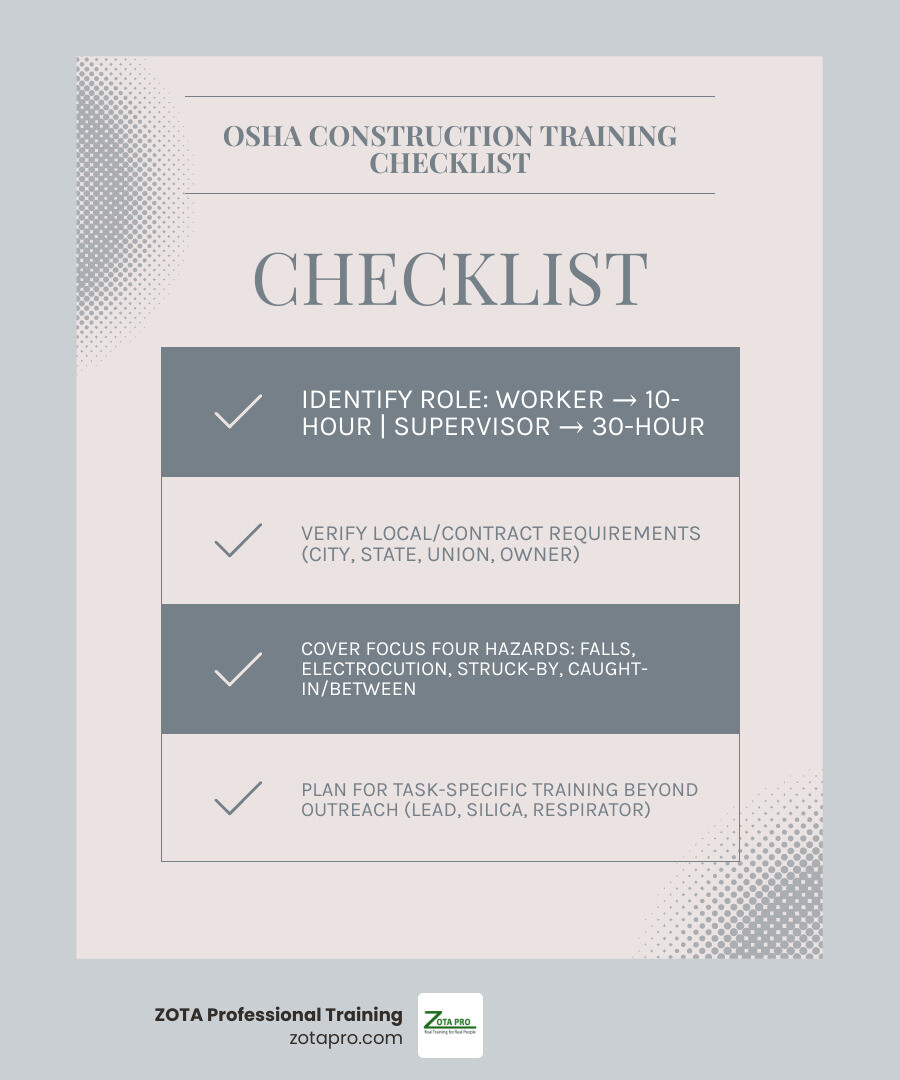
Choosing the right course comes down to your crew members’ job duties and legal requirements. When evaluating what is the difference between OSHA 10 and OSHA 30 training, the primary distinctions involve curriculum depth, managerial responsibility, and time commitment.
The 10-hour course serves as a baseline orientation for frontline workers, while the 30-hour course provides in-depth hazard control principles for those directing work. The table below highlights key comparisons:
| Feature | OSHA 10-Hour Construction | OSHA 30-Hour Construction |
|---|---|---|
| Target Audience | Entry-level laborers, apprentices, trade workers | Foremen, superintendents, safety coordinators |
| Minimum Instructional Time | 10 Hours (Spread over at least 2 days) | 30 Hours (Spread over at least 5 days) |
| Mandatory Topic Hours | Minimum 6 Hours | Minimum 14 Hours |
| Focus Four Coverage | 4 Hours (1.5 hrs minimum on Falls) | 6 Hours (1.5 hrs minimum on Falls) |
| Typical Online Cost | $60 – $90 | $159.99 – $189.00 |
| Final Exam Requirements | 20 questions (70% passing score) | 20 questions (70% passing score) |
| Primary Regulatory Scope | 29 CFR 1926 Hazard Recognition | 29 CFR 1926 Implementation & Safety Management |
Before purchasing seats for your crew, spend a few minutes determining who needs OSHA 10 vs OSHA 30 training to avoid over-training entry laborers or under-training jobsite leaders.

OSHA 10-Hour Construction Training: Curriculum and Focus Four Hazards
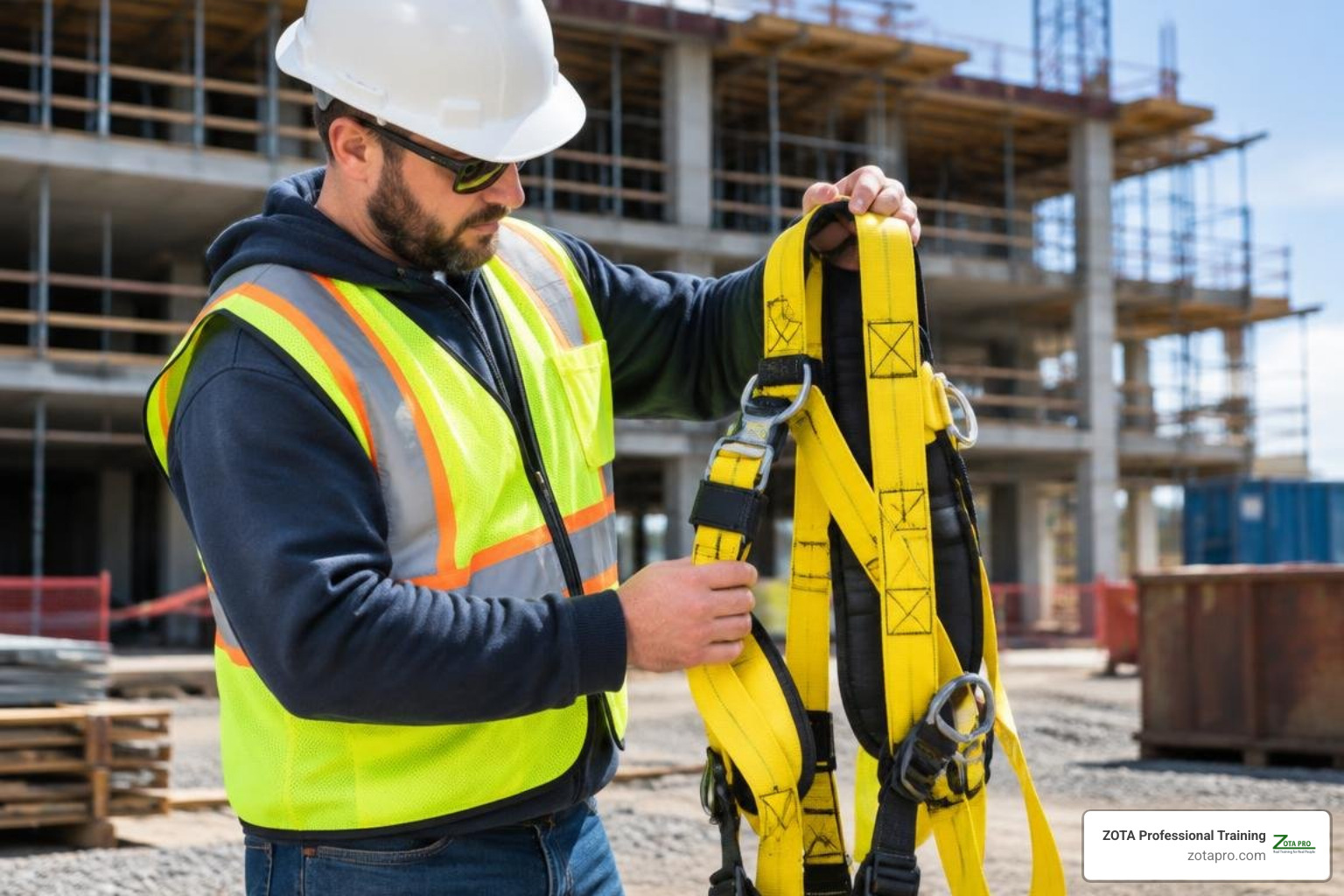
Our 10-Hour Construction Industry Training teaches frontline workers how to identify, avoid, and report unsafe conditions. The curriculum is governed by the official Outreach Training Program construction procedures, which establish clear instructional time minimums.
The 10-hour program consists of at least 6 hours of mandatory topics:
- Introduction to OSHA (1 hour): Covers worker rights, employer responsibilities under the General Duty Clause, and how inspections work.
- OSHA Focus Four Hazards (4 hours): Addresses the leading causes of fatal jobsite incidents. Because fall hazards cause the majority of construction deaths, OSHA mandates that fall prevention receive at least 1 hour and 30 minutes of dedicated study. The remaining time is allocated across electrical hazards, struck-by hazards (like swinging equipment), and caught-in/between hazards (such as trench collapses).
- Personal Protective Equipment (30 minutes): Details selection, fit, and maintenance of eye, head, foot, and hearing protection.
- Health Hazards in Construction (30 minutes): Identifies risks related to hazard communication, silica, and airborne contaminants.
The remaining 4 hours are divided between elective topics—such as scaffolds, excavations, and power tools—and optional jobsite-specific topics. Reviewing an OSHA 10 training survival guide & certification requirements helps new workers prepare for classroom or online modules effectively.
OSHA 30-Hour Construction Training: Supervisory Curriculum and Modules

For crew leads, site safety managers, and general contractors, our 30-Hour Construction Industry Training delivers advanced safety management instruction. Spanning 21 distinct instructional modules, this course includes at least 14 mandatory instructional hours:
- Introduction to OSHA (1 hour)
- Managing Safety and Health (2 hours): Focuses on job hazard analyses (JHAs), safety culture, and accident prevention programs.
- OSHA Focus Four Hazards (6 hours): In-depth analysis of falls, struck-by, caught-in, and electrical risks.
- Personal Protective Equipment (2 hours): Advanced PPE assessments and respiratory protection basics.
- Health Hazards in Construction (2 hours): Thorough coverage of lead, silica, asbestos, and noise exposure.
- Stairways and Ladders (1 hour): Structural specifications and inspection routines.
The remaining 16 hours cover critical electives like confined space entry, motor vehicles, concrete masonry, steel erection, and ergonomics. You can explore a detailed breakdown in our OSHA 30 training requirements guide.
DOL Card Issuance, Testing Rules, and Expiration Realities
Whether you take the 10-hour or 30-hour course, federal guidelines enforce strict testing and operational limits:
- Daily Study Caps: Students cannot log more than 7.5 hours of training per calendar day. A 10-hour course takes at least two calendar days to complete, and a 30-hour course requires a minimum of five days.
- Completion Timeframe: Online learners must complete all course material within 180 days of starting.
- Exam Standards: Online courses end with a 20-question multiple-choice exam requiring a passing score of 70% or higher. Students are granted up to three attempts to pass each module quiz and the final exam.
After you finish the class and submit your end-of-course survey, you can download a temporary certificate of completion right away. An official Department of Labor (DOL) wallet card is mailed via USPS within two weeks.
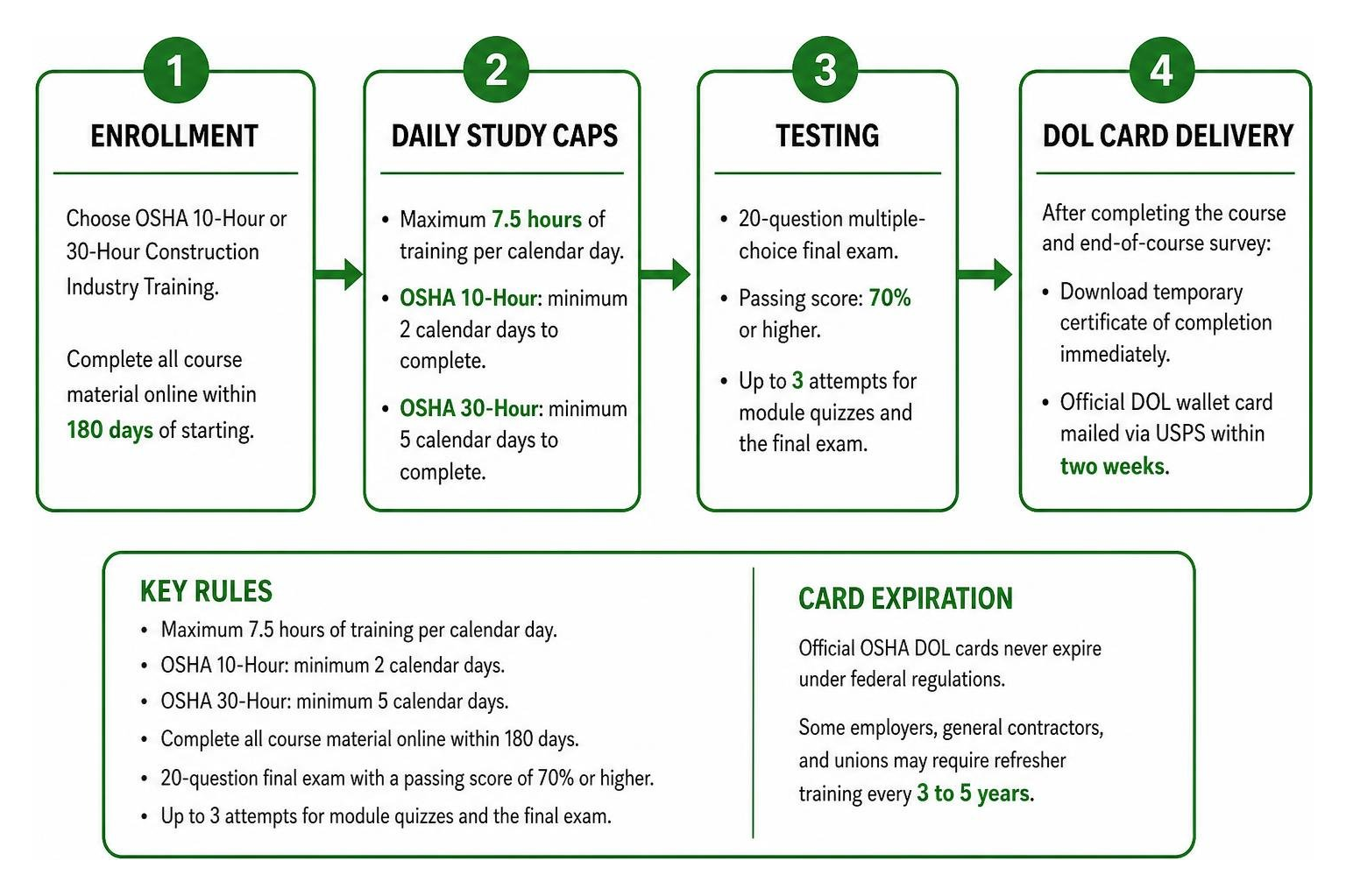
Under federal regulations, official OSHA DOL cards never expire. However, some employers, general contractors, and unions treat them like a hard hat that needs regular replacement, establishing mandatory refresher intervals every 3 to 5 years.
Mandates, Testing, and Advanced Career Pathways

While the federal government does not mandate Outreach Training for every private jobsite, understanding top OSHA required trainings for construction and general industry helps maintain general contractor compliance and protects workers. Furthermore, mastering essential OSHA safety standards for construction workers ensures teams meet site-specific guidelines and union prerequisites.
State Mandates, Legal Requirements, and Jobsite Compliance
Several states and municipal jurisdictions have passed legislation mandating OSHA construction cards on public and private projects:
- State-Level Public Works Mandates: States including Connecticut, Massachusetts, Nevada, New York, Pennsylvania, and Florida require workers on prevailing wage or publicly funded projects to hold valid OSHA cards. Certain states mandate refresher courses every 5 years.
- NYC Local Law 196: New York City construction sites require workers to possess a Site Safety Training (SST) card. Online courses used for NYC compliance must feature active proctoring, identity verification, and voice authentication.
Failing to verify these credentials before mobilizing can lead to stop-work orders and severe financial penalties. For a broader look at mandatory employer safety programs, check our guide to OSHA training requirements for the construction industry.
Authorized Trainer Pathways and Safety & Health Fundamentals Certificates
Professionals looking to advance their careers beyond field cards can pursue specialized certificates or trainer credentials.
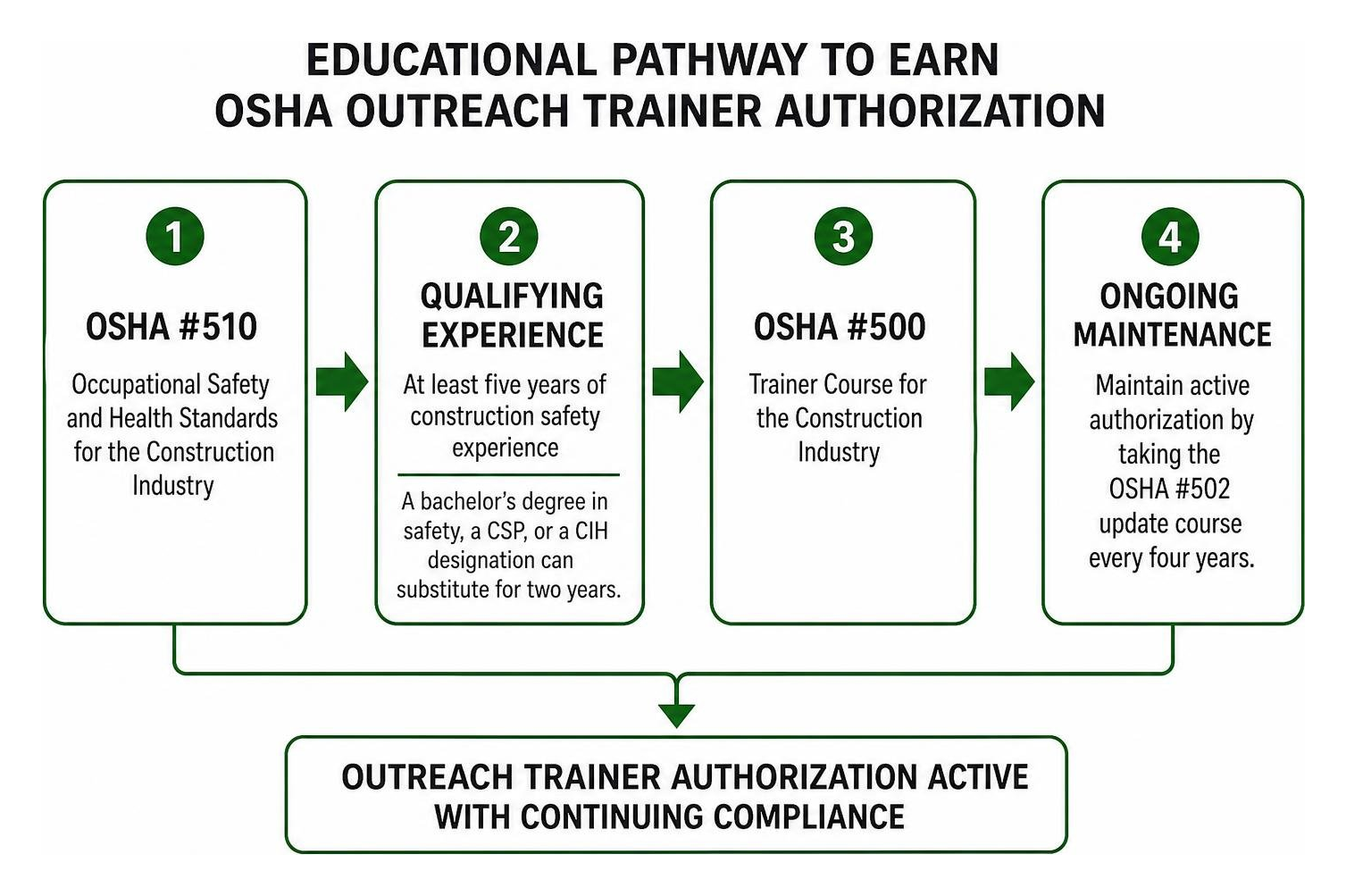
To become an OSHA-authorized construction outreach trainer:
- Complete OSHA #510 (Occupational Safety and Health Standards for the Construction Industry).
- Document at least five years of construction safety experience (a bachelor’s degree in safety, a CSP, or a CIH designation can substitute for two years).
- Complete OSHA #500 (Trainer Course for the Construction Industry).
- Maintain active authorization by taking the OSHA #502 update course every four years.
Another pathway is the OSHA Safety & Health Fundamentals Certificate Program for Construction. Unlike the hazard-awareness Outreach courses, this program requires a minimum of 68 total contact hours across formal OSHA Training Institute (OTI) Education Center classes:
- 39 Mandatory Contact Hours: OSHA #510 (Construction Standards), OSHA #7500 (Safety Management), and OSHA #7505 (Incident Investigation).
- 29 Elective Contact Hours: Specialized topics such as Excavation Hazards, Confined Spaces, Respiratory Protection, and Silica Exposure.
At ZOTA Professional Training, we support field crews and safety directors with nationwide classroom, hybrid, and group instruction. Explore our full catalog of OSHA compliance training courses to keep your workforce certified, confident, and safe.