

Introduction to EPA RRP Regulations
The EPA Lead Renovation, Repair and Painting (RRP) Rule requires contractors working on pre-1978 housing and child-occupied facilities to be certified and use lead-safe containment and cleaning practices. Under the Lead RRP Rule Overview, paid renovators must contain work areas, control lead dust, and verify cleaning before completing covered projects.
Federal lead regulations exist because sanding, cutting, or demolishing painted surfaces in older properties creates invisible, toxic dust. Lead was federally banned from residential paint in 1978, but roughly three-quarters of all U.S. homes built before that year still contain lead-based paint. The older the home, the higher the likelihood: about two-thirds of homes built between 1940 and 1960 and nearly 90% of homes built before 1940 contain lead.
When this paint is disturbed without containment, microscopic lead dust settles across carpets, furniture, and toys. Ingesting or inhaling even tiny amounts of lead causes serious health issues, especially in children under six, including lowered IQ, learning disabilities, behavioral problems, and hearing impairment. In adults, lead exposure contributes to hypertension, kidney damage, and reproductive complications.
To protect building occupants, Congress passed the Residential Lead-Based Paint Hazard Reduction Act, creating Title IV of the Toxic Substances Control Act (TSCA). Under this authority, the Environmental Protection Agency established strict mandates designed to control lead dust generated during routine construction, remodeling, and maintenance.
Understanding the Lead Renovation Repair and Painting Rule: Scope and Requirements
The EPA’s Lead RRP Rule Overview covers target housing and child-occupied facilities under Title 40 of the Code of Federal Regulations (CFR) Part 745. Target housing refers to most residential dwellings built before 1978, excluding housing for the elderly or persons with disabilities (unless a child under six resides or is expected to reside there) and zero-bedroom zero-bathroom units.
Child-occupied facilities include commercial or public buildings constructed before 1978 that are regularly visited by children under age six, such as daycares, preschools, and kindergarten classrooms.
Before disturbing surfaces, contractors can verify whether paint contains lead using EPA-recognized chemical test kits, paint chip laboratory analysis, or X-ray fluorescence (XRF) testing by a certified inspector. If testing is not conducted, contractors must presume lead is present and follow all work practice standards detailed in the Small Entity Compliance Guide to Renovate Right.
Additionally, EPA maintains updated dust-lead action levels (DLAL) and dust-lead reportable levels (DLRL) to determine hazardous lead contamination.
Who Must Comply with the Lead Renovation Repair and Painting Rule?
Compliance is required for any individual or business paid to perform work that disturbs painted surfaces in covered pre-1978 properties. Reviewing EPA’s Lead Renovation, Repair and Painting Rule 101 shows that this mandate extends far beyond general remodeling contractors.
Regulated professionals include:
- General contractors and home builders
- Painting contractors and drywall finishers
- Carpenters, window replacement installers, and siding installers
- Electricians, plumbers, and HVAC technicians cutting into walls or ceilings
- Property managers, landlords, and in-house maintenance crews
- Childcare facility maintenance personnel
Covered Activities and Exemptions
The rule applies broadly to any compensated activity that disturbs paint, such as surface preparation, sanding, carpentry, wall removal, weatherization, and electrical or plumbing penetrations.

However, specific exclusions and exemptions apply:
- Minor Repair and Maintenance Activities: Work that disturbs less than 6 square feet of painted surface per interior room, or less than 20 square feet of exterior painted surface, is exempt. This minor maintenance exemption does not apply to window replacement or demolition, which must always follow RRP protocols regardless of surface area.
- Post-1978 Properties: Housing and facilities constructed in 1978 or later are exempt from the federal rule.
- DIY Homeowners: Homeowners performing unpaid renovation or repair work on their own primary residence are exempt. However, the exemption ends if the owner rents the property, operates a commercial childcare center in the home, or flips the home for profit.
- Lead-Free Determinations: If a certified renovator, lead inspector, or risk assessor tests the affected components with an EPA-recognized test kit or laboratory analysis and documents that the paint is lead-free, RRP work practices are not required.
- Emergency Renovations: Emergency repairs resulting from non-routine events (such as pipe bursts or storm damage) are exempt from pre-renovation education and certain containment rules to the extent necessary to protect against imminent structural damage or safety threats.
Lead Renovation Repair and Painting Rule Work Practices and Prohibitions
When a project falls within the scope of the rule, renovators must follow specific containment, dust control, and cleaning standards to prevent lead migration.
Key lead-safe practices include:
- Work Area Containment: Seal all doors, HVAC vents, and windows with heavy-duty plastic sheeting. For interior work, extend plastic sheeting at least 6 feet in all directions from the work area. For exterior projects, extend plastic at least 10 feet from the work surface, using vertical containment when working close to property boundaries.
- Worker Protection: Wear appropriate personal protective equipment (PPE), including N-100 or HEPA-rated respirators, disposable coveralls, and shoe covers to prevent tracking dust out of the containment zone.
- Prohibited Work Methods: Open-flame burning or torching, operating heat guns above 1,100°F, and using power tools without HEPA-shrouded exhaust controls are strictly banned under the rule.
- Cleaning and Verification: Following project completion, crews must HEPA vacuum and wet-wipe all surfaces within the containment zone. A certified renovator must then perform a cleaning verification procedure comparing disposable cleaning cloths against an EPA cleaning verification card, or conduct dust wipe clearance testing.
A designated certified renovator oversees these steps on site, as outlined in our guide to certified renovator responsibilities.
Compliance, Enforcement, and Getting Certified
To maintain compliance, contracting firms and renovators must operate under valid credentials, follow documented workflows, and maintain auditable project files according to the EPA Lead-Based Paint Program FAQ.
Pre-Renovation Education and Recordkeeping Mandates
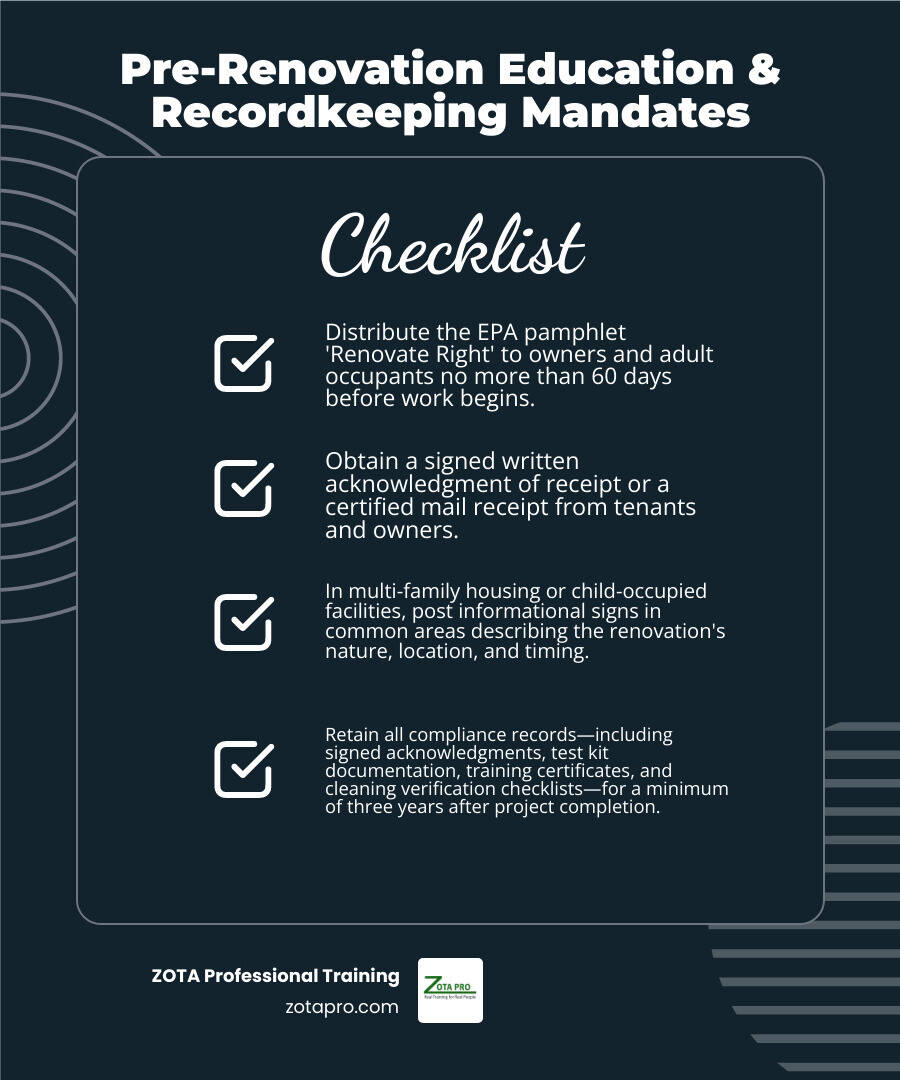
Before starting any renovation in target housing or child-occupied facilities, contractors must distribute the EPA pamphlet Renovate Right: Important Lead Hazard Information for Families, Child Care Providers and Schools.
Contractors must meet the following documentation rules:
- Tenant and Owner Sign-Off: Provide the pamphlet to the owner and adult occupants no more than 60 days before work begins, obtaining a signed written acknowledgment of receipt or a certified mail receipt.
- Common Area Notices: In multi-family housing or child-occupied facilities, post informational signs describing the nature, location, and timing of the renovation in common areas.
- Record Retention: Retain all records demonstrating compliance—including signed pamphlet acknowledgments, lead test kit documentation, certified renovator training certificates, and the post-renovation cleaning verification checklist—for a minimum of three years after project completion.
RRP Rule Non-Compliance Penalties vs Lead Abatement
Failure to follow RRP regulations can lead to severe enforcement actions. Under TSCA Section 16, the EPA can levy civil penalties of up to $49,722 per violation, per day. Several states manage their own authorized RRP programs (such as the Oregon Health Authority and Construction Contractors Board, which assess civil penalties up to $5,000 per violation per day).
It is also important not to confuse RRP renovation with lead abatement.
| Requirement / Criterion | EPA RRP Rule (Renovation, Repair & Painting) | Lead-Based Paint Abatement |
|---|---|---|
| Primary Project Objective | Remodeling, maintenance, or repair where disturbing paint is incidental | Permanent elimination of lead-based paint hazards |
| Target Structures | Pre-1978 housing and child-occupied facilities | Pre-1978 target housing and child-occupied facilities |
| Required Firm Credential | EPA or State-Certified RRP Renovation Firm | EPA or State-Certified Lead Abatement Firm |
| Personnel Certification | Certified Renovator (8-hour initial training) | Certified Lead Abatement Supervisor & Workers (multi-day training) |
| Post-Work Clearance | Cleaning verification procedure or optional dust wipe testing | Mandatory independent clearance inspection with laboratory dust wipe testing |
| Notice to State/EPA | Pre-renovation pamphlet delivery to occupants | Formal advance project notification to regulatory agencies |
To understand how scope and project objectives dictate whether a job requires an abatement supervisor or an RRP renovator, read our breakdown on lead abatement vs RRP renovator credentials.
How to Verify Contractor Certification and Obtain Training
Homeowners and commercial property managers can verify a contractor’s status by asking to see their EPA Firm Certificate and individual Certified Renovator badge, or by searching the EPA’s online database of lead-safe certified firms.
Achieving compliance requires two separate certifications:
- Individual Renovator Certification: An individual takes an 8-hour hands-on accredited training course to earn their renovator certificate. We offer both in-person and hybrid formats for the EPA Lead Renovator Initial Certification. Certificates must be renewed every five years (or every three years for online-only refreshers) by completing an EPA Lead Renovator Refresher Course.
- Firm Certification: The business entity itself must submit an application and fee directly to the EPA (or authorized state program). Explore our comprehensive walkthrough on firm certification requirements to register your business.
At ZOTA Professional Training, we deliver EPA-accredited, interactive instruction in English and Spanish across the United States. Whether you require on-site group training for your entire maintenance team or need an individual refresher course, we help you master lead safety and maintain compliance. Check our course schedules today to get certified and protect your crew, your clients, and your business.