

What Is an Asbestos Abatement Class — and Do You Need One?
An asbestos abatement class is a federally required training course for anyone who removes, encapsulates, or disturbs asbestos-containing materials (ACM) in buildings. Here’s a quick overview of what’s available:
| Course Type | Duration | Who Needs It |
|---|---|---|
| Contractor/Supervisor Initial | 40 hours (5 days) | Anyone overseeing abatement projects |
| Abatement Worker Initial | 32 hours (4 days) | Hands-on removal workers |
| Inspector Initial | 24 hours (3 days) | Building inspectors assessing ACM |
| Management Planner Initial | 16 hours (2 days) | Planners managing ACM in schools |
| Operations & Maintenance Initial | 16 hours (2 days) | Custodial/maintenance staff |
| Awareness Training | 2 hours | Anyone who may encounter ACM |
| Refresher Courses | 8 hours (1 day) | All certified pros — required annually |
Initial courses are in-person. Most refresher courses can be completed online.
If you manage renovation crews working in pre-1978 buildings, at least some of your workers are legally required to hold a valid asbestos certification under the federal Asbestos Hazard Emergency Response Act of 1986 (AHERA). Working without it puts your crew, your clients, and your business at serious legal risk.
The rules aren’t complicated once you know them — but the stakes are high enough that getting trained the right way matters.
I’m Bob Zak, founder of ZOTA Professional Training and a former Occupational Health & Safety Manager with over 32 years of experience helping contractors navigate asbestos certification requirements. In this guide, I’ll walk you through everything you need to know to find the right asbestos abatement class for your role and get your crew certified fast.
Choosing the Right Asbestos Abatement Class for Your Career
Choosing the correct class depends entirely on the type of work you or your employees perform. Under the EPA Model Accreditation Plan (MAP) and OSHA regulations, asbestos training isn’t a one-size-fits-all deal. If you enroll in the wrong course, you might end up overqualified (and over budget) or, worse, under-certified and non-compliant.
At ZOTA Professional Training, we help you identify exactly which asbestos training fits your specific career goals. Whether you are a general contractor, a demolition expert, or a school maintenance technician, matching your job description to the correct EPA-approved curriculum is the first step toward compliance.
Initial vs. Refresher Training Requirements
Understanding the lifecycle of an asbestos certification is crucial. Initial training courses are intensive, multi-day programs designed to build a foundation of safety from scratch. However, these certifications do not last forever.
To maintain your credentials, you must complete an 8-hour refresher course every single year. Staying on top of this requirement is critical. Many regulatory jurisdictions enforce a strict retraining penalty: if you fail to take your annual refresher within a specific grace period (often up to two years after your certificate expires), your certification is permanently voided. If that happens, you are legally required to retake the entire multi-day initial course from scratch.
To understand the regulatory nuances of these options, you can read our guide on refresher vs initial asbestos training whats the difference. To ensure you never miss a deadline, check out our breakdown of asbestos training renewal how often why it matters for workplace safety. The costs of letting your license lapse are steep—make sure you understand what happens if you work with asbestos without certification before skipping a renewal cycle.
Course Lengths and Prerequisites for Different Roles
Before you register for an asbestos abatement class, you need to know what each role entails and if you meet the prerequisites. For example, you cannot jump straight into designing management plans without first qualifying as an inspector.
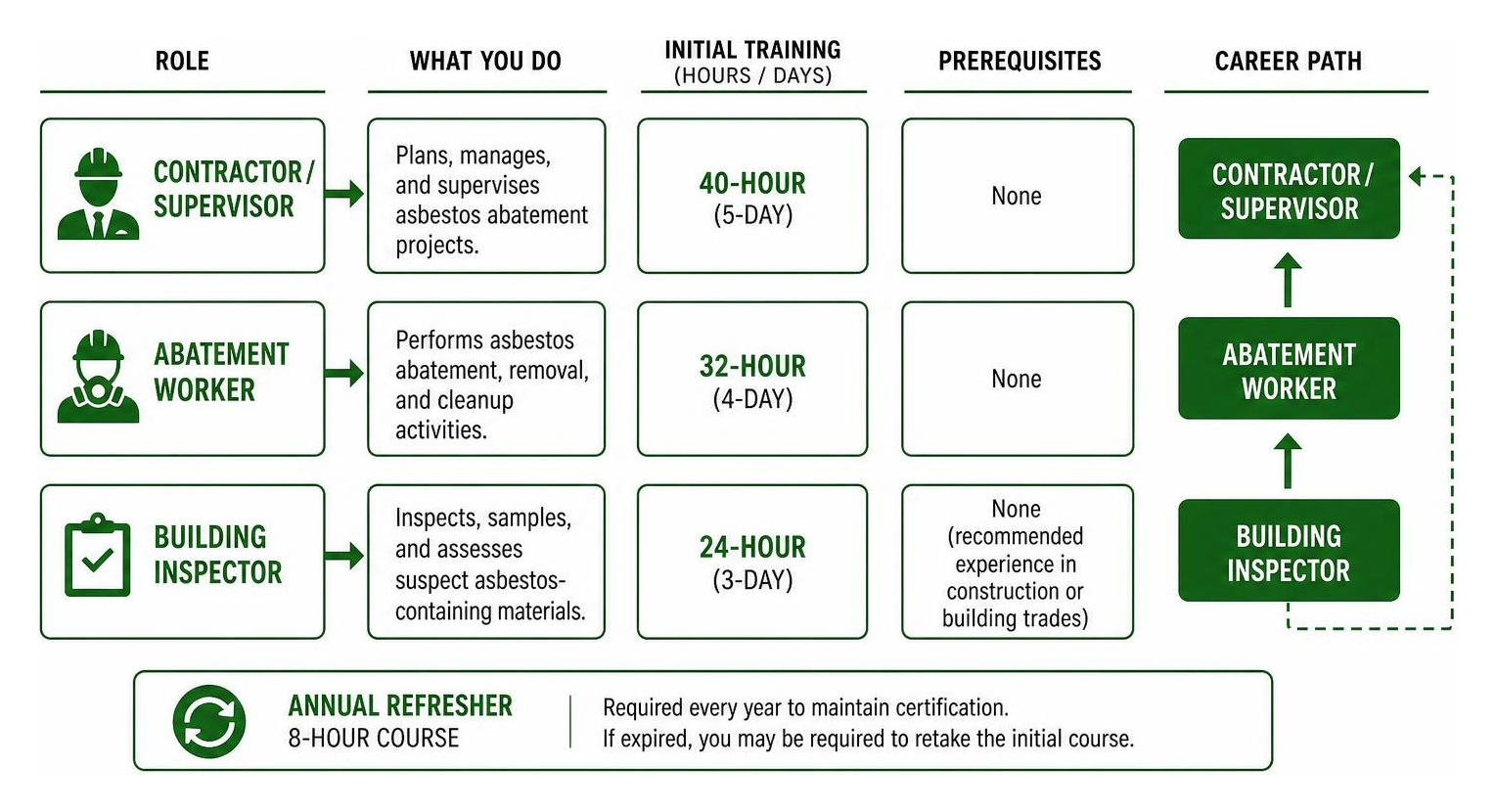
Here is a breakdown of the primary courses we offer and how they align with your career goals:
- Contractor/Supervisor: This 40-hour (5-day) course is the gold standard for anyone managing abatement projects or acting as an OSHA Competent Person. Learn more about the contractor-supervisor-initial class.
- Abatement Worker: A 32-hour (4-day) course focused on hands-on containment, removal, and cleanup. Review the details for the worker-handler-initial class.
- Building Inspector: A 24-hour (3-day) class focused on identifying, sampling, and assessing suspect materials. Check out the inspector-initial course.
- Management Planner: A 16-hour (2-day) course specifically designed for developing response actions in K-12 schools. Prerequisite: You must hold a valid Inspector certification. See the management-planner-initial course.
- Project Designer: A 24-hour (3-day) course for professionals who write the technical specifications for abatement projects. Explore the project-designer-initial course.
- Project Monitor: A 24-hour (3-day) class focused on oversight, final visual inspections, and clearance air monitoring. Learn about the project-monitor-initial course.
- Operations & Maintenance (O&M): A 16-hour (2-day) class for custodial and facility staff who perform minor maintenance that might disturb small amounts of asbestos. Learn more about operations-and-maintenance-initial training.
For a broader breakdown of how these positions interact on a job site, read our article where the asbestos certification roles explained can help clarify your path. If you only need a high-level overview to protect your team from accidental exposure, our asbestos awareness training guide for construction workers and property managers is the perfect place to start.
State-Specific Regulations and Licensing Costs
While federal EPA and OSHA rules set the baseline, individual states have the authority to implement stricter laws and manage their own licensing boards. As of July 2026, navigating these local variations is a critical part of your business planning.
- Michigan (MIOSHA): Michigan uses a rigorous course-approval process and permits approved online formats specifically for annual refresher courses.
- New York (NYSDOH): New York maintains highly specific schedules, requires physical hard cards on-site, and frequently offers multilingual training (including Spanish, Russian, and Polish) to support a diverse workforce.
- California (Cal/OSHA): Individual workers do not need a separate state-issued license if they hold a valid AHERA certificate, but employers must register with Cal/OSHA for any project involving 100 square feet or more of asbestos-containing material.
- Florida (DBPR): Abatement supervisors must work under the direction of a Licensed Asbestos Contractor, and training must meet strict state board standards.
- Colorado: Specific rules govern local specialists; see our colorado-ams-refresher page for details.
In addition to course tuition (which ranges from $150 for refreshers to over $900 for comprehensive initial courses), you must factor in state licensing application fees. These typically range from $25 to $100 annually. To stay safe and compliant, make sure you are up to date on Scientific research on occupational asbestos exposure limits.
Inside the Classroom: Curriculum, Hands-On Skills, and Certification
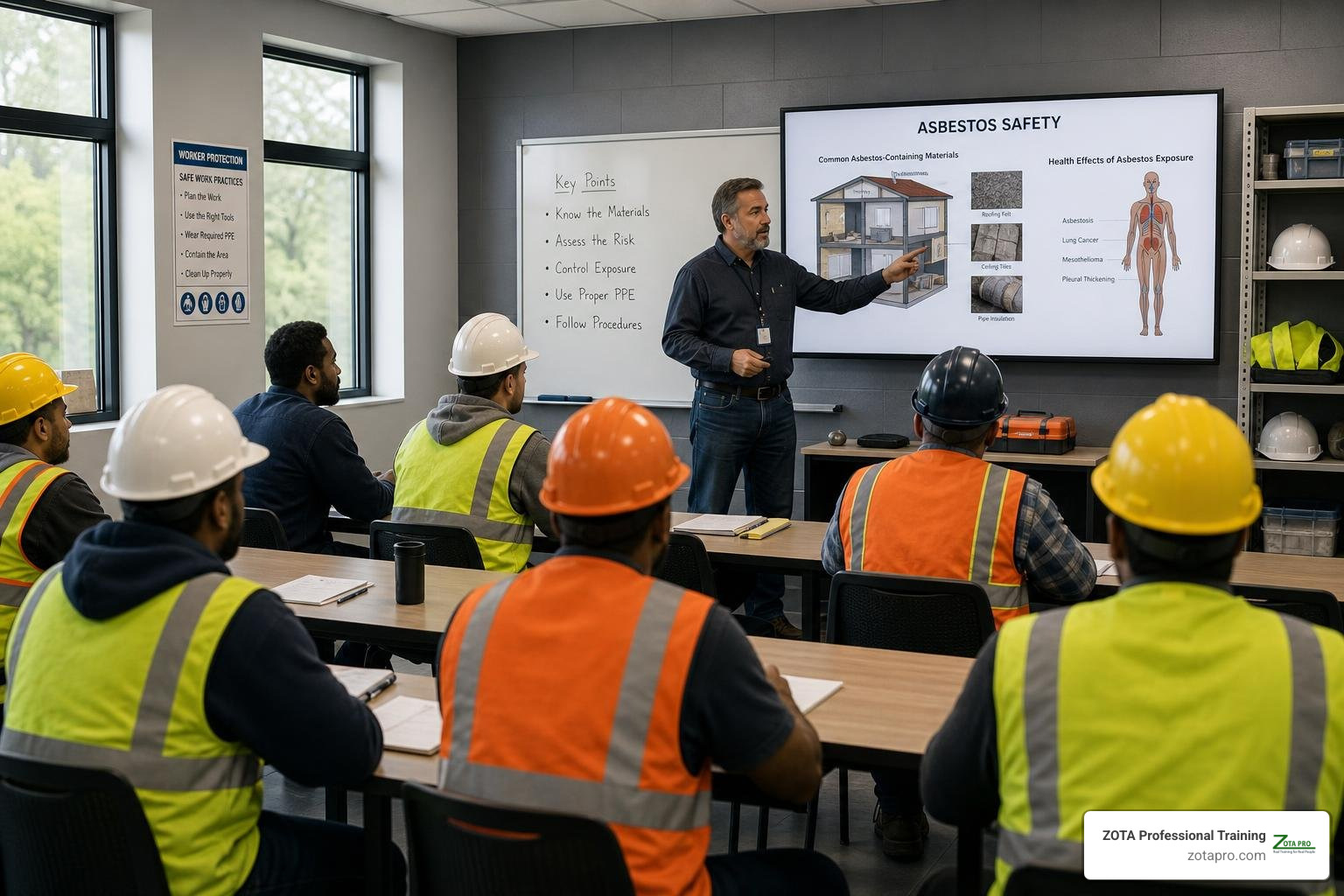
Taking an asbestos abatement class isn’t just about sitting in a room listening to lectures. To truly understand how do professionals go about removing asbestos from properties, you must get your hands dirty in a controlled, simulated environment.
Core Topics Covered in an Asbestos Abatement Class
A certified curriculum balances classroom theory with practical, hands-on labs. Here are the core topics we cover:
- Health Effects & Exposure Risks: Understanding how microscopic fibers bypass the body’s natural defenses, causing diseases like asbestosis, lung cancer, and mesothelioma. We also study the extreme synergistic risk of smoking and asbestos exposure.
- OSHA Work Classifications: Distinguishing between Class I (surfacing/thermal insulation removal), Class II (non-surfacing materials like vinyl tile or roofing), Class III (maintenance disturbance), and Class IV (custodial cleanup).
- Containment & Negative Pressure Setup: Learning how to build critical barriers using polyethylene sheathing (with a 12-to-36-inch overlap) and calculating negative air machine capacity to achieve at least four air changes per hour.
- Glovebag Removal Techniques: Mastering localized isolation to remove asbestos pipe insulation safely without contaminating the surrounding room.
- Personal Protective Equipment (PPE): Practicing respirator fit-testing, user seal checks, and selecting the correct asbestos removal clothing based on Assigned Protection Factors (APFs).
- Waste Disposal & Air Sampling: Following strict EPA NESHAP wet-removal methods, bagging waste properly, and understanding aggressive air clearance testing.
To learn more about the science behind these protocols, you can review the Scientific research on asbestos health effects.
Online vs. In-Person Learning Formats
Can you take an asbestos abatement class online? Yes and no.
For initial certifications, federal law requires in-person attendance. You cannot learn how to properly seal a three-chamber decontamination unit or perform a respirator seal check through a computer screen. However, for annual refreshers, many states allow fully online or hybrid learning formats.
To see if virtual training fits your business model, read our analysis on can online asbestos training keep you osha compliant pros cons and explore the general asbestos training online benefits.
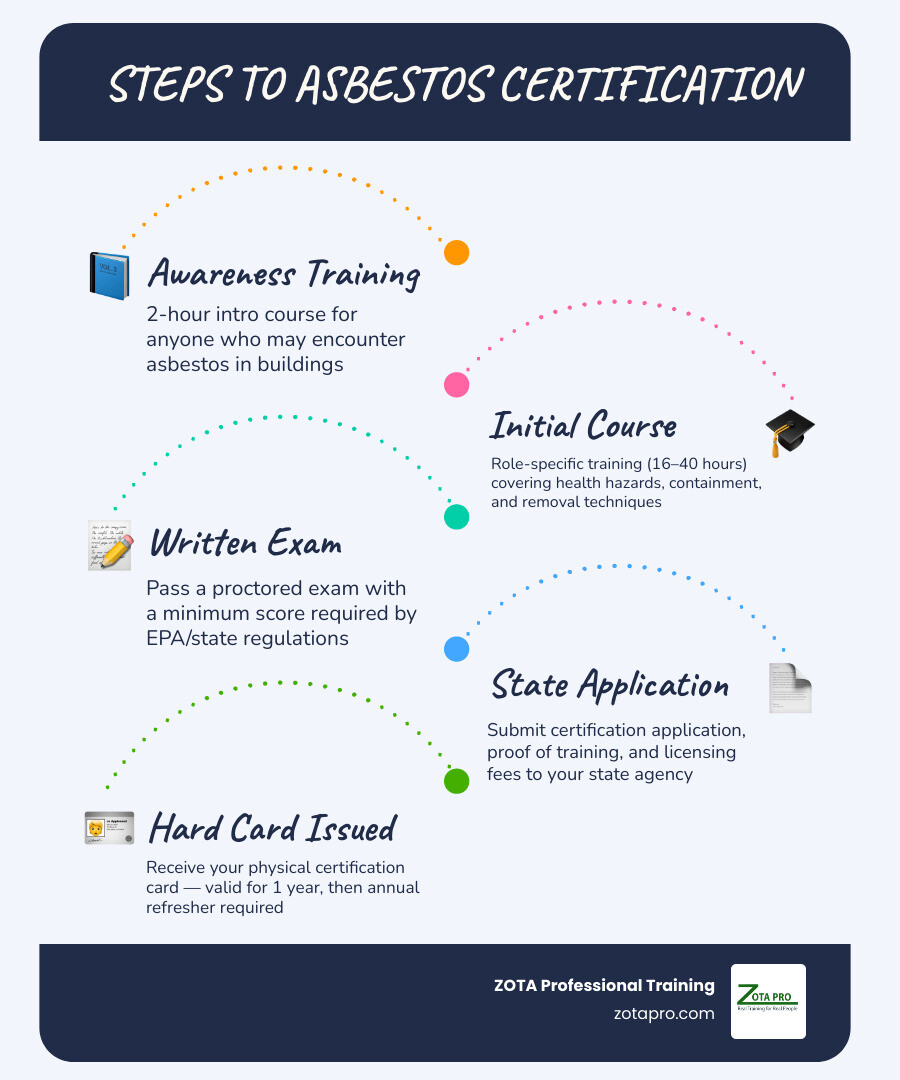
How to Get Certified After Your Asbestos Abatement Class
Once you complete your instructional hours and hands-on training, you must pass a closed-book, multiple-choice exam (usually requiring a score of 70% or higher).
After passing the exam, your training provider will issue a physical certificate of completion. Depending on your state, you will then submit this certificate, along with a state application and licensing fee, to receive your official state license or “hard card.”
At ZOTA Professional Training, we streamline this process. We offer flexible, multilingual (English/Spanish) training, group discounts, and nationwide on-site support to get your team certified with minimal downtime. For a detailed, step-by-step roadmap, read our comprehensive guide on step-by-step asbestos removal certification for construction workers.
Ready to schedule your next class? Explore our upcoming schedules and find an accredited asbestos training course near you today!