

Core Frameworks of Federal and State Lead Based Paint Rules
Federal and state lead based paint rules require property owners and contractors to identify, disclose, and control lead paint hazards in pre-1978 housing and child-occupied facilities. Core compliance duties include providing EPA-approved disclosures before lease or sale, conducting visual assessments or dust wipe sampling in covered rental dwellings, and completing lead-safe work practices or abatement when hazards are found. The primary federal framework is codified under eCFR :: 40 CFR Part 745 — Lead-Based Paint Poisoning Prevention in Certain Residential Structures and the Residential Lead-Based Paint Hazard Reduction Act of 1992 (Title X). These regulations cover two key property categories:
- Target Housing: Any residential dwelling constructed prior to 1978, excluding zero-bedroom units (such as studio apartments) and designated housing for the elderly or persons with disabilities (unless a child under six resides or is expected to reside there).
- Child-Occupied Facilities: Buildings, or portions thereof, constructed prior to 1978 visited regularly by the same child under six years of age (including daycares, preschools, and kindergarten classrooms).
Lead paint was once prized across the country for its outstanding durability and quick drying times. Today, properties are prized for being completely lead-free! Beneath those historic coats of paint lies a severe public health risk. Pre-1980 American housing stock contains more than 3,000,000 tons of lead in the form of paint, with the vast majority of homes built before 1950 containing substantial amounts. According to federal health studies, low-level lead poisoning still afflicts up to 3,000,000 children under age six across the United States, and deteriorated paint or contaminated dust endangers families in roughly 3,800,000 American homes.
Understanding basic lead-based paint regulations allows property managers and contractors to operate safely while avoiding severe compliance penalties.
Rental Dwellings and Scope Under Lead Based Paint Rules
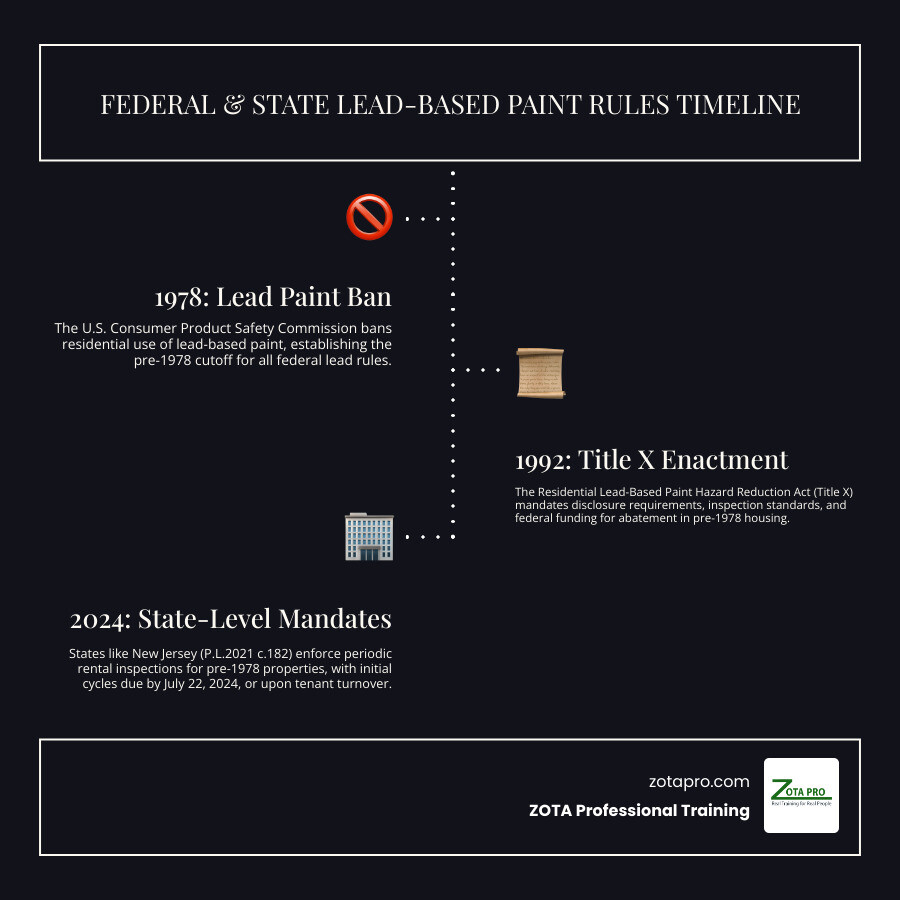
State and federal jurisdictions enforce specific mandates for rental properties to safeguard tenant health. In New Jersey, for instance, P.L.2021, c.182 requires municipal inspections of pre-1978 rental properties to locate lead-based paint hazards. The initial cycle mandated inspections no later than July 22, 2024, or upon tenant turnover—whichever came first.
Not every property is subject to mandatory periodic rental inspections. Exemptions generally apply to:
- Dwellings constructed during or after 1978.
- Seasonal rental units leased for less than six consecutive months per calendar year.
- Rental units certified as “lead-free” by a certified lead evaluation contractor.
- Multiple dwellings that have been registered with state housing authorities for at least five years with no outstanding paint violations.
For covered rental properties, periodic inspections must take place every three years, or upon any tenant turnover if it occurs before the three-year mark. Properties subject to federal funding or subsidies must also satisfy the HUD Lead-Safe Housing Rule, which requires visual assessments and rapid environmental investigations if a child residing in the property presents an elevated blood lead level.
Inspection Protocols and Hazard Thresholds Under Lead Based Paint Rules
Evaluating lead safety requires standardized testing methodologies. The two primary evaluation procedures are visual assessments and dust wipe sampling. Municipalities often dictate which protocol is legally required: jurisdictions where 3% or more of screened children demonstrate elevated blood lead levels must perform dust wipe sampling, whereas low-risk municipalities may permit visual assessments alone.
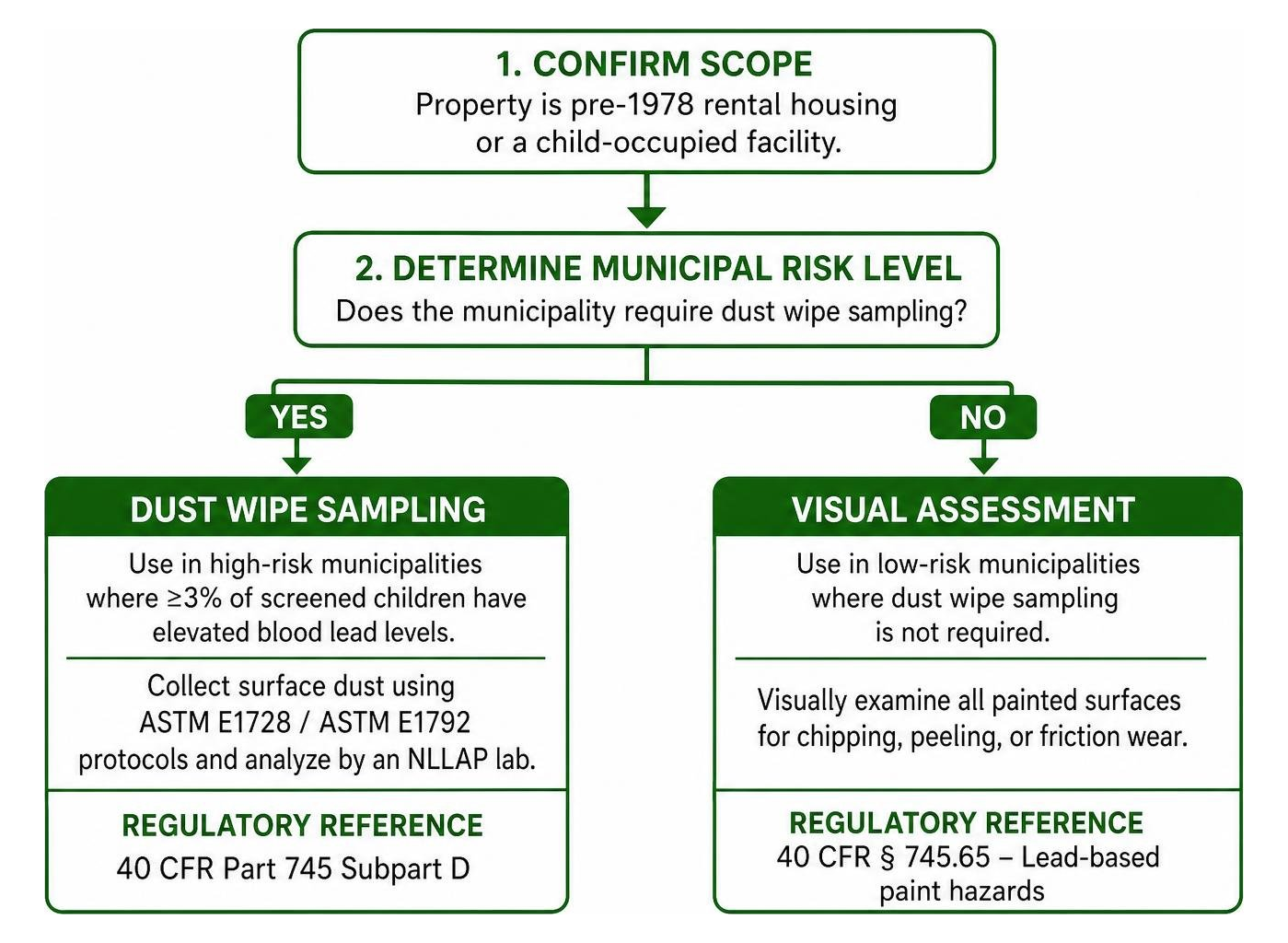
| Inspection Protocol | Primary Methodology | Standard Use Case | Regulatory Reference |
|---|---|---|---|
| Visual Assessment | Visual examination of all painted surfaces for chipping, peeling, or friction wear. | Low-risk municipalities; initial rental turnover screening. | 40 CFR § 745.65 – Lead-based paint hazards |
| Dust Wipe Sampling | Collection of surface dust using ASTM E1728 / ASTM E1792 protocols analyzed by an NLLAP lab. | High-risk municipalities; post-remediation clearance testing. | 40 CFR Part 745 Subpart D |
Regulatory thresholds govern surface dust and bare residential soil:
- Dust-Lead Standards: Post-abatement action levels require clearance dust levels below 5 µg/ft² for floors, 40 µg/ft² for interior window sills, and 100 µg/ft² for window troughs. Under current rules, dust-lead hazard standards align with the dust-lead reportable level (DLRL)—meaning any reportable level detected by an NLLAP-recognized laboratory constitutes an actionable hazard. Check out what are the latest updates in EPA lead regulations to review recent threshold changes.
- Soil-Lead Hazard Limits: Bare soil containing lead at or above 400 parts per million (ppm) in children’s play areas, or 1,200 ppm average across the remainder of the yard, constitutes an environmental hazard.
Interim Controls vs. Complete Abatement Strategies
When an inspection reveals lead-based paint hazards, property owners must address them through either interim controls or permanent abatement.
| Strategy Attribute | Interim Controls | Complete Abatement |
|---|---|---|
| Operational Goal | Temporarily reduce exposure to lead hazards. | Permanently eliminate lead-based paint hazards for 20+ years. |
| Standard Techniques | Paint stabilization, specialized cleaning, friction point repair. | Component replacement, chemical stripping, enclosure, encapsulation. |
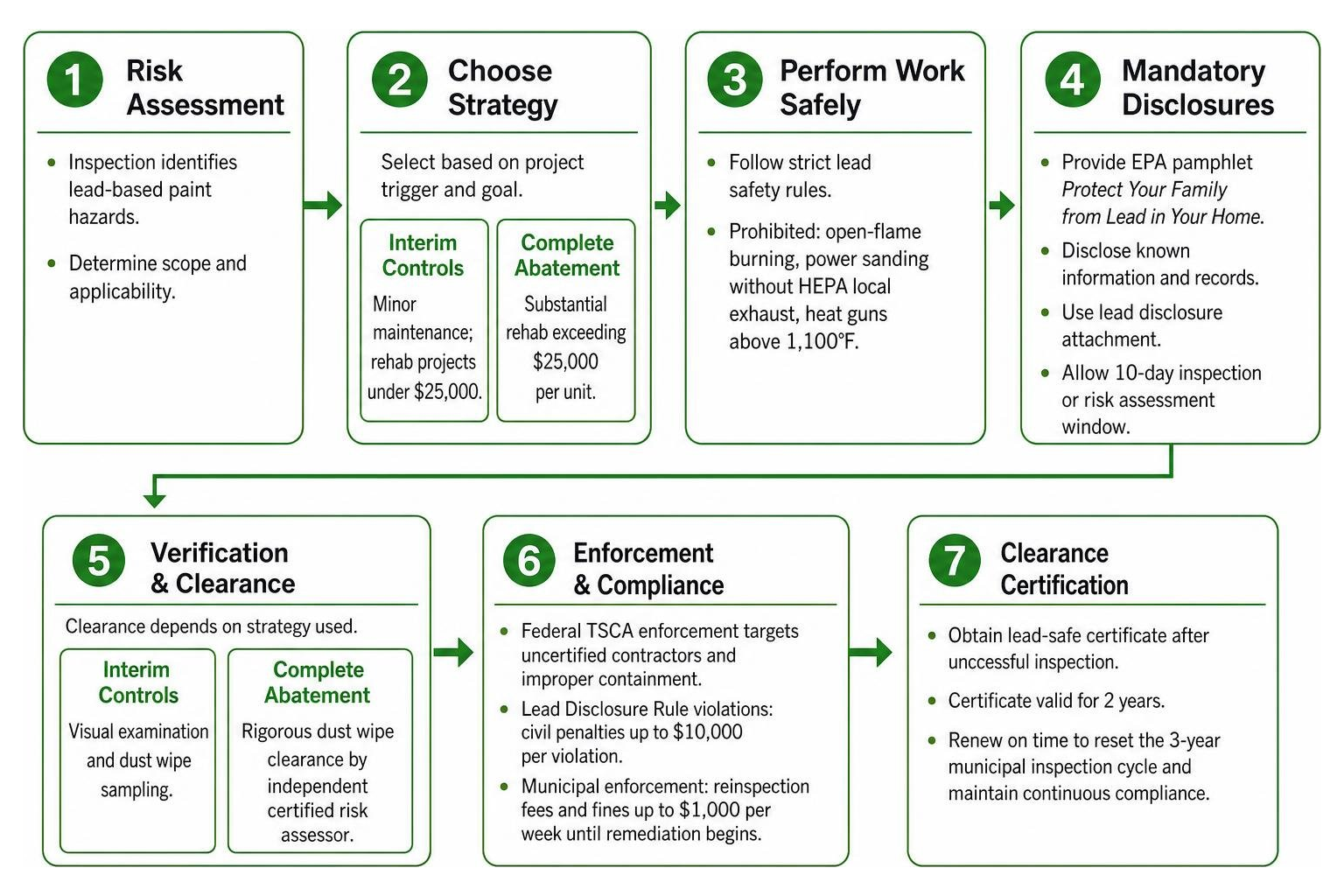
| Applicability Trigger | Minor maintenance; rehabilitation projects under $25,000. | Substantial federally assisted rehabilitation exceeding $25,000 per unit. |
| Required Clearance | Visual examination and dust wipe sampling. | Rigorous dust wipe clearance by independent certified risk assessor. |
Whenever work is performed, crews must follow strict lead safety rules. Prohibited paint removal methods include open-flame burning, power sanding without HEPA local exhaust, and heat guns operating above 1,100°F.
Implementation, Enforcement, and Certification Standards
Federal, state, and local agencies actively monitor and enforce compliance with lead safety standards across the country.

Federal enforcement under the Toxic Substances Control Act (TSCA) targets uncertified contractors and improper jobsite containment through administrative penalties and mandatory settlements under the EPA Lead Renovation, Repair, and Painting Program Rules. Contractors can review core requirements within our lead RRP rule knowledge bank.
Mandatory Disclosures, Recordkeeping, and Municipal Enforcement
Under the federal Lead Disclosure Rule, property owners and lessors must provide prospective buyers and tenants with specific documentation before signing any lease or sales agreement:
- An EPA-approved information pamphlet, Protect Your Family from Lead in Your Home.
- Known information and official records concerning lead-based paint or hazards in the dwelling.
- A lead disclosure attachment confirming that all statutory disclosures were completed.
- A 10-day window for purchasers to conduct an independent lead inspection or risk assessment.
Failure to provide these disclosures under eCFR :: 40 CFR Part 745 Subpart D — Lead-Based Paint Hazards carries civil penalties of up to $10,000 per violation. At the municipal level, local ordinances enforce compliance through reinspection fees (such as a $20 surcharge per unit supporting state Lead Hazard Control Assistance Funds). Property owners who fail to cure a cited lead violation within 30 days face local fines of up to $1,000 per week until remediation begins.
Contractor Certification and Achieving Lead-Safe Compliance
Achieving full compliance requires qualified, licensed personnel. A standard lead-safe certificate issued after a successful inspection remains valid for two years. Renewing this certificate on time resets the three-year municipal inspection cycle, ensuring continuous property compliance.
Working on older residential units requires different credentials depending on the project:
- Renovation, Repair, and Painting (RRP): Required for general contractors, painters, and tradespeople who disturb more than 6 sq ft of interior paint or 20 sq ft of exterior paint on pre-1978 structures. Learn the fundamentals with EPA’s lead renovation, repair, and painting rule 101.
- Lead Evaluation & Abatement: Required for professionals conducting formal risk assessments, inspections, or permanent hazard abatement projects. Review our complete guide to lead paint certification for a full breakdown of credential requirements.
At ZOTA Professional Training, we provide comprehensive, accredited training designed to keep your business fully compliant with federal and state lead standards. We offer in-person, online, and bilingual hybrid training options with nationwide support to help your crews work safely and efficiently. Explore our EPA lead certification training programs today to schedule training for your team.