

Find the Right Accredited Asbestos Training Course
For renovation work in older homes and buildings, choose training based on what your crew will actually do:
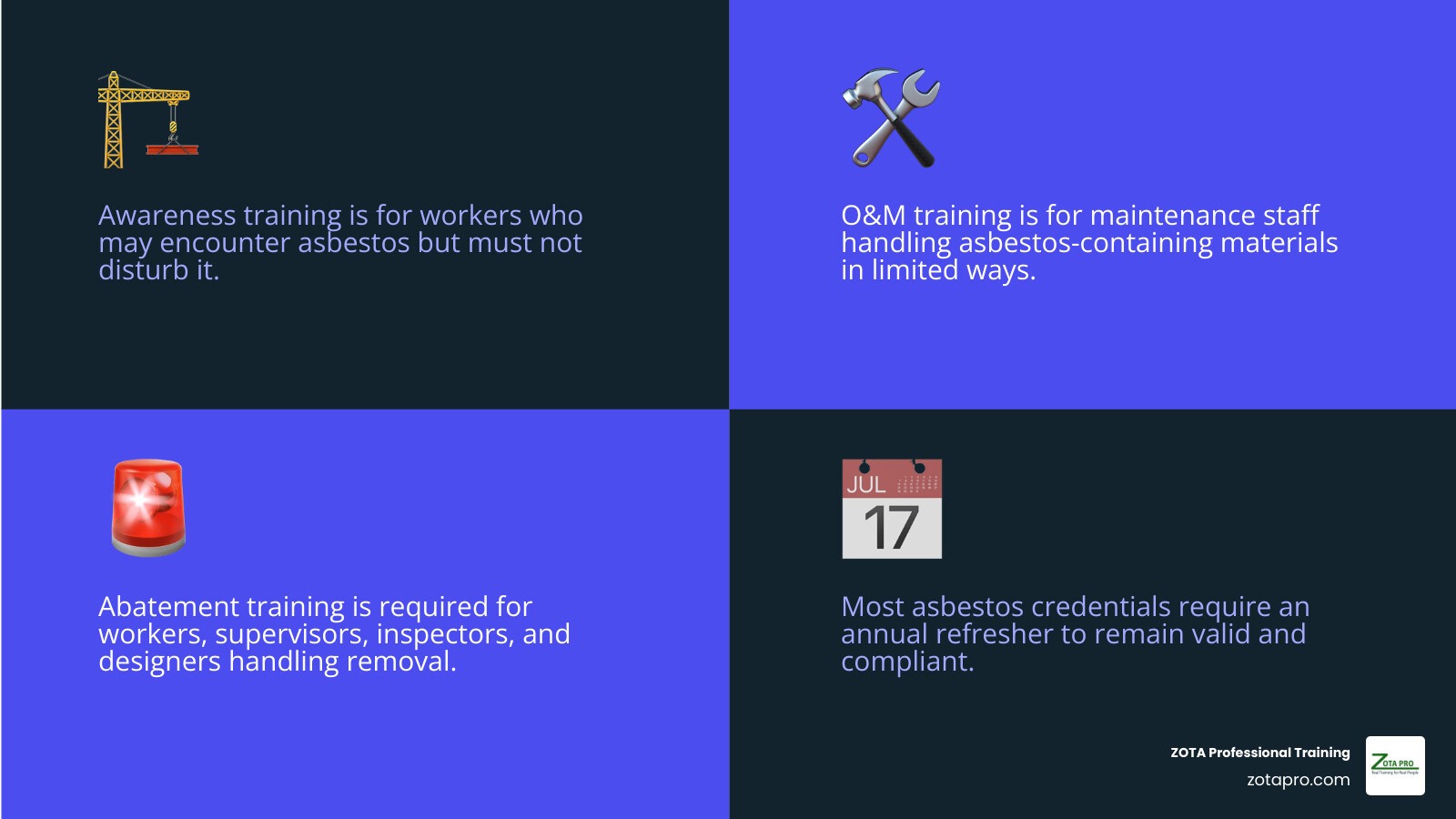
- Awareness training is for workers who may encounter suspected asbestos but must not disturb or remove it.
- Operations and maintenance (O&M) training is for maintenance staff who perform limited work around asbestos-containing materials.
- EPA- or state-accredited abatement training is for workers, supervisors, inspectors, and project designers who handle, remove, oversee, or assess asbestos work.
Before enrolling, confirm that the provider is approved for your state and for the job role you need. Awareness courses can often be completed online, while abatement credentials generally require instructor-led and hands-on training. Most asbestos credentials also require an annual refresher to stay current.
Asbestos is a group of mineral fibers once widely used in insulation, floor tile, roofing, siding, pipe wrap, and other building materials. It becomes dangerous when work such as drilling, cutting, sanding, demolition, or improper cleanup releases tiny fibers into the air. Breathing those fibers can lead to asbestosis, lung cancer, and mesothelioma, often decades after exposure.
For contractors, the key is simple: do not guess whether a material is safe. Train workers to recognize suspected asbestos-containing material, stop work when it may be disturbed, and bring in properly accredited professionals when the scope calls for it.
I am Bob Zak, Founder and CEO of ZOTA Professional Training, with more than 32 years of occupational health and safety experience. I have helped contractors build practical asbestos training programs that support safer work, regulatory compliance, and real-world jobsite decisions.
Similar topics to asbestos training:
Introduction
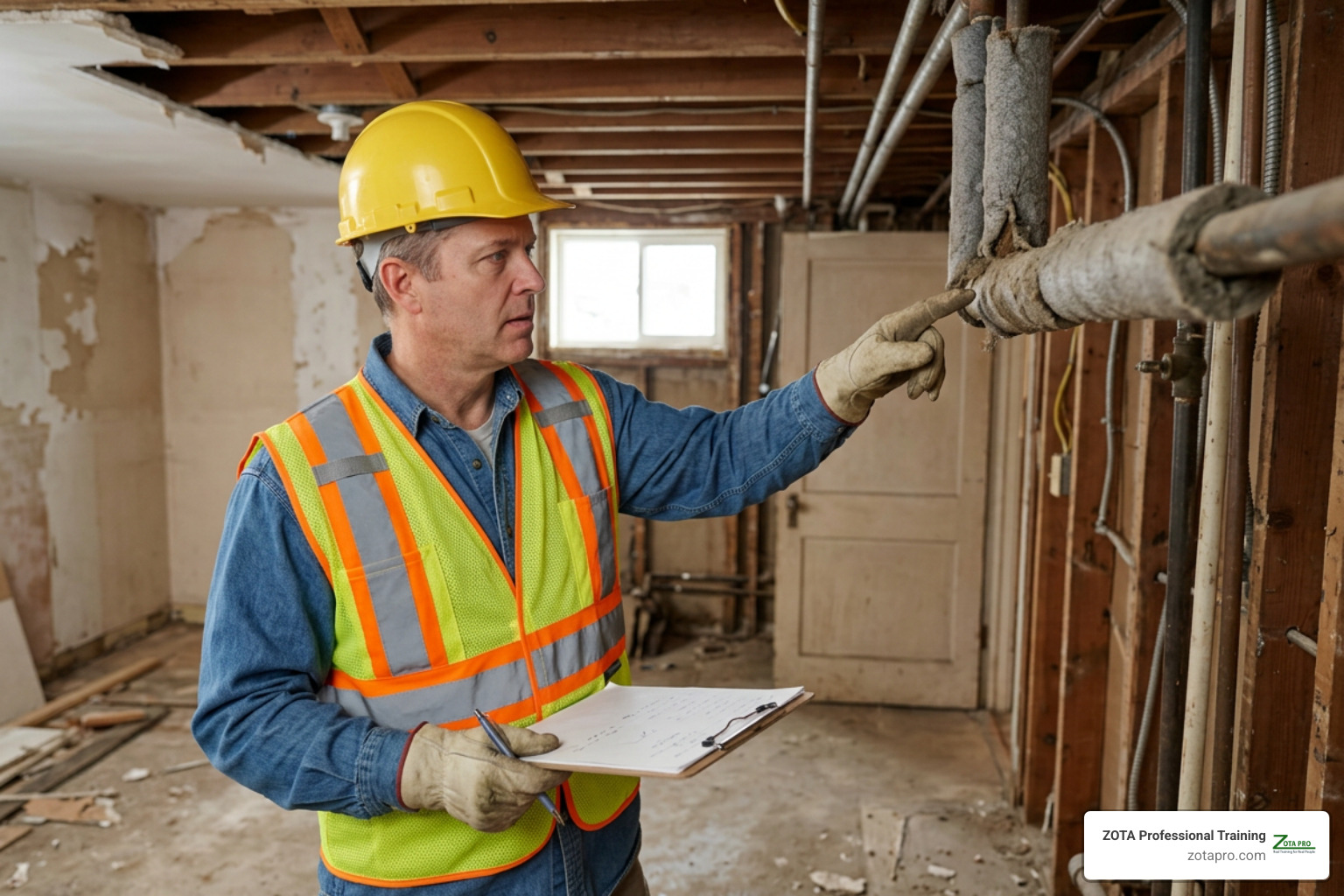
Asbestos consists of naturally occurring mineral fibers prized historically for their tensile strength and fire resistance. Chrysotile asbestos accounts for nearly 95 percent of all asbestos used globally, though amphibole varieties such as amosite and crocidolite were also widely installed. Despite manufacturing bans dating back to the late 20th century, these materials remain embedded across thousands of commercial, residential, and educational facilities.
When disturbed, microscopic fibers enter the respiratory tract. Because the human body cannot break down these mineral strands, they become permanently lodged in lung tissue and the mesothelial lining. The latency period ranges from 10 to 40 years before symptoms emerge, leading to fatal conditions including asbestosis, lung cancer, and mesothelioma.
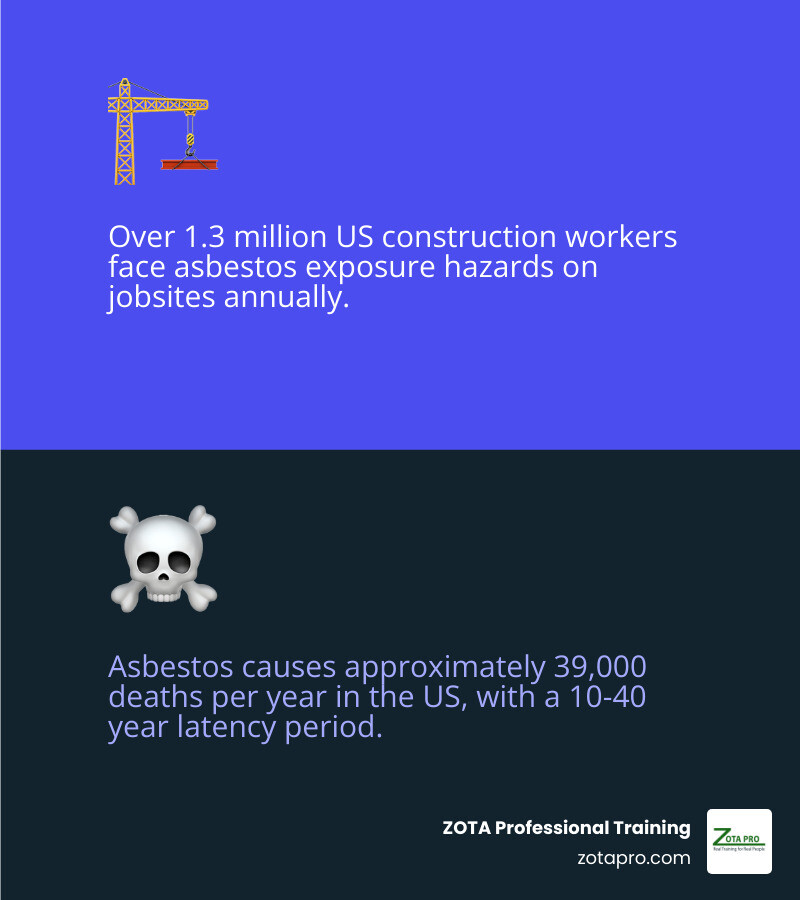
Today, over 1.3 million construction and general industry workers in the United States face exposure hazards on jobsites. Across the globe, an estimated 125 million people remain in danger of occupational exposure, making asbestos the leading cause of work-related deaths worldwide with over 90,000 fatalities annually. In the US alone, asbestos is to blame for approximately 39,000 deaths each year, with roughly 3,000 new mesothelioma diagnoses annually.
Core Requirements and Disciplines in Asbestos Training
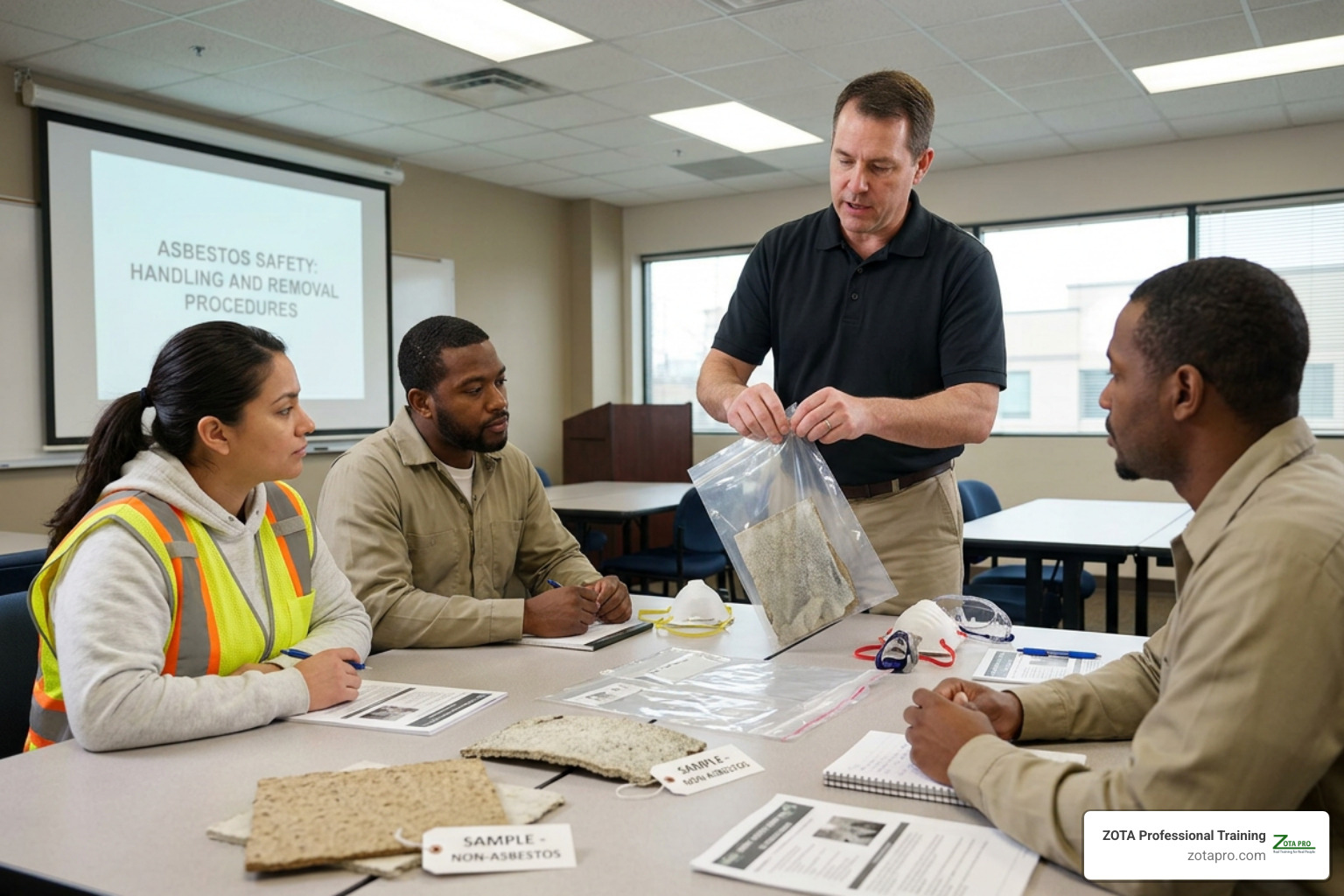
Federal and state frameworks protect tradespeople and building occupants through strict training thresholds. Comprehensive education traces back through asbestos history and health hazards, ensuring workers understand the persistent presence of current asbestos products in building structures as well as the active risks of asbestos still used today.
State regulatory frameworks, such as WAC 296-65-005 standards in Washington, enforce specific curriculum criteria. These state regulations require EPA-accredited instruction covering air monitoring, containment setup, and co-hazards such as silica and carbon monoxide before workers handle regulated materials.
OSHA Standards and EPA Regulations for Workplace Safety
Occupational safety is regulated under two primary standards: OSHA 29 CFR 1926.1101 for construction and demolition, and OSHA 29 CFR 1910.1001 for general industry. Both standards establish a strict Permissible Exposure Limit (PEL) of 0.1 fibers per cubic centimeter of air (0.1 f/cc) calculated as an 8-hour time-weighted average (TWA), alongside an excursion limit of 1.0 f/cc over a 30-minute period.
OSHA divides construction tasks into four discrete categories, making identifying your OSHA classification level crucial for establishing legal work practices. Class I covers the highest-risk removal of thermal system insulation and surfacing materials, demanding negative-pressure enclosures and medical surveillance. Class II involves removing non-thermal ACM such as floor tiles and siding. Class III governs repair and maintenance operations where ACM is disturbed, while Class IV applies to custodial activities contacting dust and debris.
Facility owners must maintain clear protocols for managing asbestos in facilities, deploying HEPA filtration, wet methods, and proper asbestos removal clothing and PPE to prevent hazardous migration.
Different Types of Asbestos Training Courses from Awareness to Abatement
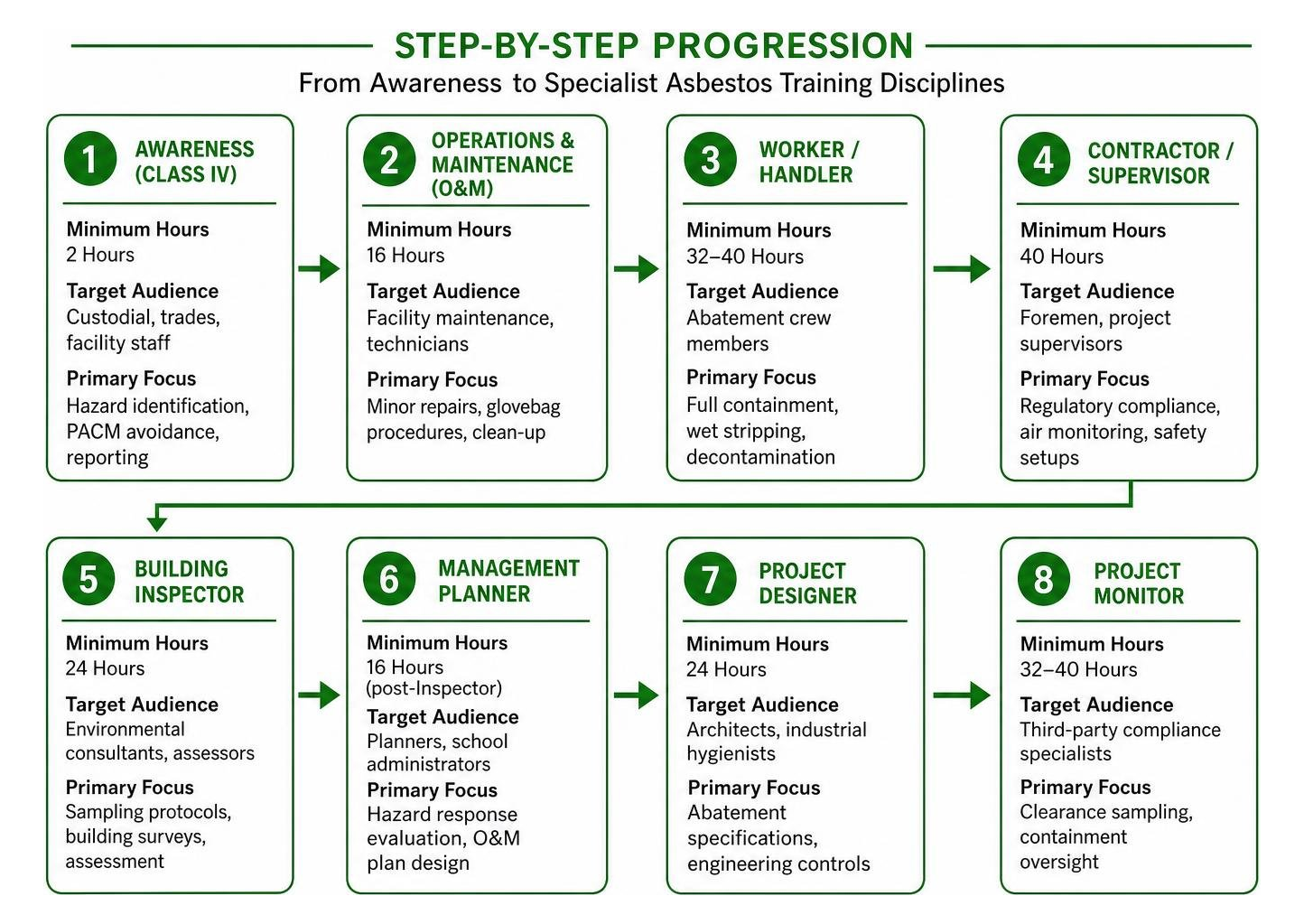
Accreditation programs under the EPA Model Accreditation Plan (MAP) establish tailored coursework for every jobsite role.
| Course Discipline | Minimum Hours | Target Audience | Primary Focus Area |
|---|---|---|---|
| Awareness (Class IV) | 2 Hours | Custodial, trades, facility staff | Hazard identification, PACM avoidance, reporting |
| Operations & Maintenance (O&M) | 16 Hours | Facility maintenance, technicians | Minor repairs, glovebag procedures, clean-up |
| Worker / Handler | 32–40 Hours | Abatement crew members | Full containment, wet stripping, decontamination |
| Contractor / Supervisor | 40 Hours | Foremen, project supervisors | Regulatory compliance, air monitoring, safety setups |
| Building Inspector | 24 Hours | Environmental consultants, assessors | Sampling protocols, building surveys, assessment |
| Management Planner | 16 Hours (post-Inspector) | Planners, school administrators | Hazard response evaluation, O&M plan design |
| Project Designer | 24 Hours | Architects, industrial hygienists | Abatement specifications, engineering controls |
| Project Monitor | 32–40 Hours | Third-party compliance specialists | Clearance sampling, containment oversight |
Foundational learning starts with OSHA compliance training for asbestos awareness, which follows the asbestos awareness training syllabus overview to instruct non-abatement trades on avoiding fiber disturbance.
Operatives conducting regulated removals enroll in the asbestos worker handler initial course, while site managers complete asbestos contractor supervisor initial certification. Site assessment and planning require specialized disciplines, including the asbestos inspector initial program, management planner initial training, asbestos project designer initial training, and the asbestos project monitor initial class.
Requirements for Custodial, Operations, and Maintenance Personnel
Under EPA AHERA regulations (40 CFR Part 763), custodial and maintenance staff in educational and commercial buildings must complete specific coursework. The mandate requires 16 total hours of training, divided into 2 hours of Type 1 Awareness training and 14 hours of Type 2 Special Operations and Maintenance (O&M) instruction.
Staff members learn how to handle non-friable materials safely without initiating an uncontrolled fiber release. Training covers Presumed Asbestos-Containing Material (PACM) protocols, HEPA-shrouded equipment use, and localized glovebag techniques for pipe insulation.
For general maintenance teams, taking OSHA compliance training for operations and maintenance or enrolling in an asbestos training for operations and maintenance initial course delivers the necessary legal safety skills. Property managers can consult an awareness training guide for construction workers and property managers to recognize common danger zones, such as identifying asbestos in wall structures and evaluating hazards of garage asbestos.
How to Choose Accredited Courses and Maintain Your Certification
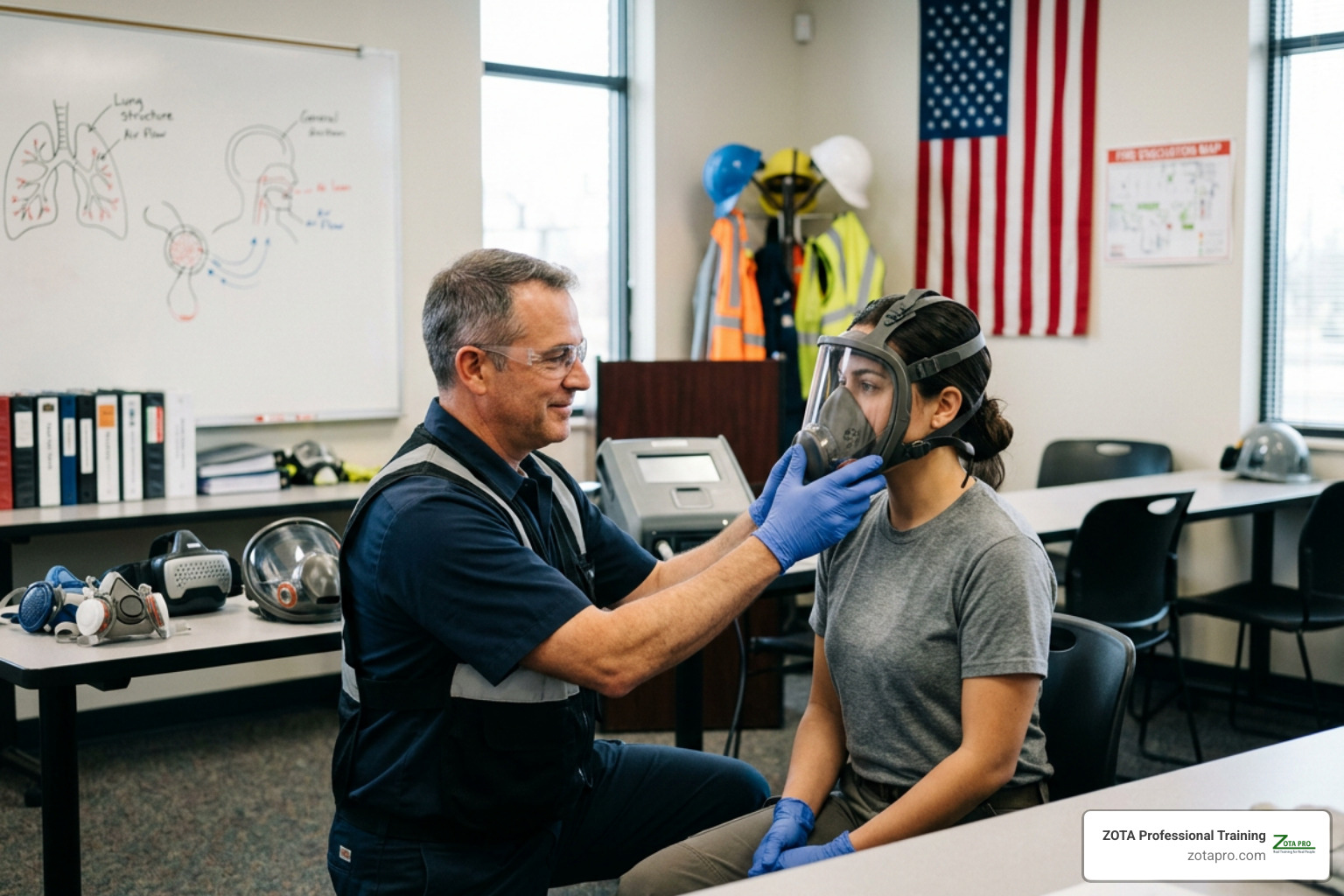
Selecting an approved provider ensures your certification satisfies both state licensing boards and federal enforcement bodies. We provide accredited asbestos training programs that balance classroom theory with practical, hands-on demonstrations.
While exploring the benefits of online asbestos training is useful for awareness-level modules, hands-on abatement credentials mandate in-person practical instruction. When evaluating online training for OSHA compliance, employers must determine if the course fulfills hands-on requirements or if they need to learn how to choose the best asbestos awareness program for non-abatement staff.
Step-by-Step Pathway to Obtain Asbestos Certification and Licensing
Obtaining an official asbestos license follows a systematic compliance path:
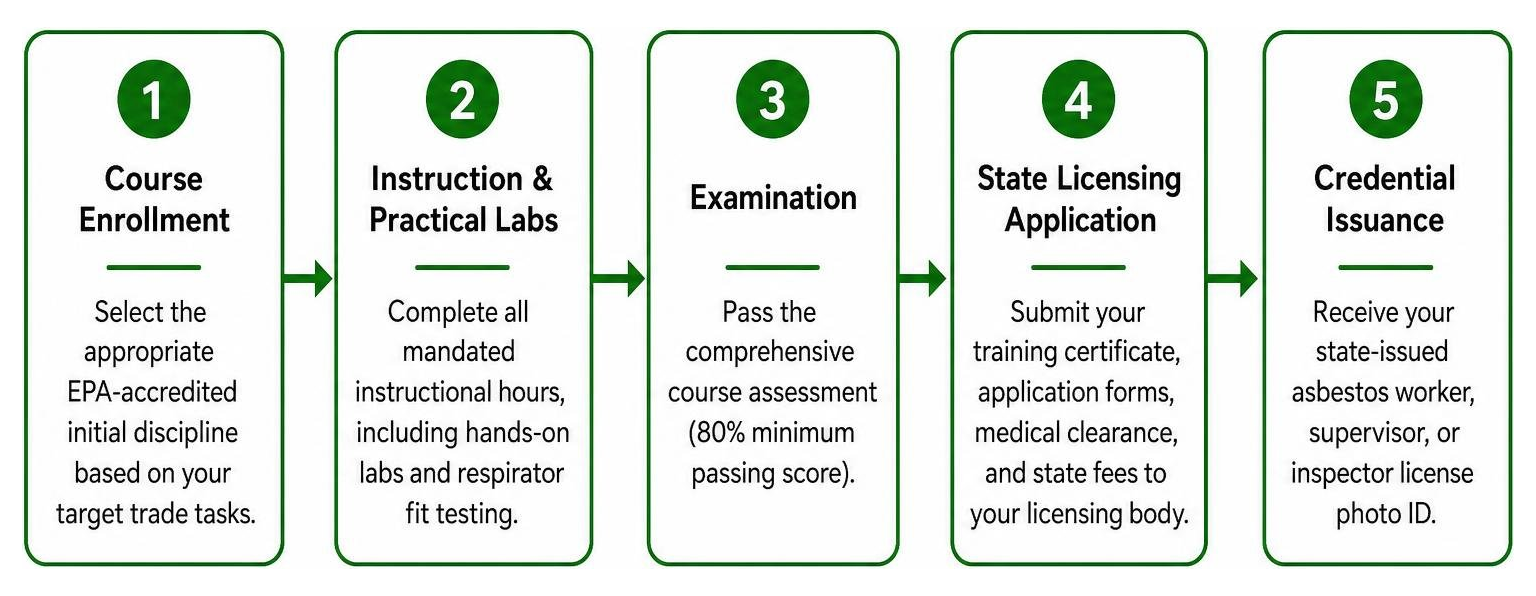
- Course Enrollment: Select the appropriate EPA-accredited initial discipline based on your target trade tasks.
- Instruction & Practical Labs: Complete all mandated instructional hours, including hands-on glovebag manipulation, containment construction, and qualitative/quantitative respirator fit testing.
- Examination: Pass the comprehensive course assessment (requiring an 80% minimum passing score).
- State Licensing Application: Submit your training certificate, government application forms, medical clearance documentation, and state fees to your regional licensing body.
- Credential Issuance: Receive your state-issued asbestos worker, supervisor, or inspector photo ID license prior to performing field work.
Understanding the step-by-step asbestos removal certification process helps students prepare for what to expect in an asbestos abatement class. Reviewing asbestos certification roles explained clarifies the boundaries between professional testing versus DIY inspection and ensures crews employ standard professional asbestos abatement protocols on site.
Selecting an Approved Asbestos Training Provider and Renewal Schedules
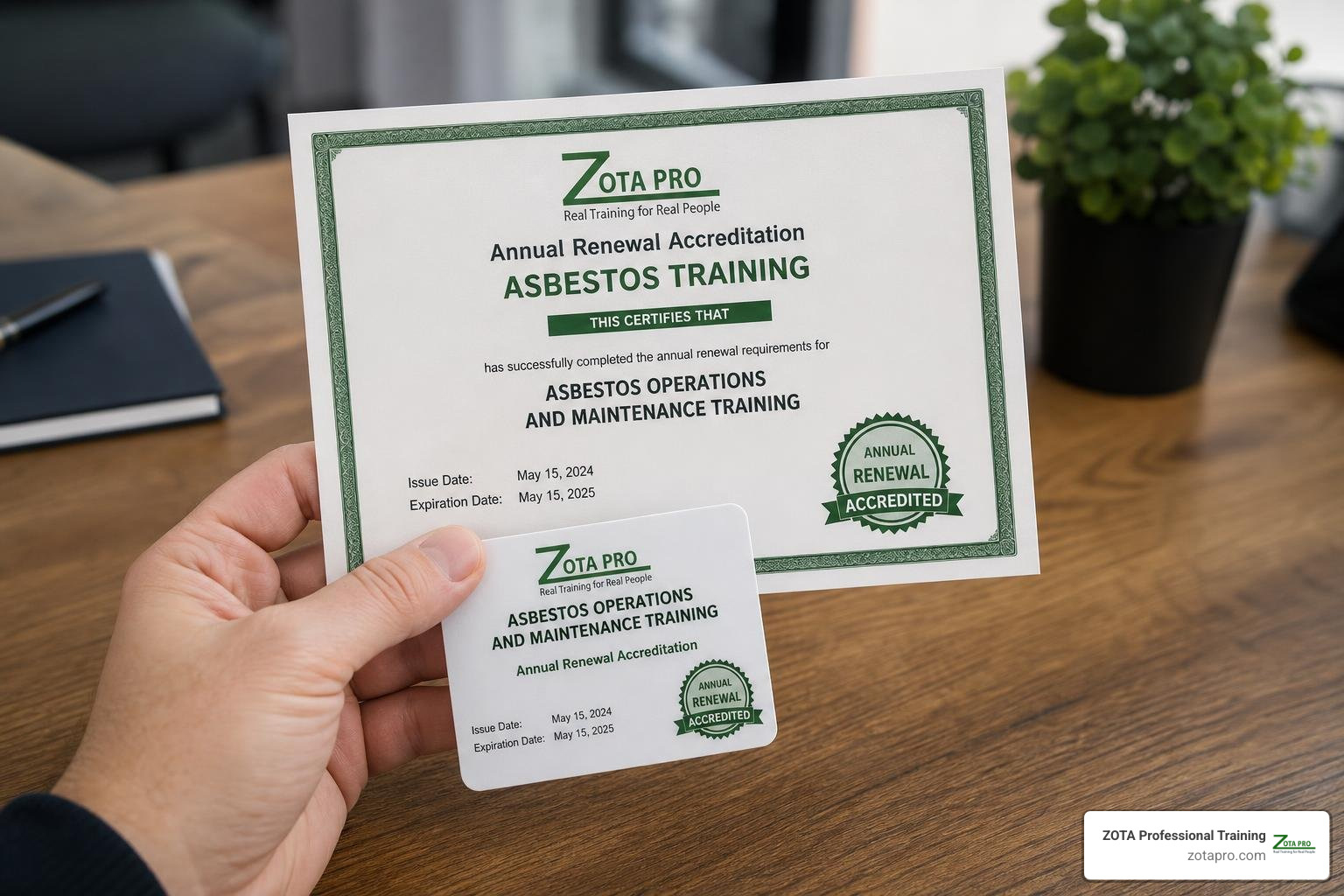
Asbestos credentials remain valid for exactly one year from the course completion date. To maintain uninterrupted certification, workers must complete an annual refresher course before their certificate expiration date.
A two-year grace period exists under EPA MAP rules regarding course retakes: if your certificate expires, you cannot legally work on asbestos projects. If you fail to complete an approved refresher within two years of your expiration date, your credential lapses completely, requiring you to retake the entire initial multi-day course. Understanding how long asbestos certification lasts and the key differences in refresher vs initial asbestos training differences helps prevent costly lapses.
Attending an annual update is essential for maintaining safety skills in asbestos refresher classes and adhering to strict asbestos training renewal schedules and importance. Failure to comply exposes contractors to severe legal consequences of working without asbestos training, including stop-work orders and major penalties of uncertified asbestos work reaching upwards of $37,500 per violation day.
We offer full multilingual training tracks, including Spanish asbestos worker handler initial training and the corresponding Spanish asbestos worker handler refresher. English refresher courses are available across all operational disciplines:
- asbestos worker handler refresher
- asbestos contractor supervisor refresher
- asbestos inspector refresher
- operations and maintenance refresher training
- management planner refresher course
- project designer refresher course
- project monitor refresher training
- Colorado AMS refresher training
Ready to get certified or renew your team’s credentials? Explore our course schedules and register for accredited asbestos training today to stay compliant, safe, and fully certified on every jobsite.