

What Lead Paint Disclosure Requires
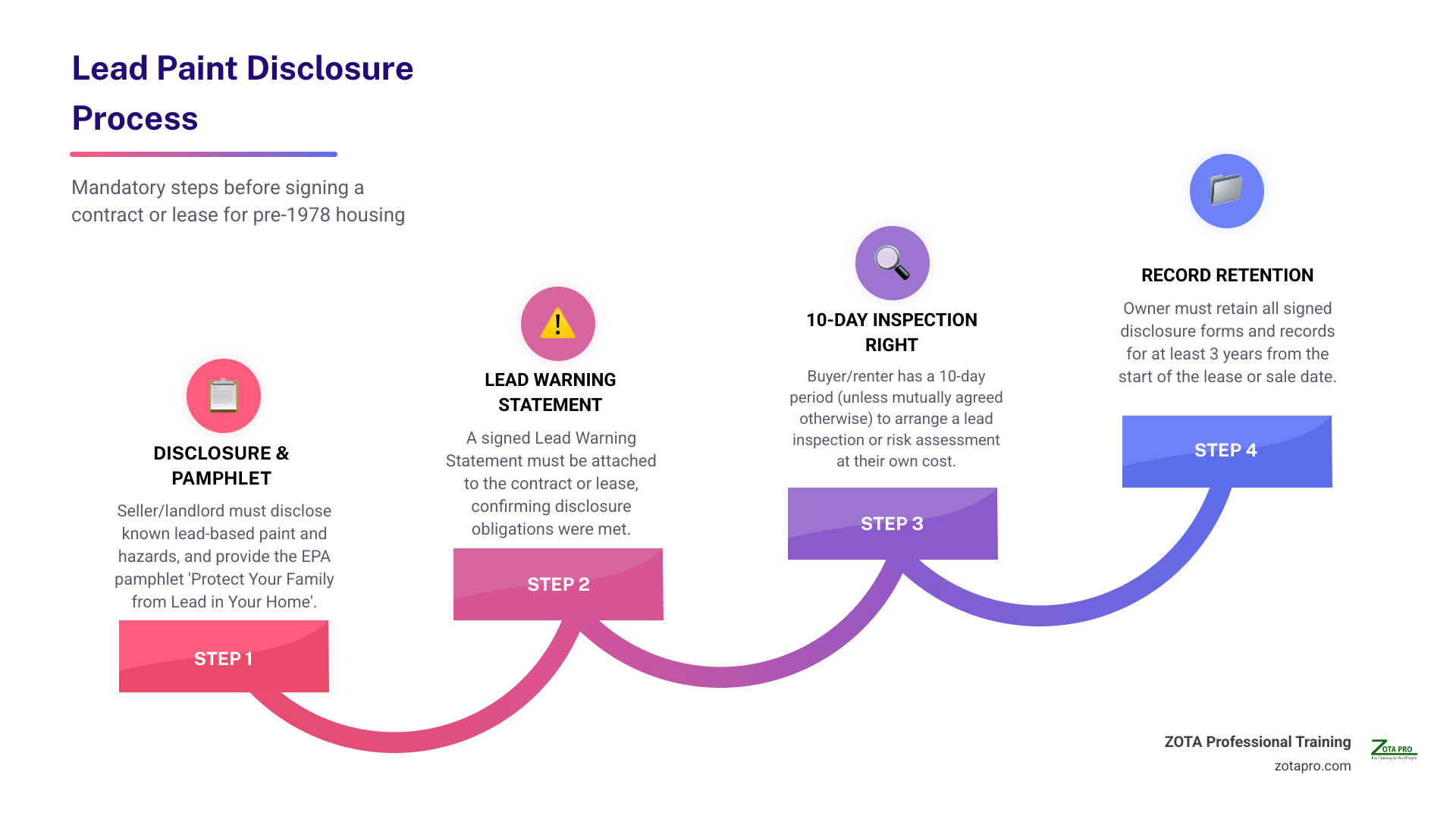
For most homes built before 1978, lead paint disclosure must happen before a buyer signs a purchase contract or a renter signs a lease. Sellers and landlords must share what they know about lead-based paint and hazards, provide any available reports, give the federal lead-safety pamphlet, and include a signed lead warning statement. Buyers must also get 10 days to arrange a lead inspection, unless both sides agree to a different period. Federal disclosure rules do not, by themselves, require an owner to test for lead or remove it.
Local laws may add inspection or certification requirements. And if you renovate older homes, disclosure is separate from the lead-safe work rules that may apply to your crew.
I’m Bob Zak, founder of ZOTA Professional Training. My 32 years in occupational health and safety have shaped how I teach lead paint disclosure and related compliance requirements to contractors and other professionals.
Essential lead paint disclosure terms:
Federal Lead Paint Disclosure Regulations for Pre-1978 Housing

Lead-based paint was banned for residential use nationwide in 1978. However, millions of residential structures across the United States still contain original lead paint layers. When lead paint chips, chalks, or creates invisible dust through normal wear and tear, it poses severe health risks—especially to young children. Medical data shows that children’s blood lead levels tend to rise rapidly between 6 to 12 months of age and peak between 18 and 24 months, when hand-to-mouth behaviors are most frequent.
To address these risks, Congress passed Section 1018 of Title X (the Residential Lead-Based Paint Hazard Reduction Act of 1992). This statute created the federal disclosure framework enforced jointly by the Environmental Protection Agency (EPA) and the Department of Housing and Urban Development (HUD).
Under federal law, properties built before 1978 are categorized as “target housing.” If you are managing transactions for target housing, you must follow strict statutory procedures unless a specific exemption applies.
Common exemptions under federal law include:
- Housing constructed after December 31, 1977.
- “Zero-bedroom” dwellings where the sleeping area is not separated from the living area (such as studio apartments or loft efficiencies), provided no child under six resides there.
- Short-term leases lasting 100 days or fewer (such as vacation rentals), provided no renewal occurs.
- Dedicated housing for the elderly or persons with disabilities, unless a child under age six lives in or is expected to reside in the dwelling.
- Properties that have been certified as completely lead-free by a state-certified inspector.
- Foreclosure sales.
To better understand how these federal baseline standards fit into everyday real estate and property management operations, review our comprehensive guide to lead-based paint rules compliance.
Requirements Under the Federal Lead Paint Disclosure Rule
Federal law requires sellers and landlords of pre-1978 residential housing to deliver a complete disclosure package before a binding contract or lease agreement is executed.
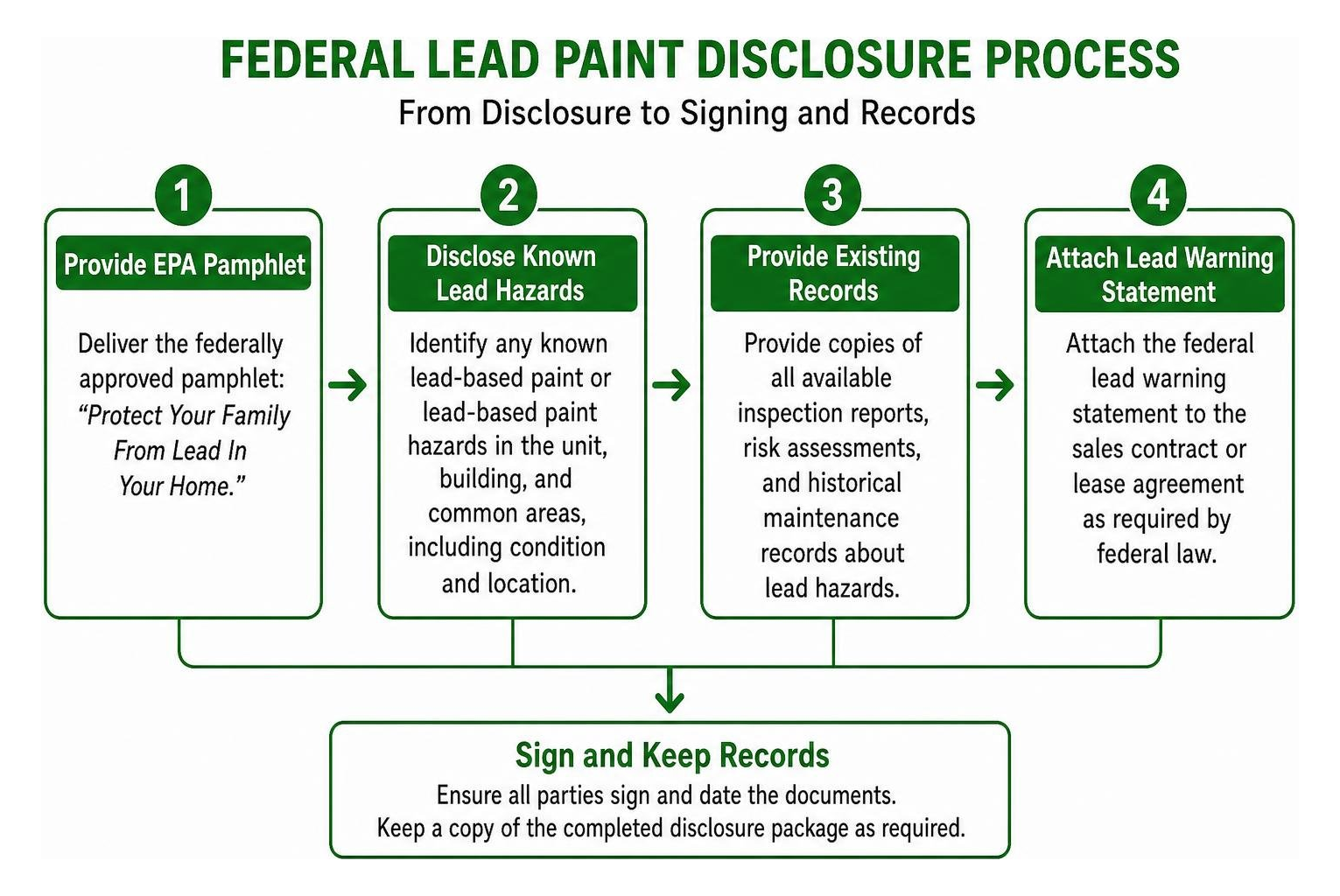
Under the EPA guidance for target housing property owners, the disclosure package must include:
- The Official EPA Pamphlet: Deliver the federally approved informational guide, “Protect Your Family From Lead In Your Home.”
- Identification of Known Hazards: Disclose any known presence of lead-based paint or lead-based paint hazards in the unit, building, and common areas, detailing the condition and location of the paint.
- Provision of Existing Records: Hand over copies of all available inspection reports, risk assessments, and historical maintenance records concerning lead hazards.
- Mandatory Lead Warning Statement: Attach the federal warning language directly to the sales contract or lease agreement as required under HUD 24 CFR Part 35 certification and acknowledgment rules.
- Purchaser Inspection Window: Grant prospective home buyers a mandatory 10-day period (or a mutually agreed alternate timeframe) to conduct an independent lead inspection or risk assessment.
Electronic signatures and digital document delivery are legally permissible, but property owners must obtain express prior consent from the buyer or tenant for electronic delivery, along with providing notice that physical paper copies remain available upon request. Furthermore, federal rules require that disclosures be provided in the same language as the transaction contract (such as Spanish), ensuring that non-English-speaking buyers and tenants fully comprehend the health warnings and legal waivers.
All completed, signed disclosure attachments must be retained by sellers, lessors, and real estate agents for at least three years from the date of the sale closing or lease commencement.
Agent Obligations and TREC Compliance in Property Sales
Real estate agents and brokers carry explicit legal responsibilities under the federal Lead Disclosure Rule. Agents must inform the property seller or lessor of their federal obligations, ensure all documentation is supplied to the purchaser or tenant, and co-sign the disclosure addendum verifying compliance.
If you practice real estate in Texas, the Texas Real Estate Commission (TREC) enforces strict disclosure and agency rules that operate alongside federal mandates. License holders must provide the Information About Brokerage Services (IABS) written statement at the first substantive communication with a prospective client—typically during initial property discussions or within the first 48 to 72 hours of contract negotiations.
Key compliance requirements for agents and brokers include:
- Fiduciary Notification: Informing clients in writing of their statutory lead paint disclosure obligations before marketing pre-1978 target housing.
- Ownership Disclosures: Under TREC rules, license holders who own 10% or more of an entity selling or leasing a property must disclose their licensed status alongside all known physical hazards.
- Mandatory Co-Signatures: Federal law mandates that real estate agents sign the Lead Warning Statement, confirming that they informed the seller/lessor of their legal duties.
- Record Retention: Maintaining copies of completed disclosures and agency notices in brokerage transaction records for at least three to four years, depending on state licensing requirements.
Failing to meet these standards can result in severe professional sanctions. For a clear look at how agent missteps lead to regulatory action, see our case breakdown on realtor liability and undisclosed lead paint. To keep day-to-day transactions organized, landlords and listing professionals should also refer to our complete lead disclosure checklist for landlords and tenants.
Lead Safe vs. Lead Free Certifications and Federal Hazard Thresholds
In property transactions, buyers and tenants often encounter the terms “Lead Safe” and “Lead Free.” These classifications are not interchangeable; they reflect distinct environmental standards established by certified lead inspectors using X-ray fluorescence (XRF) analyzers and laboratory dust-wipe sampling.
| Attribute | Lead Free Certification | Lead Safe Certification |
|---|---|---|
| Primary Definition | No lead-based paint exists on any interior or exterior structural surface above regulatory limits. | Lead paint may be present, but it is fully intact, sealed, and producing no active dust/soil hazards. |
| Testing Methodology | Comprehensive paint inspection using XRF analysis and laboratory paint-chip testing across all coated surfaces. | Visual assessment for deteriorated paint combined with laboratory dust-wipe sampling on floors and window sills. |
| Duration of Validity | Permanent (does not expire). | Temporary (typically valid for 24 to 48 months depending on municipal code). |
| Federal Threshold | Paint lead content is below 1.0 mg/cm² or 0.5% by weight (local codes may use lower limits, such as >0.7 mg/cm² in Philadelphia). | Dust and soil levels fall strictly below federal and municipal clearance thresholds. |
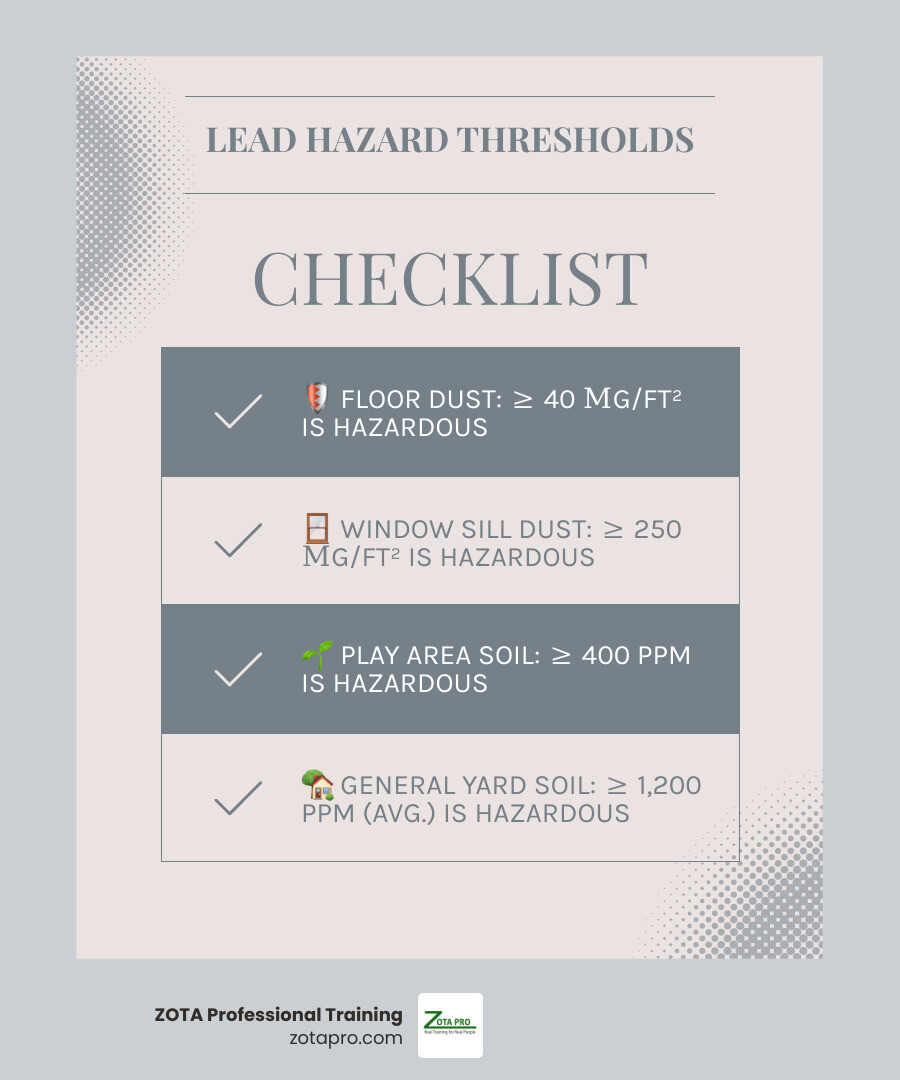
Federal standards enforced across housing programs—such as those detailed in the HUD Lead-Based Paint Regulations toolkit (24 CFR Part 35)—define a hazard whenever paint is deteriorated (peeling, chipping, or flaking) or when dust and soil exceed the following action levels:
- Floors: 40 micrograms per square foot (µg/ft²)
- Interior Window Sills: 250 micrograms per square foot (µg/ft²)
- Play Area Bare Soil: 400 parts per million (ppm)
- General Yard Bare Soil: 1,200 parts per million (ppm)
Property owners seeking to certify an older building must work with accredited specialists. For detailed operational workflows, see our guide to certified lead inspection services and our breakdown of homeowner lead inspection protocols.
State Variations, Inspection Rights, and Enforcement Penalties

While federal rules establish a national baseline, states and municipalities frequently enforce more stringent requirements. These local mandates often link lead inspections directly to rental licensing, short-term occupancy permits, and mandatory public health tracking for children identified with an elevated blood lead level.
State and Municipal Lead Paint Disclosure Rules Across the U.S.
Local jurisdictions have updated their property codes to require proactive testing rather than passive disclosure:
- Philadelphia, PA: Under § 6-803 of the Philadelphia Code, landlords of pre-1978 residential rental properties must obtain a valid Lead Safe or Lead Free certification before issuing a lease or securing a municipal rental license. Lead-safe certificates in Philadelphia remain valid for exactly forty-eight (48) months and require dust-wipe clearance testing submitted directly to the Philadelphia Department of Public Health.
- Massachusetts: Governed by 105 CMR § 460.725 (Tenant Lead Law Notification), property owners must provide prospective tenants with two copies of the state Tenant Lead Law Notification form, copies of any Letter of Full Compliance or Letter of Interim Control, and all historical inspection reports before executing a lease.
- California: Under California Department of Public Health real estate disclosure standards, sellers and landlords must provide state-specific environmental hazard booklets alongside federal forms and must use state-certified inspectors listed on the CDPH registry when testing target housing.
To maintain continuous regulatory compliance across shifting state and federal boundaries, explore our review of the latest EPA lead regulation updates and our foundational lead paint safety guide.
Buyer Testing Windows, Contract Rescission, and Violation Penalties
Under federal law, home buyers have a statutory 10-day window to conduct a comprehensive lead risk assessment. The parties may mutually agree in writing to lengthen or shorten this timeframe. In municipal frameworks such as Philadelphia’s, if an independent inspection reveals uncorrected lead hazards, the buyer has the legal right to rescind the purchase contract within five days of receiving the report with all earnest money returned.
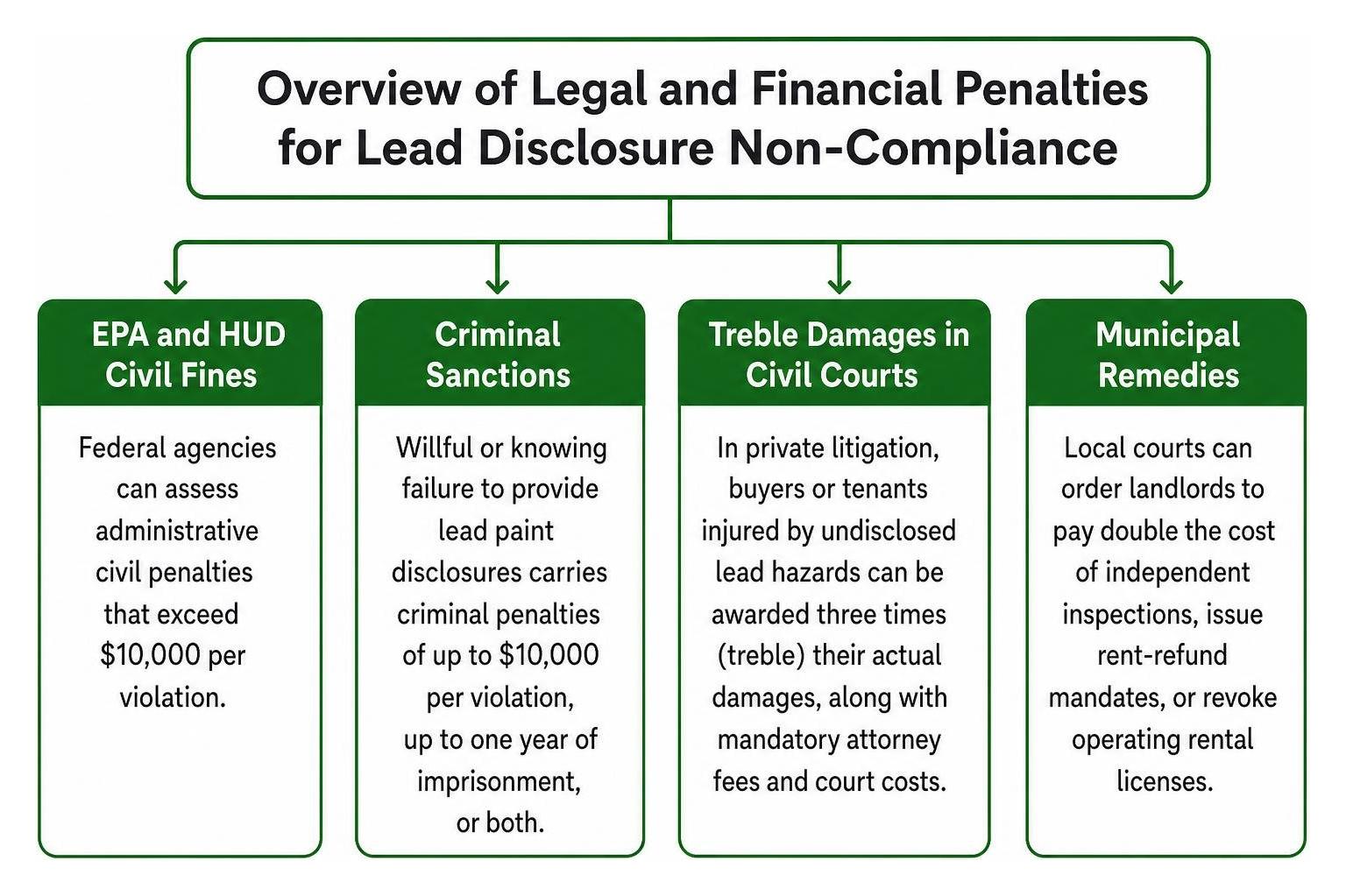
Non-compliance carries heavy legal and financial liabilities:
- EPA and HUD Civil Fines: Federal agencies can assess administrative civil penalties that exceed $10,000 per violation, with statutory maximums adjusted upward for inflation.
- Criminal Sanctions: Willful or knowing failure to provide lead paint disclosures carries criminal penalties of up to $10,000 per violation, up to one year of imprisonment, or both.
- Treble Damages in Civil Courts: In private litigation, buyers or tenants injured by undisclosed lead hazards can be awarded three times (treble) their actual damages, along with mandatory attorney fees and court costs.
- Municipal Remedies: Local courts can order landlords to pay double the cost of independent inspections, issue rent-refund mandates, or revoke operating rental licenses.
At ZOTA Professional Training, we provide EPA-accredited training programs that equip property owners, real estate managers, and contractors with the skills needed to maintain full regulatory compliance. Whether you need initial certification or refresher courses, our flexible online, hybrid, and bilingual (English/Spanish) training formats ensure your teams stay safe and compliant.
Master your transaction obligations today by reviewing our complete resource on mandatory lead paint disclosure requirements and ensure your team holds the right credentials through our guide on professional lead certification standards.